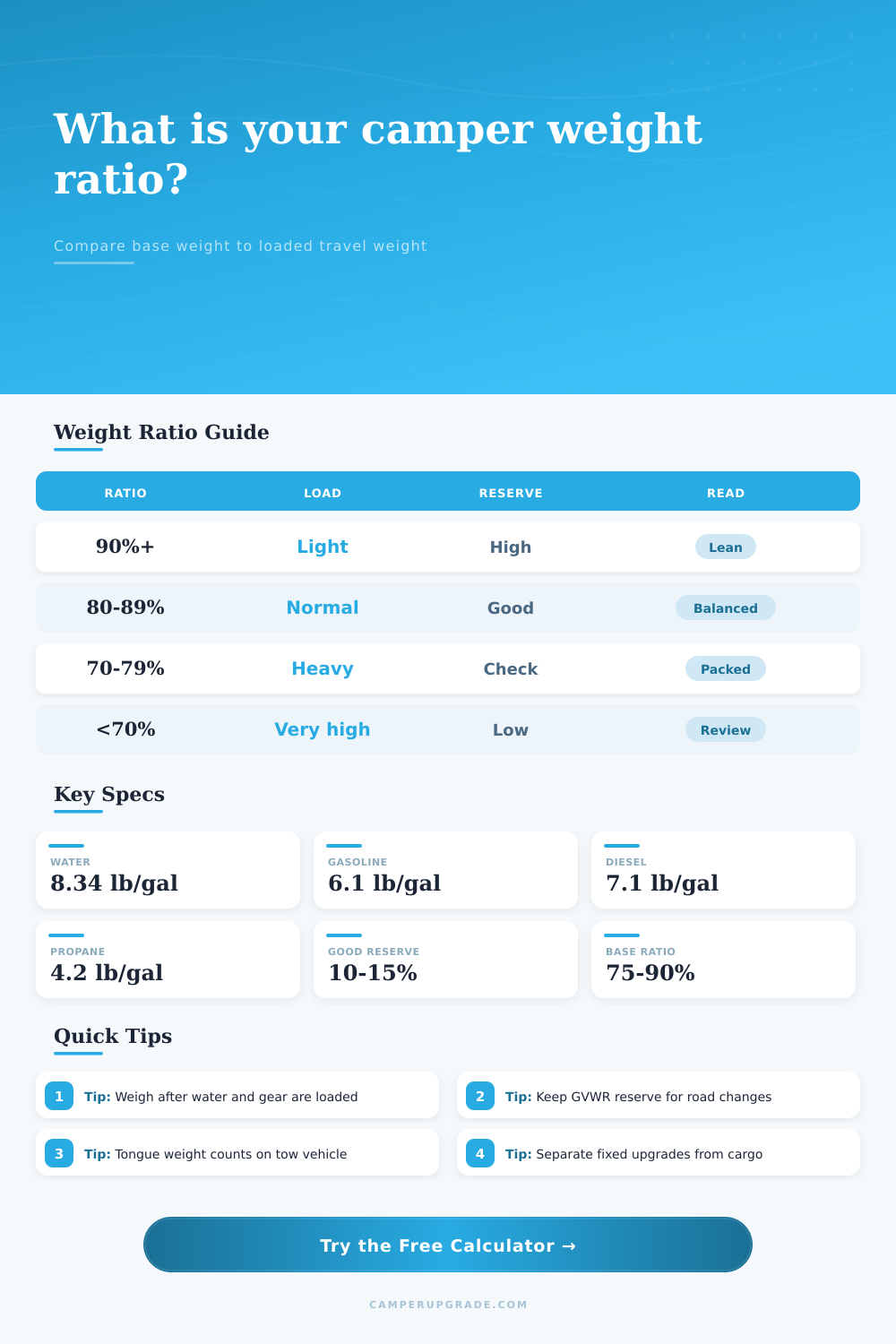
Base Weight vs Total Weight Ratio Calculator
Compare dry or curb weight against real loaded travel weight, payload share, reserve margin, and GVWR status for campers, vans, trailers, and truck campers.
Detailed Weight Breakdown
Base ratio = base weight / loaded travel weight x 100.
Payload share = (loaded travel weight - base weight) / loaded travel weight x 100.
GVWR margin = GVWR - loaded travel weight; reserve percent = margin / GVWR x 100.
| Base Weight Ratio | Added Load Share | Typical Meaning | Action Before Travel |
|---|---|---|---|
| 90% or higher | 10% or less | Lightly loaded or limited supplies | Check that essentials are included |
| 80% to 89% | 11% to 20% | Balanced weekend or family load | Confirm axle and tongue distribution |
| 70% to 79% | 21% to 30% | Heavy water, gear, or upgrades | Use scale weights before long trips |
| Below 70% | Over 30% | Very load-heavy setup | Reduce cargo or raise rated capacity |
| Fluid or Supply | Imperial Factor | Metric Factor | Common Camper Use |
|---|---|---|---|
| Fresh water | 8.34 lb per gal | 1.00 kg per L | Tanks, jugs, shower cans |
| Gasoline | 6.1 lb per gal | 0.73 kg per L | Generator cans, bikes, toys |
| Diesel | 7.1 lb per gal | 0.85 kg per L | Aux tanks, heaters, tow rigs |
| Liquid propane | 4.2 lb per gal | 0.50 kg per L | Cylinders, built-in tanks |
| Camper Setup | Typical Base Weight | Added Load Range | Base Ratio Range |
|---|---|---|---|
| Teardrop trailer | 900 to 1,800 lb | 250 to 700 lb | 72% to 88% |
| Pop-up camper | 1,500 to 2,800 lb | 500 to 1,000 lb | 70% to 85% |
| Travel trailer | 3,500 to 7,500 lb | 900 to 2,000 lb | 72% to 88% |
| Fifth wheel | 8,000 to 13,500 lb | 1,500 to 3,500 lb | 70% to 86% |
| Truck camper | 1,800 to 4,000 lb | 500 to 1,500 lb | 68% to 86% |
| Camper van | 7,000 to 8,800 lb | 700 to 1,800 lb | 78% to 91% |
| Rig Type | Common Transfer | Where It Counts | Scale Check |
|---|---|---|---|
| Travel trailer | 10% to 15% tongue | Tow vehicle payload and rear axle | Truck + trailer axle tickets |
| Fifth wheel | 15% to 25% pin | Truck payload and rear axle | Truck axle ticket hitched |
| Truck camper | Nearly 100% payload | Truck GVWR and axle ratings | Truck axle ticket loaded |
| Motorhome or van | No hitch transfer | Vehicle GVWR and axle ratings | Front and rear axle ticket |
When you buy a new travel trailer and see dry weight sticker, it’s tempting to breathe a sigh of relief as it seems well within towing range of your tow vehicle. However, that sense of security usually evaporates somewhere around mile two when you realize actual rig feels heavier then the paper suggested it would be. The reality is that gap between paper weight and what you’re actually towing becomes your buffer between mechanical failure and peace of mind.
Bridges are not the only concern. It’s not just about following law. Not so much. Understanding how much you can put into an empty shell before exceeding axle capacity are essential. Marketing takes away Total Weight Ratio: Strips away marketing illusions by comparing base weight to gear and fluids By entering your personal loads into the calculator it does math for you, eliminating guesswork of converting your fuel or water amount.
Why Your Trailer Is Heavier Than the Sticker Says
For instance, many folks don’t consider that fresh water is approximately eight and a third pounds per gallon. That means just a full freshwater tank add over two hundred fifty pounds to vehicle’s load, changing both its center of gravity as well as the way it pull behind you. Add in filling up with diesel to run a generator, and you have to account for another seven pounds per gallon. While those liquids aren’t felt while loading them they are immediately picked up by suspension.
Another place to hide weight is fixed improvements. Exterior racks, solar panels, and a lithium battery bank sounds light when they’re first added. However, the brackets, wiring, and hardware to hold them on adds up quickly. By separating the permanent stuff from other gear, the tool lets you view exactly what’s taking up space without having to crack pantry lid, and then decide if you really want those hundred pounds of food onboard.
It sounds insignificant, but add in the propane and occupants and that ratio drop rapidly. You don’t want to be driving an empty shell, nor do you want the trailer pushed past its capacity. Aim for a 10 percent reserve below your Gross Vehicle Weight Rating (GVWR) to provide a safety margin for things like extra clothing or a forgotten bag of ice.
This gets complicated with tongue weight transfer as well. Whatever percentage of a travel trailer’s loaded weight sits on the hitch ball (10-15% for trailers) decreases your tow vehicle’s payload capacity one-for-one. So even though the trailer might not feel like too much, loading that tongue may send you over the top of your rear axle if your truck is already unsteadily near capacity. Fifth wheels relocate that weight to the pin, so they gets rated differently altogether.
The chart on the page breaks down these ratings by type of rig so you can see where all that weight moves in the real world. The total weight of the trailer is easy to focus on without thinking about how that weight are spread along the hitch point and then through the road surface underneath. The best way to make sure though is to weigh yourself, all in. Estimates will not work, stickers lie and scale tickets speak volumes.
If you notice that you’re inching towards the limit, you’ll have time to drop your waters down before departing and that’s much safer than guessing while still on dry land. Organize your equipment so you can clearly identify what goes off next as the scales start tightening up. It is better to leave extra camping chairs at home than to arrive at camp with nervous riders whose knees sag on leaf spring.
While the ratio isn’t as important as the reality of how much weight they carry, having an idea of where you stand will give you the warning needed to avoid trouble long before it rolls onto the road. You should of checked your weights more carefully if you want a luxurios trip. It is naturaly better to be safe than sorry when traveling with heavy furnitures.