🛠️ Base Layer Weight Calculator
Estimate camper base layer weight from shape, material, thickness, waste, and build allowances
| Material | Density | 1/2 in | Notes |
|---|---|---|---|
| 1/2 in plywood | 34 lb/ft3 | 1.4 lb/ft2 | Balanced |
| 3/4 in marine ply | 38 lb/ft3 | 2.4 lb/ft2 | Moisture safe |
| 5/8 in OSB | 38 lb/ft3 | 2.0 lb/ft2 | Budget core |
| Cork board | 15 lb/ft3 | 0.6 lb/ft2 | Quiet layer |
| XPS foam board | 2 lb/ft3 | 0.1 lb/ft2 | Ultra light |
| Cement board | 70 lb/ft3 | 2.9 lb/ft2 | Very dense |
| Aluminum sheet | 168 lb/ft3 | 7.0 lb/ft2 | Rigid skin |
| Honeycomb panel | 18 lb/ft3 | 0.8 lb/ft2 | Light but stiff |
| Thickness | Ply lb/ft2 | XPS lb/ft2 | kg/m2 |
|---|---|---|---|
| 1/4 in | 0.7 | 0.0 | 3.6 |
| 1/2 in | 1.4 | 0.1 | 6.8 |
| 5/8 in | 1.8 | 0.1 | 8.8 |
| 3/4 in | 2.1 | 0.1 | 10.3 |
| 1 in | 2.8 | 0.2 | 13.7 |
| 1.5 in | 4.3 | 0.3 | 20.6 |
| Panel | Area | Sheets / 100 ft2 | Use Case |
|---|---|---|---|
| 4 x 8 ft | 32 ft2 | 3.1 | Floors |
| 4 x 4 ft | 16 ft2 | 6.3 | Small bays |
| 5 x 5 ft | 25 ft2 | 4.0 | Modules |
| 3 x 8 ft | 24 ft2 | 4.2 | Aisles |
| 2 x 8 ft | 16 ft2 | 6.3 | Runners |
| 6 x 4 ft | 24 ft2 | 4.2 | Wide tops |
| Project | Area | Layers | Typical Weight |
|---|---|---|---|
| Van floor | 70 ft2 | 1 | 90-160 lb |
| Bed platform | 30 ft2 | 1 | 35-80 lb |
| Galley base | 18 ft2 | 2 | 25-60 lb |
| Wet bath deck | 20 ft2 | 1 | 28-70 lb |
| Dinette base | 24 ft2 | 1 | 30-75 lb |
| Full shell | 90 ft2 | 1 | 120-240 lb |
When you build a camper floor, you must calculate the weight of the materials that will be used to build that floor. The weight of those materials will impact teh total payload of the camper trailer. The payload is the total amount of weight that the trailer can carry.
If the weight of the floor, the weight of the cabinets, the weight of the water tanks, and all of the other component of the camper is too great for the payload, then the camper may be unsafe to operate. The weight of the subfloor that is used in the camper must also be accounted for, as it is the foundation for the other component of the camper. Plywood is one of the most common materials that can be used to build camper floors.
How to Calculate the Weight of a Camper Floor
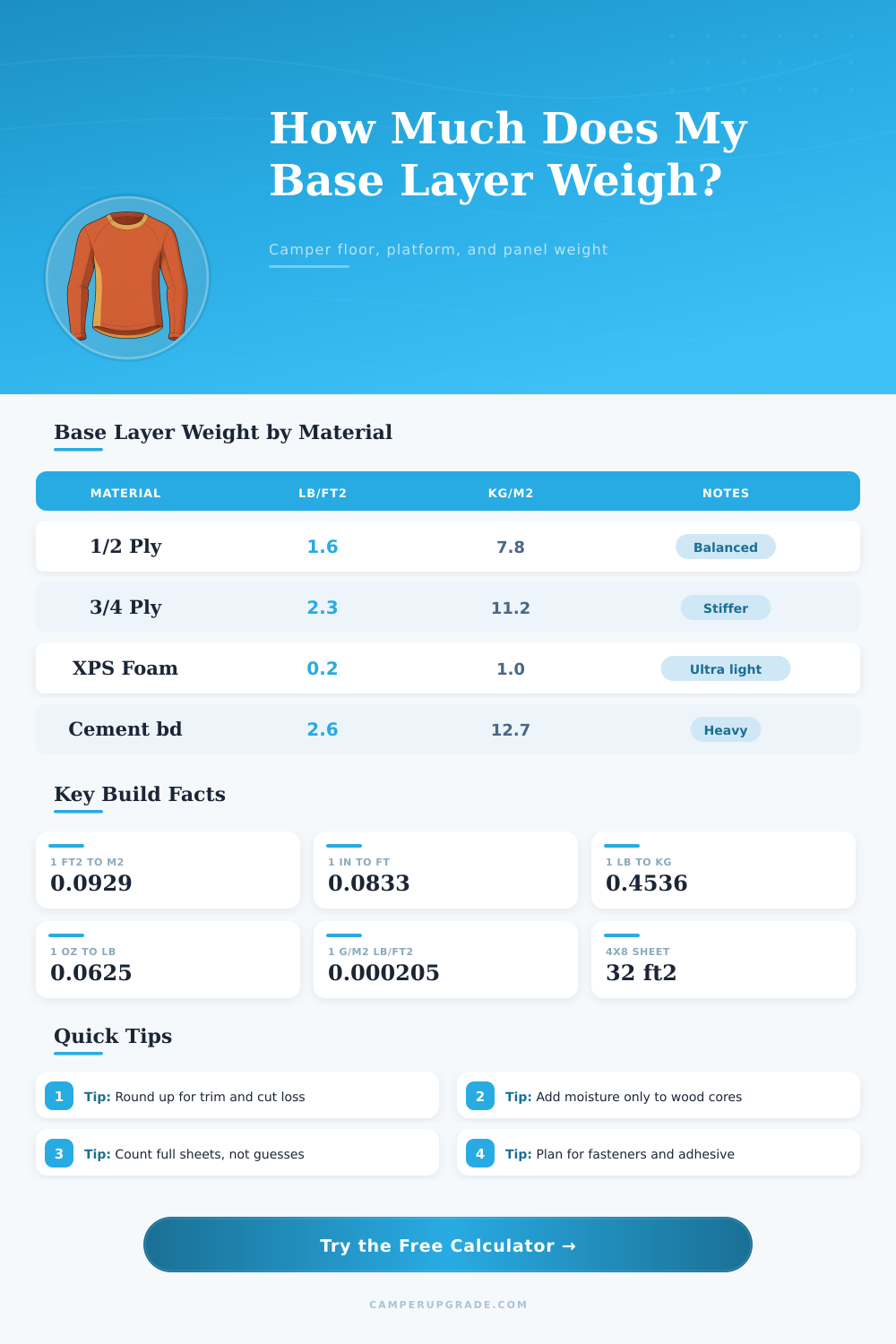
Half-inch plywood weighs about 1.5 pound per square foot and is stiff enough to support the weight of individuals walking on the floor. Three-quarter-inch marine grade plywood weighs more than 2 pounds per square foot and people often use it on areas of the camper that are likely to get wet because this type of plywood resists rot. The weight of plywood increase linearly with the thickness of the plank.
If the thickness of the plank is doubled, then the weight of that plank will also be doubled. Foam boards can also be used as an alternative to plywood for building camper floors. Foam boards tend to be lighter than plywood.
Extruded polystyrene (XPS) foam boards can weigh approximately 2 pounds per cubic foot and people often use them to insulate cargo bay area of campers because this material is very light. Honeycomb panels are also often used for camper floors because these panels is both stiff and lightweight. Because honeycomb panels are lightweight, they can help to reduce the total weight of the camper.
Because the total weight of the camper can impact the fuel efficiency of the camper, using honeycomb panels is one way to improve the fuel efficiency of the camper. In order to determine the amount of material necessary to build the floor, it is first necessary to calculate the total area of the floor. For rectangular areas, you can calculate the area by multiplying the length of the floor by the width of the floor.
For shapes other than rectangles, the formula is more complex. In either case, it is a good idea to add a “buffer” to the amount of material calculated for the floor. Adding a ten percent buffer is common, and this ensures that there is enough material to complete the camper build.
Not adding a buffer to the total amount of material needed may result in running out of material during the building process. The amount of moisture that is present in the air will add to the total weight of the floor. The wood that is used for the floor is a porous material that can absorb moisture from the air and from rain.
If the floor is made of wood, the weight of that floor may increase by between 2 and 5% due to the moisture in the air. In addition to the weight of the wood, there is also the weight of the adhesives that will be used to attach the panels together. These adhesives will add to the total weight of the camper floor.
The same is true of the fasteners that will be used to attach the panels to the subfloor of the camper. Each of the materials have a different weight and each have a different use within the camper trailer. Cement board is one of the heaviest materials, at 2.5 pounds per square foot, but it is good for areas that require waterproofing, like bathrooms.
Aluminum is another material that is very rigid for the camper trailer but it is also very heavy at over 5 pounds per square foot. Oriented strand board or OSB is a relatively cheap material that can be used as an alternative to plywood. The disadvantage of using OSB is that it will absorb moisture faster than plywood does.
The use of different materials within a camper trailer depends based off the needs for that camper trailer and the payload of the camper trailer. In order to avoid costly mistakes while building the camper trailer, it is a good idea to calculate the number of sheets of material that are needed before traveling to the store to purchase those materials. It is also important to account for the weight of the adhesives and the moisture that will be present in the material.
If the total weight of the camper is heavier then you estimated when planning the build, the camper may be overweight for the payload of the trailer. By calculating the weight of each component that will be included in the camper trailer, you can ensure that the total weight of the camper will remain within the limits of the payload of the trailer. You should of checked the weight of the furnitures too.