Backpacking Sunscreen Ounces Calculator
Estimate sunscreen fluid ounces, stick touchups, total applications, container count, group share, and pack weight from trip length, exposed skin, UV index, altitude, sweat, water crossings, and sun-reflective terrain.
🏕Backpacking Sunscreen Presets
🧴Trip And Skin Exposure Inputs
Use 1 for solo planning or the full group size for a shared tube count.
Include partial approach, exit, layover, and resupply days.
Count hours with meaningful daylight on exposed skin.
The model scales exposed skin from the one-ounce full-body reference.
Use forecast peak UV or the higher value for alpine, desert, snow, or water.
Reflection adds exposure even when the sun angle feels indirect.
UV commonly intensifies as elevation increases.
Higher levels shorten the practical reapplication interval.
Most backpacking plans should start around two hours of exposure.
Used only when custom interval is selected.
Sprays need more packed volume because some product misses skin.
Common travel tubes are 1, 1.7, 2, 3, and 4 fl oz.
Enter 0 if you are packing lotion only.
Buffer covers spills, missed estimates, and extra exposed breaks.
A brimmed hat, sun hoodie, pants, gloves, and gaiters reduce the ounces dramatically.
This is planning math for sunscreen quantity, not medical advice. Follow the sunscreen label, use shade and clothing, and avoid intentional overexposure.
Your Sunscreen Carry Estimate
📊Backpacking SPF Reference
📋Coverage And Container Tables
| Exposed Zone | Share Of Full Body | Ounces Per Application | Trail Note |
|---|---|---|---|
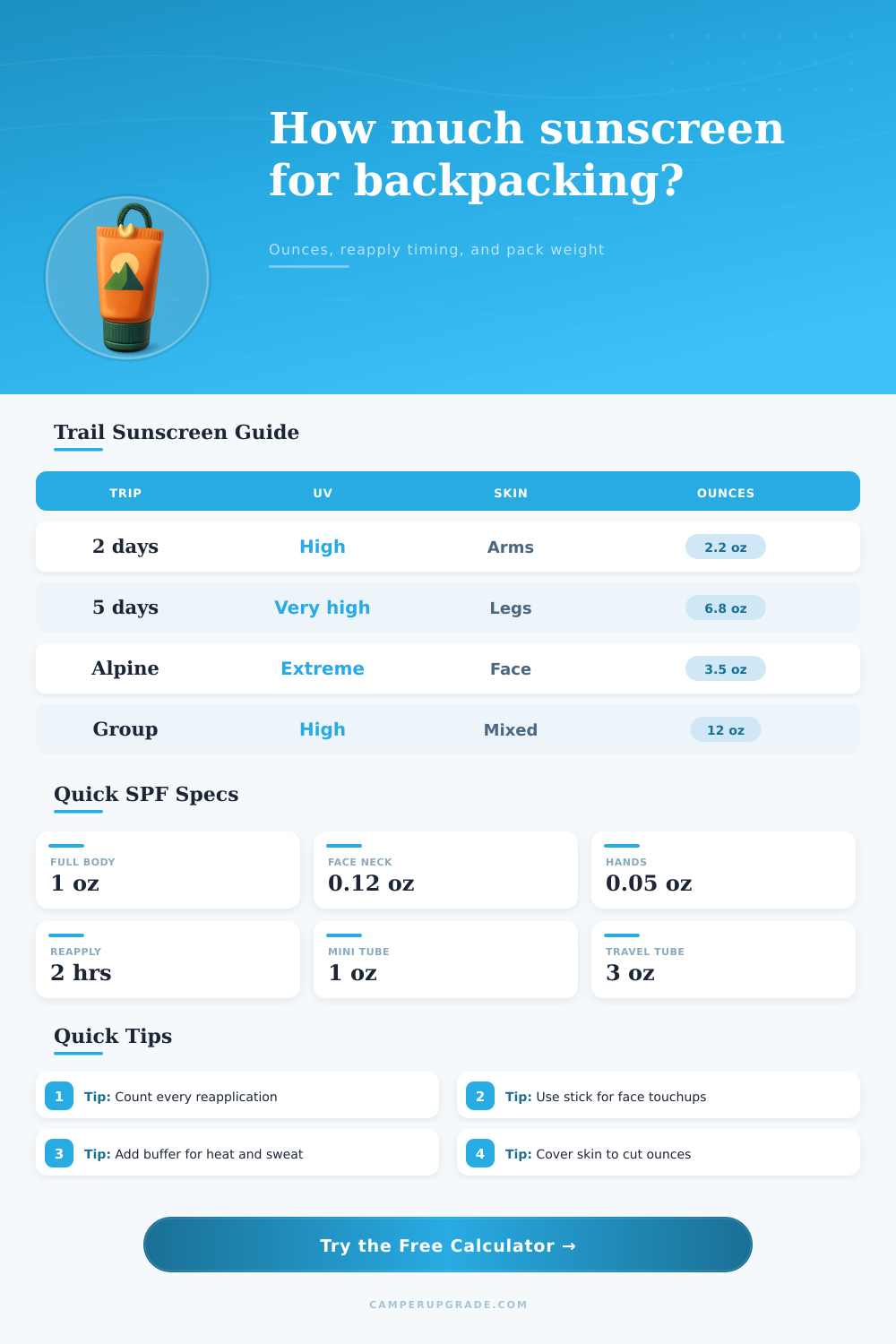
| Face, ears, and neck | 12% | 0.12 fl oz | Often best handled with stick touchups plus lotion base. |
| Hands and wrists | 5% | 0.05 fl oz | Reapply after washing, poles, rope, or snacks. |
| Both forearms | 13% | 0.13 fl oz | Sun sleeves can remove this from the bottle budget. |
| Both lower legs | 18% | 0.18 fl oz | Shorts on desert trails can double daily use. |
| Feet or sandal gaps | 4% | 0.04 fl oz | Small area, but easy to burn near water or snow. |
| Condition | Model Effect | Planning Impact | Why It Matters |
|---|---|---|---|
| High UV | 1.08 x amount | Extra attention | More careful application and less missed skin. |
| Water route | 0.80 x interval | More reapply cycles | Water, towel use, and wet straps remove product. |
| Snow travel | 1.28 x amount | Large buffer | Reflection reaches face, neck, and under-brim areas. |
| Above 8000 ft | 1.06 to 1.12 x | Higher dose | Thinner atmosphere raises UV exposure. |
| Spray format | 1.25 x product | More volume | Overspray and wind loss reduce skin coverage. |
| Container | Fluid Ounces | Milliliters | Typical Backpacking Use |
|---|---|---|---|
| Mini tube | 1.0 fl oz | 30 ml | Short solo trips, face-only plans, emergency backup. |
| Small tube | 1.7 fl oz | 50 ml | Weekend with arms, face, and hands exposed. |
| Travel tube | 3.0 fl oz | 89 ml | Common multi-day solo or pair container. |
| Family tube | 6.0 fl oz | 177 ml | Group trip or high-use water route. |
| Stick | 0.5 oz | 14 g | Face, ears, nose, lips, and quick touchups. |
| Trip Style | Common Exposure | Applications Per Day | Starting Ounces Per Person |
|---|---|---|---|
| Shaded forest weekend | Face, hands, forearms | 3 to 4 | 1.2 to 2.0 fl oz |
| Desert or slickrock | Face, arms, legs | 4 to 6 | 3.0 to 6.0 fl oz |
| Alpine above treeline | Face, hands, neck | 4 to 5 | 2.0 to 4.0 fl oz |
| Snowfield travel | Face, under chin, hands | 5 to 6 | 3.0 to 5.0 fl oz |
| Paddle and portage | Arms, legs, feet, face | 5 to 7 | 4.0 to 8.0 fl oz |
🧭Trail Planning Notes
Backpacking trips can be tricky when it comes to planning sunscreen; it sits in that middle ground between being obvious and surprisingly complicated. It’s certainly necessary, but how do you know what amount of product to throw into your bag? How much should you bring without weighing yourself down with excess baggage?
Your strategy depend on knowing why you go through so much more sunscreen out there than you do in everyday life. How long are you gone? That’s not the only factor. It also matters how sweaty you get, what the ground conditions is, how intense sunlight is, and whether there are trees to block some exposure and reduce amount you need.
How Much Sunscreen Do You Need?
If you’re in a forested weekend hike with your face and hands and maybe forearms showing, you’ll need less then if you were crossing an alpine area where reflected light off snow bounces back up onto you. Even if two people take the exact same route for the exact same time, one may require double the lotion.
These variables is made clear through calculator inputs. Trip length and daily sun hours determine basic exposure window. Adjustments are made based on body size (taller or broader = more surface area). Terrain type, altitude, and water exposure adjust frequency of application and amount applied per session. All of these factors interact with one another.
For example, high UV, frequent water crossings, and snowy terrain will mean you need to reapply it more often than any one of those factors would suggest on its own.
Most hikers don’t realize how much the area of exposed skin matter. How many ounces do you want for your hands, neck, and face? How about your lower legs and forearms? Those are two options that will swing the total weight up or down a lot. The default reference is one ounce all over, which is why this tool scales accordingly.
It’s also why clothing options matter. Long pants and a hooded sun shirt not only add comfort they shrink the sunscreen dollar budget in a measurable way: fewer protected square inches means less product applied.
The third place plans fail to account for is reapplication timing. Unlike application volume, which scales up in proportion to environmental factors (sun, wind, rain), basic time interval shifts as well. In other words, you don’t simply divide by sun hours; how often you need to reapply depend on a variety of different factors. The calculator considers how these factors interact, so the outputs is based off real-world trail conditions rather than ideal lab estimates.
Knowing how many products you really need allows you to make a container decision. Then you round up to a full stick or tube. You can leave room in your containers by using the Buffer setting, which shows how much extra space works for your travel style. You just multiply that number by group size; this make it easier if people is sharing planning.
Running a few scenarios ahead of time is where it gets good. You see right away what impact changing from mixed trails to a snowfield will have on your overall load, as well as day-to-day use. Turning up the water/sweat setting reveals the impact that moisture has on protection. Running these types of scenario lets you know if it makes more sense to change clothes or to rethink your approach with containers rather than just add one more tube.
The reason most people go over- or under-supplied with sunscreen is they think of it in terms of absolute quantity instead of variable calculation. With the right inputs (the specifics of your trip), it becomes clear how much you need and no longer feels like a guessing game. It looks more like a plan based on miles to come.
You should of known that planning for different terrain makes a big differance. It’s actualy more moddern than I thought.