Backpacking Resupply Calculator
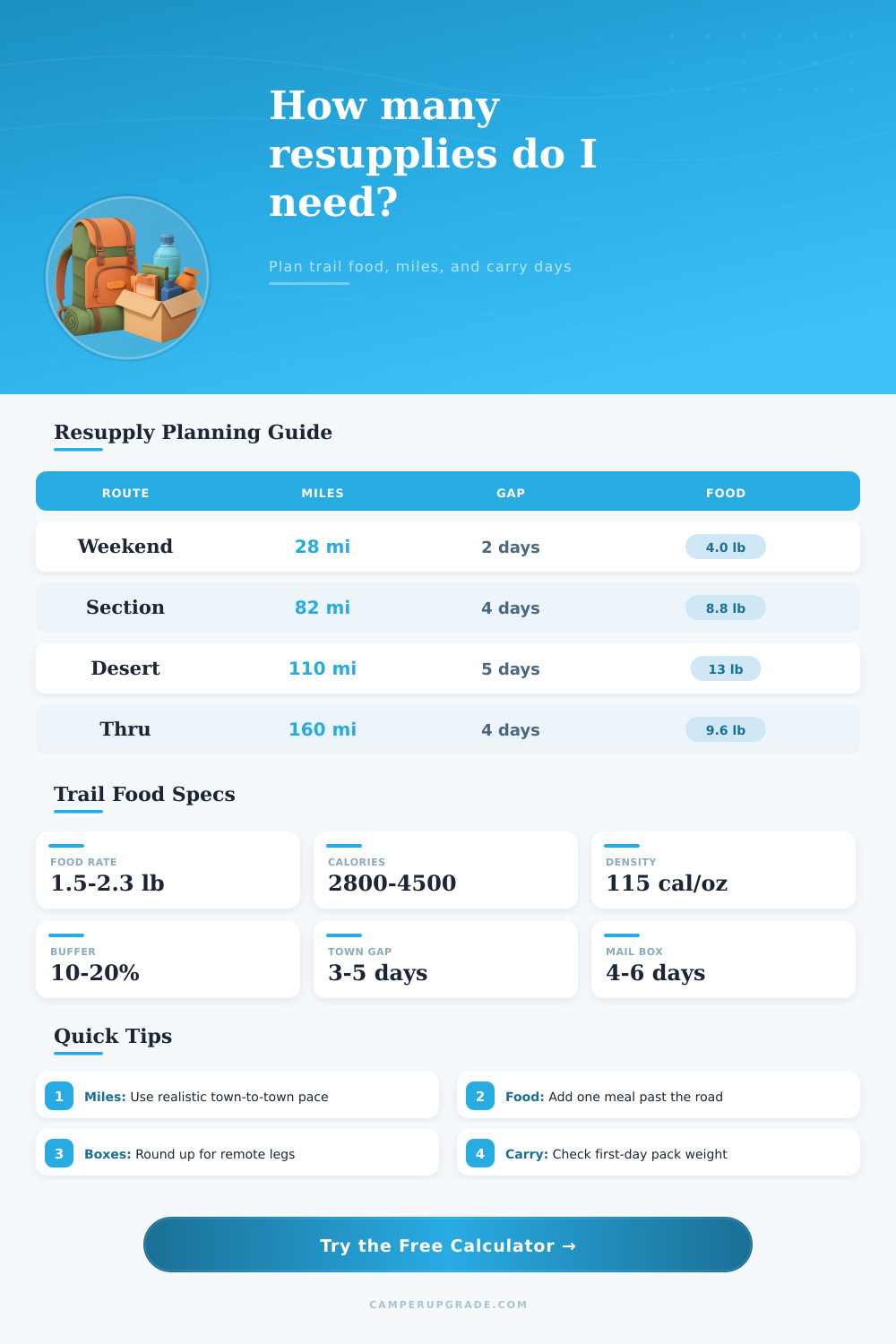
Estimate resupply stops, food carry weight, calories per leg, town spacing, mail drops, and first-day food load for section hikes and long trails.
🗺Trail Resupply Presets
⚙Mileage, Days, Calories, and Resupply Inputs
📦Food and Logistics Spec Grid
📋Resupply Planning Tables
| Food Density | Calories/Oz | 3600 Cal Day | 5-Day Carry |
|---|---|---|---|
| Bulky comfort menu | 100 | 2.25 lb | 11.3 lb |
| Mixed grocery menu | 115 | 2.0 lb | 9.8 lb |
| Balanced trail menu | 125 | 1.8 lb | 9.0 lb |
| High-fat dense menu | 145 | 1.6 lb | 7.8 lb |
| Daily Miles | 3-Day Gap | 4-Day Gap | 5-Day Gap |
|---|---|---|---|
| 10 mi/day | 30 mi | 40 mi | 50 mi |
| 14 mi/day | 42 mi | 56 mi | 70 mi |
| 18 mi/day | 54 mi | 72 mi | 90 mi |
| 22 mi/day | 66 mi | 88 mi | 110 mi |
| Resupply Type | Best Use | Buffer | Watch Item |
|---|---|---|---|
| Town grocery | Frequent trail towns | 5-10% | Store hours |
| Outfitter stop | Gear plus meals | 10% | Limited food |
| Mail drop | Remote long legs | 10-20% | Pickup window |
| Food cache | Dry or road sections | 15-25% | Access rules |
| Route Pattern | Miles | Suggested Stops | Food Carry |
|---|---|---|---|
| Short section | 45 | 0-1 | 3 days |
| Classic week | 90 | 1-2 | 4 days |
| Remote traverse | 125 | 2-3 | 5 days |
| Fast thru segment | 160 | 3-4 | 4 days |
⚠Resupply Planning Tips
This planner estimates dry food weight only. Water, fuel, packaging, bear-canister volume, town meals, and personal medical needs should be checked separately.
Food resupply planning are a process of determining how much food you must carry and how often you must stop to get more foods. Food resupply planning is difficult because you must find a balance between the weights of the food you will carry and the distance that you will hike between food sources. While many hikers believe that the only consideration when planning food resupplies is the number of calories you will require, you must also take into consideration the weight of the food and the distances between food sources.
The longest gap between food sources is a critical component of planning your food resupplies. Often the longest gap between food sources is more important than the total mileage that you will hike during your trip. For instance, a ninety-mile stretch of hiking terrain that includes a town every three days is much easier to hike than a ninety-mile stretch that includes one sixty-mile gap in which there is no food available for hikers.
How to Plan Food and Resupplies for a Hike
Long gaps between food sources poses a decision for hikers of whether to carry more weight during the early days of the hike or whether to carry less weight. This calculator allow you to enter your longest gap between food sources, your preferred limit of the weight of food that you will carry, and your target number of calories that you would like to consume each day. These three variables will allow you to understand how these variables affects one another.
Food density is another variable that will impact the weight that your backpack will have to carry. The density of the food that you carry will impact the weight that you carry for a given number of calories that you consume each day. Two hikers can plan to consume 3,600 calories per day, but one hiker can plan to consume that many calories through eating bulky foods like crackers and dried fruit while the other eats more densly food like nut butters and olive oil.
Foods that are more dense will lead to the hiker carrying less weight. This food density variable allow you to test different densities of food to see how they may impact the total weight of your pack. Finally, the weather and the time of year that you go on your hike will impact the number of calories that you need to burn each day.
Weather and time of year can impact your appetite and the number of calories that your body requires each day. For instance, hiking in cold weather will require your body to burn more calories each day than hiking in hot weather. Since the weather can be difficult to fully plan for in advance, many hikers will include a food buffer in their hiking plans.
A food buffer is extra food that you will carry in case you require additional calories beyond the initial plan. This hiking food calculator does include an option to include a food buffer in your hiking plan, but the hiker must make the decision of how much food buffer to include based off the weather forecast for the hike in question. In addition to the variables discussed above, the hiking resupply styles that you plan to use for obtaining food will also impact your food planning.
Resupply styles includes stopping in towns or using mail drops to deliver food to the hiker. Hikers who prefer stopping in towns have more flexibility in the amount of food that they can eat and when they may eat. Mail drops, however, reduce decision fatigue for the hiker as they are forced to adhere to a schedule.
However, a fixed schedule for resupply for mail drops may be difficult to change in the case of an injury to a hiker or bad weather. This calculator does not feature an option to select a resupply style for the hike, but it does allow you to see how each resupply style may impact the number of resupply stops that you must make and the weight of the heaviest food that you will have to carry on your hike. The first day of hiking poses a challenge for food planning for backpackers.
Most backpackers will overpack the first day of hiking with the food that they will eat. Some hikers may plan to have a light food load for the first day of hiking, but others will opt for a heavy food load on the first day. The start-food option on this calculator will allow you to test each of these choices and to see how they will impact the total weight of your pack.
Many hikers makes mistakes when planning their food resupplies. For instance, one common mistake is to use the best-day mileage for a hiking trip instead of the average mileage for that trail system. Using the best-day mileage will cause an underestimation of the amount of food that is required for the sections of the hike that are remote from food sources.
A second common mistake is to forget to plan for the number of calories that are required on what are referred to as zero days or nero days. On those days, there will be no hiking, but there will still be calories required for those non-hiking days. The third most common mistake is to treat the food buffer as optional for their hike.
Yet including a food buffer is essential for emergencies in which a store is closed or a mail drop is late in delivering the food that a backpacker requires. The tables included in this article are reference tables that show the relationship between the number of miles that are hiked each day, the length of the longest gap between food sources, and the weight of the food that the backpacker will have to carry. These reference tables will allow you to see if your food plan is unusually light or unusually heavy for the requirement of your hike.
This hiking food resupply calculator provides a picture of the trade-offs between the longest gap between food sources that you will hike, the weight of the food that you will carry, and the number of calories that you will consume each day. After you understand the trade-offs between these three variables, you can make better decisions about your hiking food resupply plan when you are on the trail.