Backpacking Gas Canister Days Calculator
Estimate how long an isobutane backpacking stove canister will last from group size, meals, hot drinks, boil volume, simmer time, weather conditions, and reserve fuel.
🏕Trip Fuel Presets
🔥Stove Fuel Inputs
Count everyone using the same canister, including shared morning water.
Use trail days, not calendar nights, when breakfast and dinner both use fuel.
One 500 ml boil roughly covers a freeze-dried meal or large hot drink.
Meals add simmer and pot heat losses beyond the basic water boil.
Set to 0 for boil-only pouch meals; use higher values for pasta or rice.
Efficient upright stoves often land near 6 to 8 g in mild conditions.
Small flames save fuel; wide-open simmering can use much more.
This modifier covers colder water, wind loss, pressure drop, and longer boil times.
Fuel weight only, not total canister weight with the steel shell.
Use this for weighed partial cans after subtracting the empty tare weight.
For a full canister use 100%; for partial canisters estimate by weight.
Reserve is added before rounding up to whole canisters.
Use only safe wind protection that does not overheat the canister.
Useful for an extra dinner, late camp arrival, or water treatment backup.
This calculator estimates isobutane canister fuel use by fuel weight in grams. Real results vary with stove design, pot diameter, lid use, flame setting, altitude, wind exposure, and water temperature.
Gas Canister Days Results
📊Fuel Use Spec Grid
⛽Common Canister Fuel Sizes
| Fuel size | Typical full fuel | Solo light use | Best fit |
|---|---|---|---|
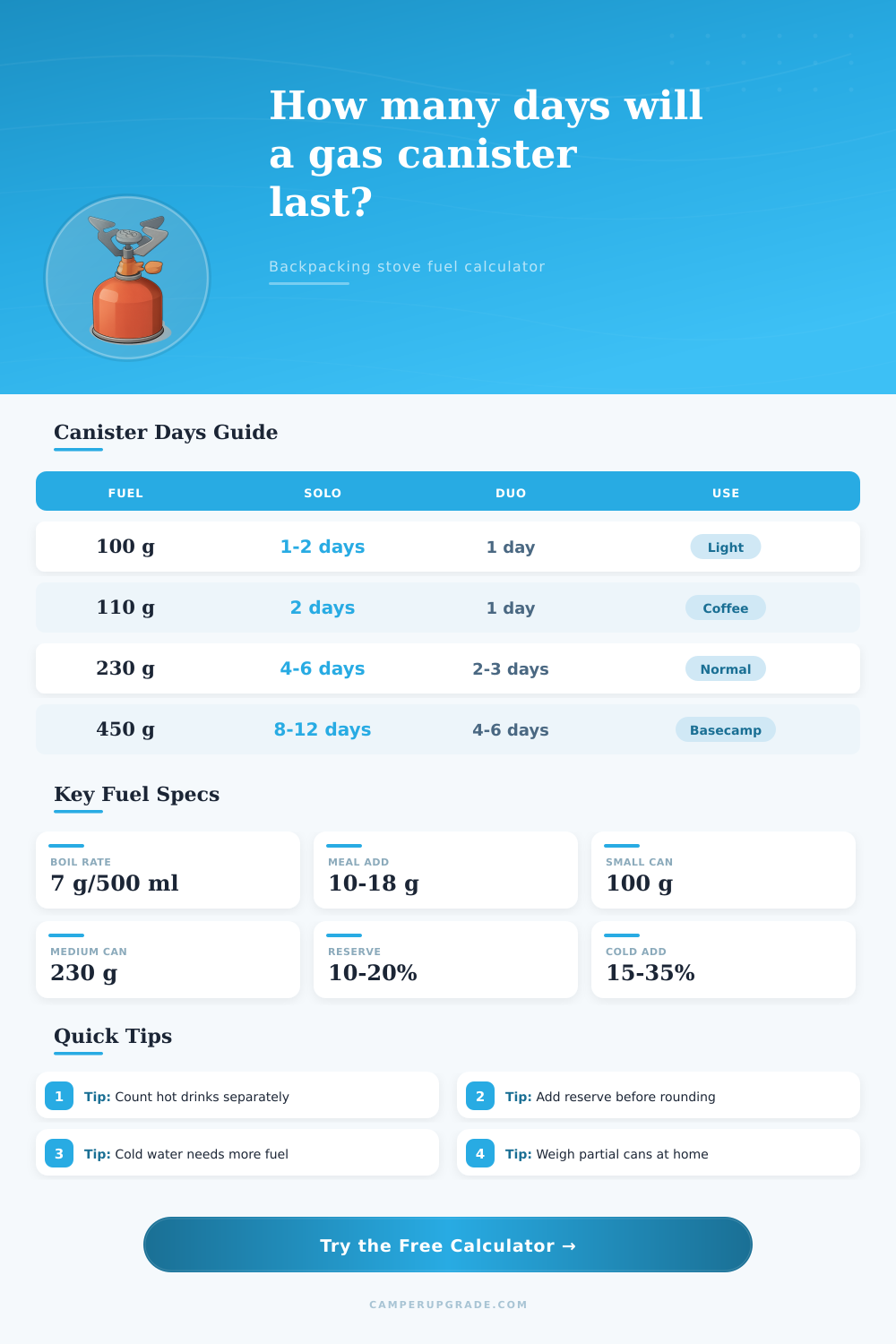
| 100 g small canister | 100 g fuel, about 3.5 oz fuel | About 1 to 3 days | Solo overnight, coffee, or backup canister. |
| 110 g compact canister | 110 g fuel, about 3.9 oz fuel | About 2 to 3 days | Compact pot systems and short solo routes. |
| 230 g medium canister | 230 g fuel, about 8.1 oz fuel | About 4 to 7 days | Most solo trips, weekend pairs, and resupply legs. |
| 450 g large canister | 450 g fuel, about 15.9 oz fuel | About 8 to 14 days | Groups, basecamps, snow melting, or long carries. |
| Partial canister | Weighed fuel minus empty tare | Depends on remaining grams | Shake tests are rough; weighing gives cleaner planning. |
🍳Backpacking Stove Fuel Rate Guide
| Task | Mild fuel estimate | Cold or windy estimate | Calculator field |
|---|---|---|---|
| Boil 500 ml water | 6 to 8 g | 8 to 12 g | Fuel per 500 ml boil |
| Freeze-dried meal water | 7 to 12 g | 10 to 16 g | Boils plus condition modifier |
| Hot drink, 300 to 400 ml | 4 to 6 g | 6 to 9 g | Use 0.6 to 0.8 of a 500 ml boil |
| Short simmer meal | 3 to 8 g extra | 5 to 12 g extra | Simmer minutes times simmer rate |
| Melting snow | Double boil fuel or more | Often 80% to 120% add | Snow condition modifier |
🌡Condition Modifier Reference
| Condition | Fuel add | When to use it | Planning read |
|---|---|---|---|
| Warm sheltered camp | 0% | Warm water, calm air, lid on pot, efficient cooking. | Best-case trail fuel use. |
| Normal three-season trail | 10% | Typical mornings, some breeze, normal pot handling. | Good default for most trips. |
| Windy or exposed site | 20% | Ridgelines, beaches, open passes, awkward cooking spots. | Expect longer boils. |
| Cold water near freezing | 30% | Late fall, early spring, cold stream water, frosty mornings. | Pressure and water temperature matter. |
| Alpine wind and cold | 40% | High exposed camps, cold canister, frequent restarts. | Bring a stronger reserve. |
| Melting snow for water | 90% | Snow is the main water source for the group. | Large canisters become more practical. |
🗺Example Trip Planning Table
| Trip style | Fuel pattern | Likely canister | Notes |
|---|---|---|---|
| Solo boil-only overnight | 2 to 4 boils total, little simmer | 100 g canister | Often enough with a small reserve if weather is mild. |
| Solo 5-day resupply leg | Breakfast drink and dinner daily | 230 g canister | Check coffee count because small drinks add up fast. |
| Two hikers, weekend meals | Shared dinners plus morning water | 230 g canister | Usually comfortable unless long simmer meals are planned. |
| Three-person basecamp | Multiple hot meals and drinks | 450 g canister | One large can can be simpler than several small cans. |
| Snow melting camp | Water production drives fuel | 450 g or multiple cans | Plan from liters of water, not only meals. |
💡Gas Canister Planning Tips
Backpacking is a game of getting the fuel math correct: not carrying too much or too little and then getting hungry/cold at the wrong time. Most folks carry just a bit too little or a bit too much, and it’s often the sum of all the little things that add up over several day. It doesn’t take a long stretch of cold water or a couple of simmered meals or a few extra hot drinks to swing the overall number more then you think.
So guesswork based off memory? Nope. Better have a structure estimate. This is how it works: First you do your homework from home. How long will the trip last? How often will everyone need to boil water until it are completely dry? How many people is sharing each canister? Then split your calculation into two track and do the math.
How to Plan Your Backpacking Fuel
One track tracks the baseline fuel for heating water. The other track adds the extra minutes spent simmering pasta or rice, which burn fuel at a different rate than a quick boil. And then add in the circumstances of your trip. High camps, cold streams, wind all require more fuel per boil, some dramatically so.
If the number-crunching doesn’t seem worth the effort, use one that takes these factors into account; you’ll be able to see the pros and cons without doing the math out by hand each time. You also need extra fuel, which is set aside above the calculated amount. Hikers estimate roughly 10-20% more then their expected needs, rounding up to full canisters. This buffer accounts for those days when the stove won’t ignite the first time, a surprise late campsite, or that extra meal. Ditto if you begin hiking with less-than-a-full can. There’s no guessing what remains after you weigh it down.
The weather also matters: Cold and wind alter the physics of the stove. Every boil slows as water approaches freezing; the canister itself loses pressure at cold temperatures. Wind will also strip heat from the sides of your pot, doing the same thing. Snow-melt camps really push the numbers. Every liter must be melted from ice first before it is boiled further, which doubles or more the daily totals versus a sheltered three-season camp.
That means that rather than starting with which canister to buy, you start by figuring out your fuel needs. If it’s just you on a short overnight with not much cooking required, then 100-gram can will be enough. Most weekend trips for two and a lot of one-person resupply legs fits easily in a 230-gram can. When multiple hiker want to share meals or if you’re melting snow every day, something larger like the 450-gram make more sense. In all cases, match the canister to how much you actualy use each day; don’t assume what worked last time will work this time.
And it shows if you can make do with a single canister for the entire trip, or if you’ll have to carry two. It shows how many complete boils you’ll have left over when the plan’s complete. This might determine whether you’d like some extra cushion for an unexpected extra night on trail or for other water treatment needs. And since the inputs are user-adjustable, you can play around with things and see the impact of swapping out your usual simmer meals for boil-only pouches or reducing by one hot drink per day.
Most importantly, make sure you get in the habit of running it twice, once optimistically and once conservatively. How far apart are those two? That’s how sensitive your plan is to cooking style/weather. Get another canister, maybe upsize a bit, but don’t add too much weight, since if there’s a big discrepancy then you won’t have anything to worry about. This one small check makes a huge difference.
Planning for fuel goes from being a potential source of anxiety, to something you don’t really need to think about, while the rest of the trip hums along quietly. You should of planned better so you can avoids the stress.