Backpacking Fuel Calculator
Estimate total stove fuel, daily burn rate, and canister count with weather and altitude adjustments.
🔥Trip Presets
⚙Fuel Planning Inputs
📊Planning Benchmarks
📘Reference Tables
| Cooking Style | Boils/Day | 500 ml Equiv/day | Fuel Tendency |
|---|---|---|---|
| No-cook + drinks | 2-3 | 2-3 | Very low |
| Boil-only meals | 4-6 | 4-6 | Low-moderate |
| Simmer + hot drinks | 6-9 | 6-10 | Moderate-high |
| Snow melt + cooking | 10+ | 12+ | High |
| Condition | Typical Multiplier | What Changes | Fuel Impact |
|---|---|---|---|
| Sheltered campsite | 1.00x | Less heat loss | Baseline |
| Light wind | 1.10x | Flame disturbance | +10% |
| Moderate wind | 1.20x | Convective loss | +20% |
| Gusty exposure | 1.35x | Frequent reheat cycles | +35% |
| Canister Net Fuel | Approx 500 ml Boils* | Weekend Use Case | Long Trip Role |
|---|---|---|---|
| 100 g | 7-12 boils | Solo short trips | Backup can |
| 230 g | 16-27 boils | Most 2-4 day trips | Primary can |
| 450 g | 32-54 boils | Group or winter use | Basecamp/main supply |
| Water Start Temp | Delta to Near-Boil | Energy Demand | Fuel Planning Note |
|---|---|---|---|
| 20 C | ~75 C rise | Lower | Best efficiency season |
| 10 C | ~85 C rise | Moderate | Common 3-season baseline |
| 5 C | ~90 C rise | Higher | Add reserve for mornings |
| 0 C | ~95 C rise | Highest liquid-water case | Carry larger margin |
Plan carefully the amount of fuel for a multi-day backpacking trip. Too little amount risks you can not cook or boil water. Bring too a lot only adds weight to the pack.
You choose gas canisters because of their convenience, during liquids because of flexibility. Outdoor journeys bid many kinds of fuels.
Plan and Pack Fuel for a Backpacking Trip
In common hiking regions, gas canisters accompany most of backpacks. They easily show up, although in distant areas that can be problem. Pressurized gas canisters answer to many backpacks, usually with propane mixed with butane either isobutane.
Some fuels combine butane, isobutane either propane. For all-season camping, high-performance isobutane-propane tins operate with almost every stove. New models can use them even in cold.
Those tins do simple, clean and dumb work. They light quickly and without effort. After a 12-hour hiking day, you want warm meal immediately.
Also they weigh little and pack easily. Problem is, that you do not know exactly, as far as stays. In cold they fail.
For additional amount, it necesas two heavy tins, because refill it are possible not. Old tins hardly recycle, they require safe prodding and removal.
Liquid fuel well heat big pots or groups. It answers, if you do not want to lose canister fuel. White gas is other chance.
Its stoves commonly self-clean and resist bullets. You can use Coleman fuel or alike white gasoline. Some people lays unleaded automobile gasoline in them.
Kerosene however is something another and do not work at all.
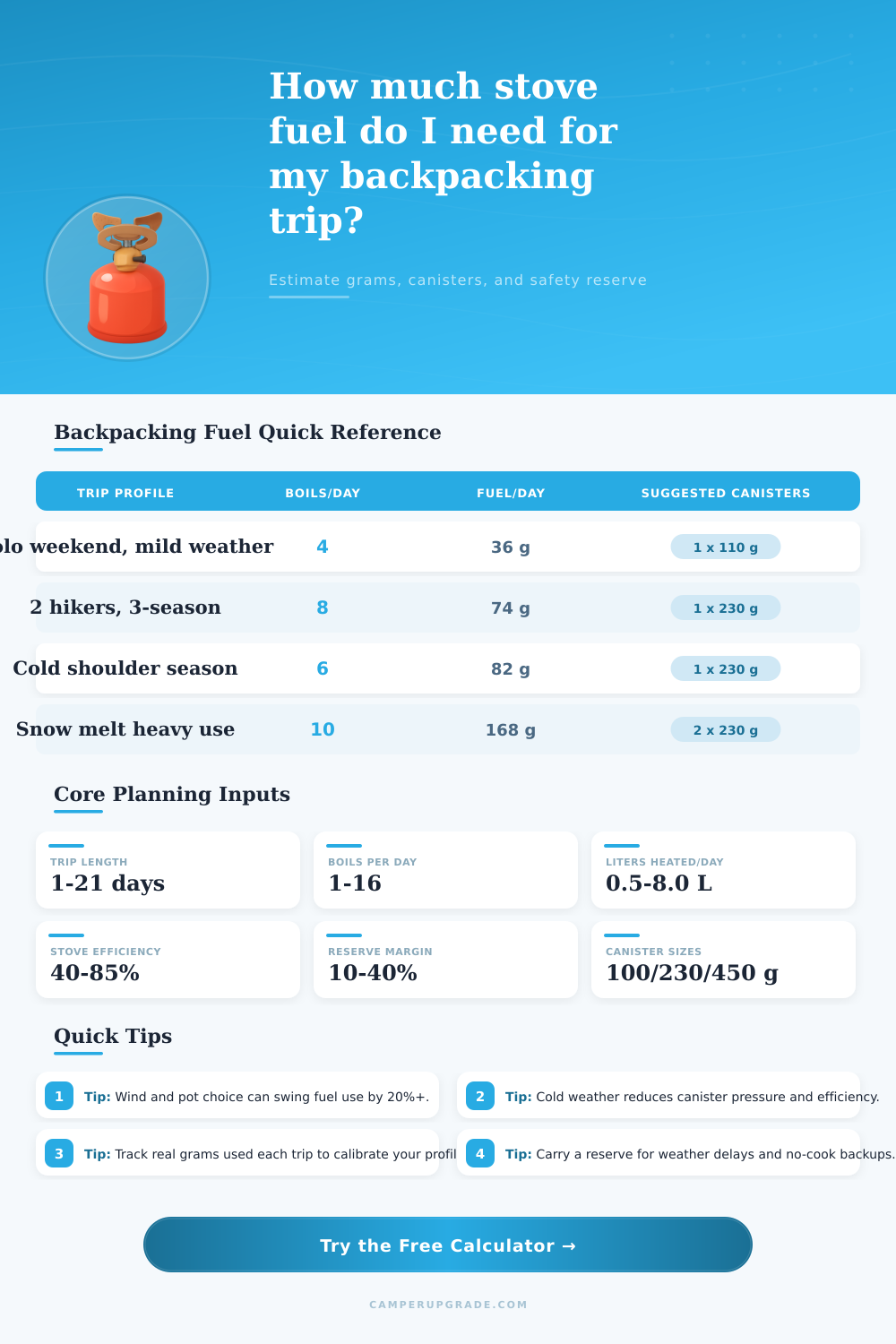
For a solo weekend trip, 100-grams tin of stove fuel commonly suffices. Rule says: bring for one liter water each person and each meal. Consider also total burn time and boil time.
Only for rehydrated meals, simple calculation helps: sum up liters required, share in 16,2 for grams of fuel. For spare, burn in quarter flame. Windscreen and lid matters for efficiency.
(typos inserted)