Backpacking Food Repackaging Weight Calculator
Estimate how much wrapper weight and bear-can volume you can save by moving backpacking meals, snacks, and bulk ingredients into lighter trail bags.
🏕Trail Food Presets
⚙Food Repackaging Inputs
Use food-carry days, including the first trail lunch if it rides in the pack.
Group meals and shared snack bags are counted across all hikers.
A common backpacking range is 2500 to 4500 calories per person per day.
Higher fat and dehydrated food usually carries more calories per weight.
Count oatmeal packets, dinners, lunch wraps, drink mixes, and hot drinks.
Bars, candy, nut packets, gels, jerky packs, and individual treat bags.
Group bags for coffee, oil, soup base, electrolyte mix, or communal dinners.
This changes how many bags replace the original wrappers.
Weigh a few wrappers after opening, then use the average.
Small zip bags often run 0.06 to 0.15 oz; quart freezer bags weigh more.
Include labels, cooking tape, desiccant packets, or oxygen absorbers if used.
Volume is modeled from ounces of food per liter before repack air is squeezed out.
Removing cardboard, pillow packs, excess air, and nested retail bags saves space.
Use zero if you only want weight results without a container fit check.
Adds extra calories and a few spare bags for appetite, delays, or breakage.
This calculator estimates trail food weight and packaging savings from your inputs. Verify actual packages with a kitchen scale, keep cooking directions, and follow local food-storage rules.
Backpacking Food Repackaging Results
📊Repackaging Spec Grid
📦Package Weight Reference
| Packaging item | Typical weight | Best use | Calculator note |
|---|---|---|---|
| Instant oatmeal paper packet | 0.08 to 0.14 oz | Breakfast portions | Often lighter than a new bag unless combined. |
| Energy bar wrapper | 0.05 to 0.12 oz | Individual snacks | Usually not worth repacking unless boxes are removed. |
| Freeze-dried meal pouch | 0.45 to 0.85 oz | Retail dinners | Big savings if meals move to freezer bags. |
| Cardboard box and inner bag | 0.7 to 2.5 oz | Pasta, couscous, crackers | Repacking can save both weight and volume. |
| Small zip snack bag | 0.06 to 0.12 oz | Daily snacks | Good for rationing small items. |
| Quart freezer bag | 0.16 to 0.28 oz | Cook-in-bag meals | Durable, but heavier than thin snack bags. |
| Odor liner or large food bag | 0.9 to 2.2 oz | Bear can organization | Add once for the group, not per meal. |
🍜Food Density And Volume Table
| Food profile | Calorie density | Bulk density | Repack read |
|---|---|---|---|
| Dense nuts, bars, nut butter | 140 to 170 cal/oz | 20 to 26 oz/L | Heavy for its size; weight matters more than volume. |
| Mixed backpacking menu | 115 to 140 cal/oz | 14 to 20 oz/L | Good default for mixed dinners, bars, and snacks. |
| Fluffy pasta, chips, crackers | 90 to 125 cal/oz | 8 to 14 oz/L | Often volume-limited before weight-limited. |
| Dehydrated meals and powders | 105 to 135 cal/oz | 11 to 17 oz/L | Remove pillow air and keep water notes. |
| Bear-can optimized packing | 125 to 155 cal/oz | 18 to 24 oz/L | Crush boxes and group similar shapes tightly. |
🧮Bag Plan Conversion Table
| Repack plan | Bag-count factor | Bag weight effect | Field use |
|---|---|---|---|
| Per-meal bags | 1.00 x package count | Standard | Clear rationing, more bag weight. |
| Daily ration bags | 0.58 x package count | Standard plus daily bag | Good for long hikes and bear cans. |
| Bulk ingredient bags | 0.42 x package count | Lighter | Best for couscous, rice, granola, and powders. |
| Freezer-bag cooking | 0.72 x package count | Heavier bag | Protects meals used with hot water. |
| Odor liner plus inner bags | 0.62 x package count | One extra liner | Helps manage scent and container organization. |
📝Common Backpacking Food Examples
| Trip food plan | Calories | Food weight | Likely repack gain |
|---|---|---|---|
| Solo 2-night weekend | 6000 to 8500 | 3.0 to 4.8 lb | Small, unless freeze-dried pouches are replaced. |
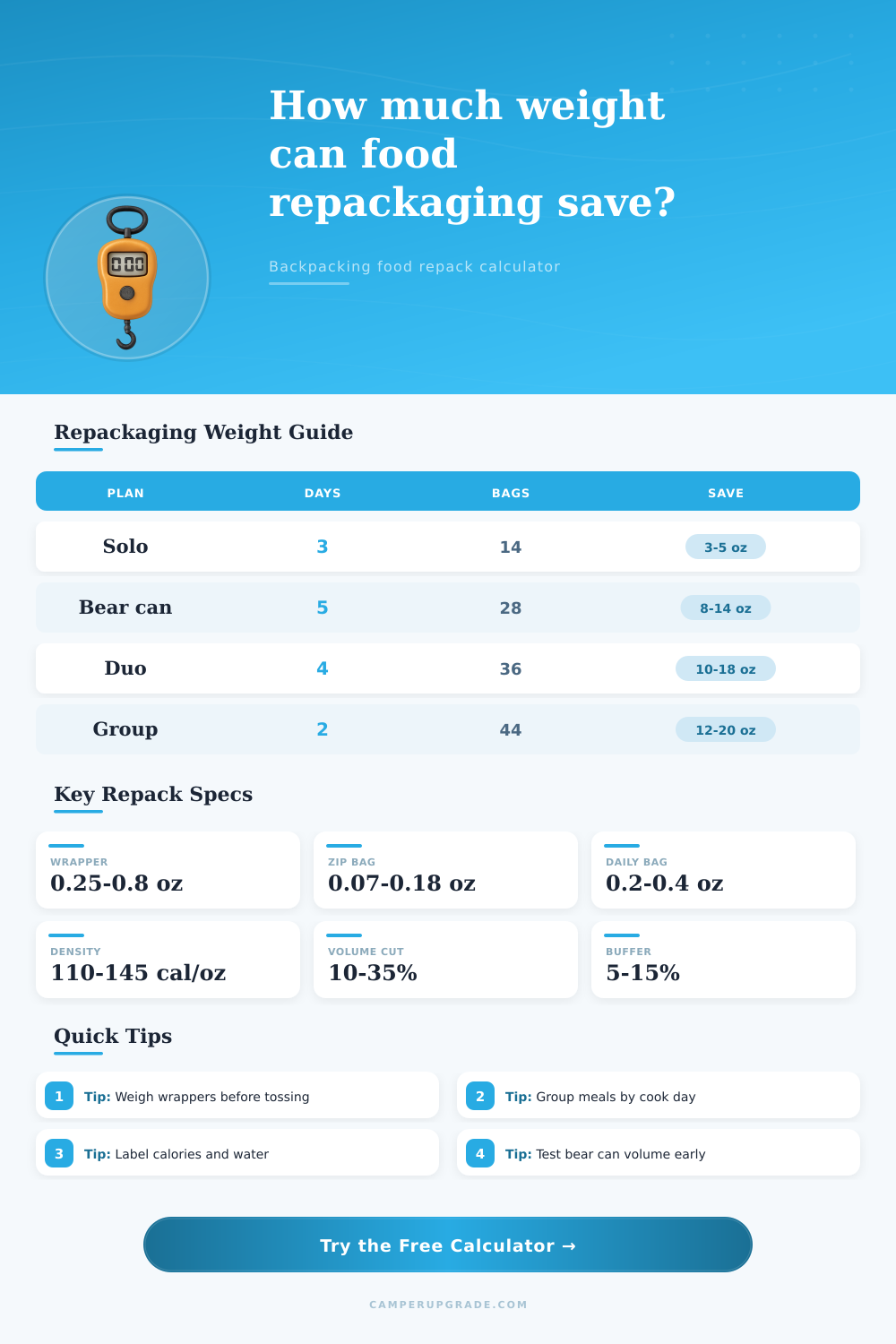
| One hiker, 5-day carry | 15000 to 20000 | 7.5 to 11.0 lb | Repacking can save 6 to 14 oz and real volume. |
| Two hikers, 4-day loop | 22000 to 32000 | 11 to 17 lb | Daily ration bags reduce package count quickly. |
| Four-person overnight | 12000 to 18000 | 6 to 10 lb | Bulk breakfast and dinner bags usually help most. |
| Seven-day long carry | 24000 to 35000 | 12 to 20 lb | Bear-can volume may drive the repack plan. |
💡Repackaging Tips
Weigh your pack after a brief adventure; more than half the weight are probably in those shiny foil pouches, pillow packs, and cardboard. Repacking food take a little work upfront but it is a small inconvenience compared to how hard day three will be when your legs are tired and every ounce matter.
This isn’t about pursuing the lightest kit imaginable. It is about understanding extra weight of packaging. You have to decide if that trade is worth the minutes spent organizing bags into new piles on kitchen table.
Why You Should Repack Your Food
Layers added by most retail foods and snacks is for the convenience of the store, not the hiker. They have cardboard boxes to put them on the shelf, and then additional inner bag to prevent items from getting crushed en route. Then, after they’re in your pack, all that excess just takes up space and weigh you down.
With new bags, enter the number of days you’ll be out, how many people will share the food, and type of bagging plan you want. The calculator does the rest. It turns these decisions into a visual snapshot of how much space you realy freed up (and how much wrapper weight you sent off) inside that stuff sack or bear can.
But inputs are important since they represent actual variations in diet along the trail. Do you like nuts and bars? Like lots of them for big miles? That’s one kind of pack. Do you cook up freeze dried meals each night? That’s another. How much packaging do you have to throw away compared to shared bulk bags? How much waste comes from all those snack wrappers versus a single bag of something?
And finally, density matter; carrying less weight is good. Carrying less weight that has higher caloric value per-ounce are better still. This is true unless the packaging negates the benefit. The tool allows you to test these trade-offs without having to guess what will happen in the end.
After I’m cramming food into a hard-sided thing, volume is usually as important (or more so) than weight. Even if something is lightweight, like chips or instant rice, it will still take up a lot of space because it are airy. Get rid of their original pouches and squeeze out the air, and what was a snug fit become something you might be able to zip shut. The calculator estimates how much the type of food you enter reduce your overall volume. This is helpful when deciding whether to combine breakfasts with dinners or keep every portion separate.
Mathematical plans are only as good as real life will allow. The morning’s cold makes us hungry; a slow start results in unplanned-for lunch. A bag is so light we wouldn’t of save anything by switching; the effort outweighs the gain. And there’s no need to swap when a wrapper or two is already so flimsy that doing so take longer.
In those cases, just check the weights of a couple of your actual food items first before committing to the full packout. Then tweak if things don’t seem substantial enough to be worth the hassle.
Leave the nutrition facts and cooking instructions on new bags to prevent weight savings from turning into a trail mistake. This isn’t supposed to be perfect. It’s learning enough about what foods you’ll take to get the package to do its job rather than fighting it along the way.