Backpacking Filter Flow Rate Calculator
Estimate real trail flow rate, group wait time, liters per stop, cartridge clogging, and backflush timing from filter type, water clarity, temperature, head height, and crew demand.
🏕Trail Filter Presets
⚙Filter Flow and Group Inputs
The model combines clean field flow, clog percentage, turbidity loss, prefilter recovery, cold-water viscosity, pressure or head height, handling time, and group demand. Always follow your filter's pathogen limits and maintenance instructions.
🧪Filter Media and Spec Comparison
Hollow-Fiber Squeeze
0.1 micronHigh flow for solo and pair trips, strong against protozoa and bacteria, but vulnerable to freezing and sediment clogging.
Hanging Gravity Kit
1.5-2.0 L/minBest when camp chores can happen while water flows. Head height, hose kinks, and dirty bags drive real performance.
Ceramic or Pump Media
0.2 micronReliable in shallow sources and cold weather. Flow depends on stroke pace, cartridge fouling, and scrubbed media condition.
Carbon Bottle Stage
taste helpImproves taste and chemicals some filters target, but added media often lowers flow compared with a plain membrane filter.
📊Filter Flow Reference Cards
📋Backpacking Filter Reference Tables
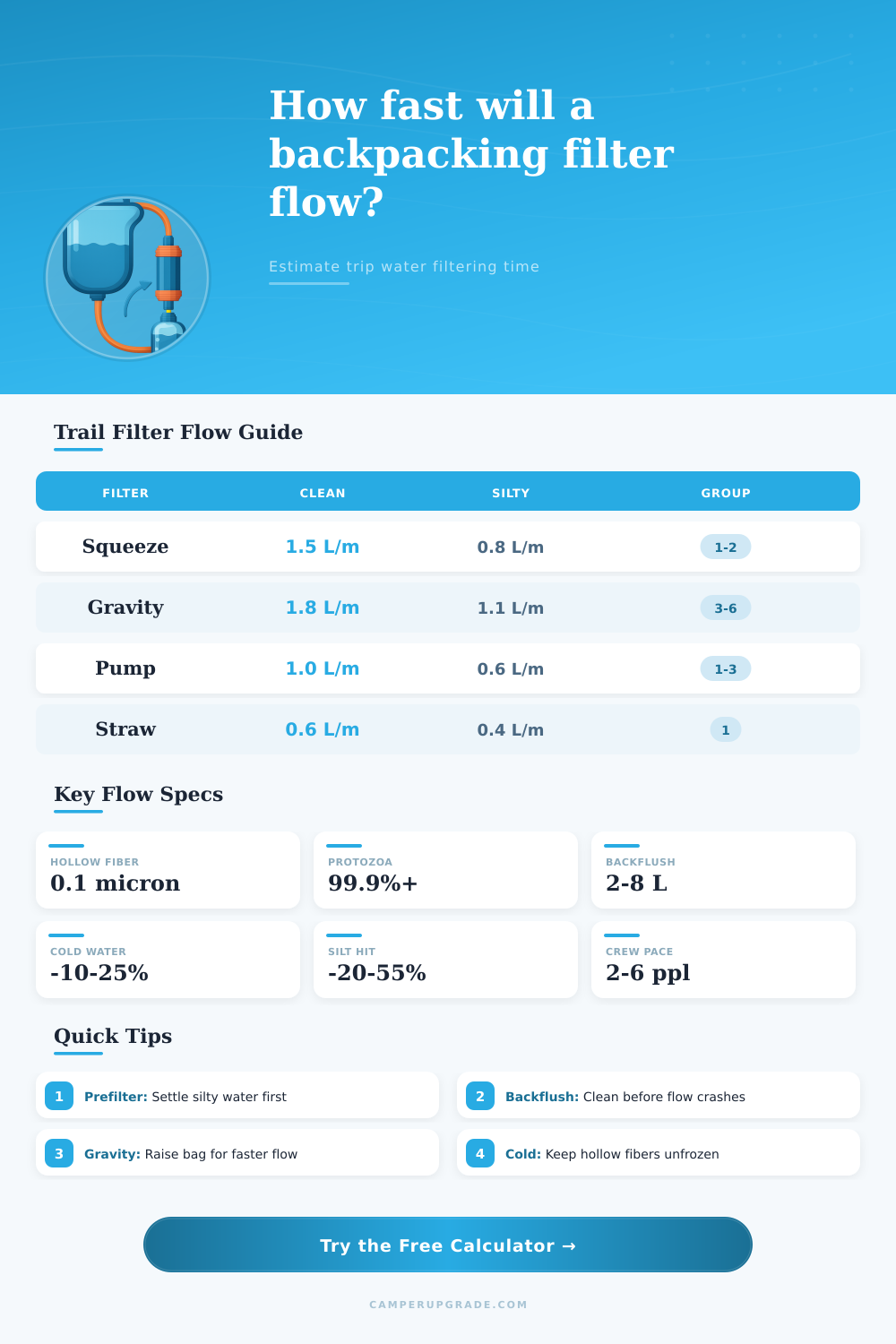
| Filter Style | Clean Field Flow | Dirty Water Flow | Best Use |
|---|---|---|---|
| Hollow squeeze | 1.2-1.8 L/min | 0.5-1.1 L/min | Solo to pair |
| Fast flask | 1.5-2.2 L/min | 0.7-1.3 L/min | Quick stops |
| Gravity kit | 1.4-2.0 L/min | 0.8-1.2 L/min | Groups |
| Hand pump | 0.8-1.2 L/min | 0.4-0.8 L/min | Shallow water |
| Straw filter | 0.4-0.7 L/min | 0.2-0.5 L/min | Emergency use |
| Water Condition | Flow Impact | Backflush Range | Field Fix |
|---|---|---|---|
| Clear creek | 0-10% loss | 20-40 L | Normal use |
| Tannin stained | 5-15% loss | 15-30 L | Rinse cap |
| Cloudy lake | 15-30% loss | 8-18 L | Settle first |
| Silty desert | 30-55% loss | 2-8 L | Prefilter |
| Muddy source | 50-75% loss | 1-4 L | Decant water |
| Group Size | Stop Volume | 0.8 L/min | 1.5 L/min |
|---|---|---|---|
| Solo | 2 L | 2.5 min | 1.3 min |
| Pair | 4 L | 5.0 min | 2.7 min |
| Three hikers | 6 L | 7.5 min | 4.0 min |
| Four hikers | 8 L | 10.0 min | 5.3 min |
| Six hikers | 12 L | 15.0 min | 8.0 min |
| Trip Situation | Recommended Setup | Flow Priority | Watch Point |
|---|---|---|---|
| Long dry carry | Gravity or fast squeeze | Batch volume | Bag refills |
| Cold alpine | Pump or protected fiber | Reliability | Freezing |
| Silty canyon | Settling plus prefilter | Clog control | Backflush |
| Large camp | Gravity filter | Hands-free | Head height |
| Fast thru-hike | Fast flask or squeeze | Quick stops | Dirty bag size |
💡Trail Flow Tips
Filtration of water involve moving the water through a filter to remove the contaminants from the water. The rate at which the water move through the filter is referred to as the flow rate of the water filter. The flow rate of many water filters that consumers purchase is expected to be the same than the flow rate that is represented for that specific water filter manufacturer on the product box.
However, the actual flow rate of an water filter is often much slower than the theoretical flow rate that the manufacturer represents. The theoretical flow rate for most water filters is calculated based off testing the water filter with distilled water. However, the water that can be found in the wilderness often contains sediment and organic particle that may enter the water filter.
Why Water Filters Slow Down and How to Keep Them Working
Because the water from the wilderness often contains these particles, the particles will create resistance for the water to pass through the filter. Thus, the slow flow of the water through the water filter will impact the ability of the hiker to complete there trip with that water. There are a variety of variable that may impact the flow rate of a water filter.
Two of these variables are the presence of silt in the water that is to be filtered and the temperature of the water that is to be filtered. Most moddern water filters use what are referred to as hollow fiber membrane to filter the water. The hollow fiber membranes force the water through the membranes through tiny pores.
The presence of silt in the water, however, can impact these membranes in that the silt will enter the tiny pores of the membranes. As a result, the flow rate of water will decrease. The temperature of the water can also impact the flow rate.
Water that has a low temperature is more viscous than water that has a higher temperature. Thus, the more viscous water will allow for the water to move more slowly through the tiny pores of the membranes, which will again reduce the flow rate of the water filter. Turbidity is a measure of the cloudiness of the water that is being tested.
Turbidity will have an impact upon the water filter in that if high turbidity is used with the water filter, the high turbidity will lead to the clogging of that filter very quick. However, if a person uses a water filter in water with low turbidity, such as a stream of mountain water, the water filter will allow for a higher flow rate. In instances in which the water to be filtered has high turbidity, a user can protect the water filter from clogging by using prefiltering method.
Prefiltering methods may involve the use of a bandana to prefilter the water, or allowing the water to sit in a bottle to allow the heavy grit within the water to settle to the bottom of the bottle prior to the water entering the water filter. By using such a method, the water filter can be kept from clogging and will maintain a consistent flow rate. There are a variety of different styles of water filters available.
One of the main determinants of the physical effort that the hiker is required to exert to utilize a water filter is the type of water filter that is used. Squeeze filters, for example, require some physical effort from the hiker to squeeze the water through the filter. Gravity systems, however, utilize the gravity of the earth to help pull the water through a filter bag and filter.
Thus, gravity systems allow the hiker to simply hang the bag from a branch or other object and continue on their hiking trip. For a solo hiker, a squeeze filter may be the most efficient system. For those that may be on a hiking trip with a large group of individual, however, a gravity system may be more efficient in that it can filter water for more individuals at once.
Most water filters will eventually get clogged with the sediment from the water. In response to the clogging of the water filter, it is important to perform a backflush of the water filter. A backflush is a process in which clean water is forced backward through the hollow fiber membranes to assist in the removal of the sediment from those membranes.
It is important to flush the water filter prior to the flow rate of the water filter becomes too slow. By flushing the water filter prior to a slow flow rate, it is easier to perform the backflush with the water filter. If the flow rate becomes too slow, the sediment may have become embedded into the hollow fiber membranes of the filter.
In such cases, the sediment may permanently damage the water filter. It is also important to protect the water filter from freezing temperature. If the water that is moving through the hollow fiber membranes of the filter reaches a temperature at which the water freezes, the ice that forms within the membranes may crack the membranes.
Thus, if the water filters membranes become cracked, the water filter will no longer be able to perform its essential function of filtering the water. Thus, a cracked water filter is a broken water filter. In order to prevent the water filter from becoming cracked, the user should of keep the water filter warm throughout the night.
By understanding the variables of turbidity, temperature, physical effort, and the maintenance of a water filter, a consumer can manage their water filtration system and its function more effectively.