Backpacking Calorie Deficit Calculator
Compare daily trail burn against packed food, appetite reduction, trip length, and food weight needed to close the calorie gap.
Backpacking deficit estimate
| Terrain choice | Factor | Typical route | Calculator use |
|---|---|---|---|
| Smooth path | 0.92x | Hardpacked rail trail | Fast low-friction miles |
| Maintained trail | 1.00x | Standard dirt singletrack | Baseline backpacking tread |
| Rolling roots and rocks | 1.08x | Mixed forest trail | Minor footing cost |
| Rocky mountain tread | 1.18x | Steps, rock gardens, ledges | Higher stabilizing cost |
| Sand, mud, or talus | 1.25x | Soft or loose surface | Reduced stride efficiency |
| Snow or off-trail | 1.35x | Route finding or soft snow | Highest surface penalty |
| Input driver | Low value | High value | Effect in calculator |
|---|---|---|---|
| Pace from miles and hours | Under 2 mph | Over 3 mph | Raises base MET as pace rises |
| Elevation gain density | 0-150 ft/mi | 600+ ft/mi | Adds climb MET to hiking burn |
| Pack to body ratio | Under 10% | 25%+ | Adds up to 25% hiking load |
| Terrain factor | 0.92x | 1.35x | Multiplies active hiking burn |
| Basal calories | User input | User input | Added once per trip day |
| Trip calorie gap | 90 cal/oz | 110 cal/oz | 125 cal/oz | 150 cal/oz |
|---|---|---|---|---|
| 1,000 calories | 0.7 lb | 0.6 lb | 0.5 lb | 0.4 lb |
| 2,500 calories | 1.7 lb | 1.4 lb | 1.3 lb | 1.0 lb |
| 5,000 calories | 3.5 lb | 2.8 lb | 2.5 lb | 2.1 lb |
| 7,500 calories | 5.2 lb | 4.3 lb | 3.8 lb | 3.1 lb |
| 10,000 calories | 6.9 lb | 5.7 lb | 5.0 lb | 4.2 lb |
| Preset | Miles/day | Gain/day | Packed cal/day | Appetite cut |
|---|---|---|---|---|
| Easy weekend loop | 8 | 800 ft | 3,000 | 0% |
| Rolling overnight | 10.5 | 1,600 ft | 3,200 | 5% |
| AT section day | 13 | 2,500 ft | 3,500 | 10% |
| PCT desert miles | 18 | 2,100 ft | 3,900 | 15% |
| Sierra pass climb | 12 | 4,000 ft | 4,200 | 18% |
| Winter heavy pack | 9 | 2,200 ft | 4,300 | 8% |
When planning a backpacking trip, calculating how much energy you will use and how much food you will have to carry are essential. You need to know how many calorie you will burn and how many calories your food will contain. A calorie deficit occurs when the calories you burn are more higher than the calories you consume.
When you have a calorie deficit, you will feel fatigue in your leg and have changes in your mood. Furthermore, a calorie deficit is the reason why many hiker need to ration there food or buy extra food from the towns along the trail. Several different variable will play a significant role in calculating the calories that will result in a calorie deficit for backpackers.
How to Plan Food and Calories for Backpacking
Your body weight will play a significant role because you will burn calories to move each pound of your body weight uphill. The weight of your pack will play a significant role because the heavier your pack, the more effort that your legs will produce to move each mile. Additionally, the number of miles and the elevation that you gain will play a significant role in the number of calories that you will burn.
However, these are not the only variables. The type of ground you are walking on and the total number of hour that you will be on the trail will play a significant role in your calorie deficit. For example, walking on a trail that contains talus or soft snow will require more calories then walking on a maintained trail of even the same distance.
Another factor to consider is appetite reduction. Many backpackers may feel less hunger on the trail due to high altitude, long hiking day, or high heat. When backpackers feel less hunger, they will consume fewer calories than what they are taking on the trip.
You can use a calculator to account for appetite reduction by entering the percentage of food that you expect to consume. Using this percentage, the calculator will show backpackers how much less food they will consume on the trip. As a result of a calorie deficit due to appetite reduction, backpackers should plan there resupply points for food before they start hiking on the trail.
Two number will represent your daily burn, your basal calories and your active calories. Your basal calories will determine how many calories your body burn while at rest to keep your organs running. Your active calories will be burned based off the hiking that you do.
The more active calories that you burn on the trail, the more calories that you will need daily. The combination of basal and active calories will represent the total number of calories that you burn daily. The calorie calculator will take this number and multiply it by the number of days that you will be on the trail.
This calculation will provide the amount of extra food that you will need to burn to avoid a calorie deficit on your trip. Food density will play a significant role in hiking trips and how much food you will need to carry. Food density is the number of calories that are contained in a specific weight of food.
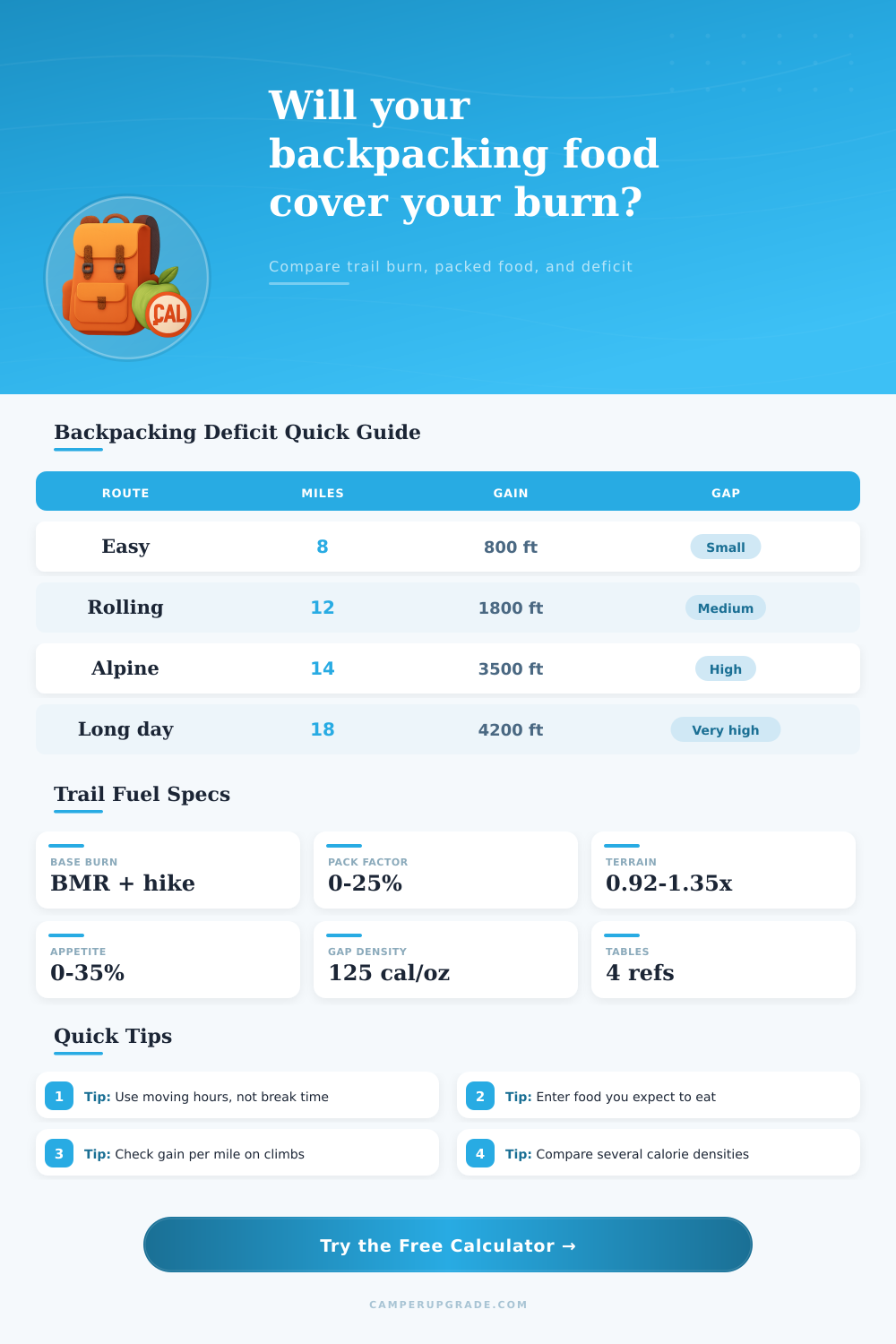
For example, food that contains 125 calories per ounce is lighter to carry than food with fewer calories per ounce. The calorie calculator will use 125 calories per ounce as the density of food for backpackers because this is a common density of food for backpackers. You can use this reference to determine how much food you can lighten your load with higher food density or lower food density.
This calculation will allow you to determine if you should purchase freeze-dried meals for your trip or add more dense bar to your hiking load. The numbers that are calculated will not necessarily translate to your actual calories burned on the hiking trip. The weather on the trail can change how fastly that you hike.
Additionally, taking a turn off the trail will increase the number of miles that you hike. Finally, taking breaks on the trail will increase the number of hours that you hike. Since the calorie calculator cannot account for the weather or the possibility of taking a turn off the trail, you must use the number that is calculated to plan your trip.
For example, if you calculate a small calorie deficit, you can use the information to purchase snacks with a high density of calories. However, if you calculate a large calorie deficit, you must decide if you want to hike with more food on your trip or shorten the distance between resupply point. The reference tables will allow you to make adjustments to your hiking plan.
These tables show the impact of terrain on your pace and your pack weight. Additionally, the reference tables will allow you to compare calorie weight to food density. You dont need to memorize the figure in the reference tables.
However, using these tables will allow you to see if your hiking plans fall to the high end or the low end of the number range represented in these tables. Using these tables will assist you in calculating the correct amount of food for your hiking trip. By running these calculations before you go on your hiking trip, you will have a better grasp of the uncertainty of the trip.
While you cannot control many variables on the trail, such as food taste, water treatment, and hiking pace, calculating your calories will help you to know if the food weight that you will carry will match your physical workload. Knowing if the food weight that you will carry matches your physical workload will make the planning of your hiking trip more manageable.