🧭 Backpacking Calorie Calculator
Calculate your daily calorie needs for any backpacking trip — by weight, intensity, pack load & weather
| Food Item | Cal/oz | Weight (oz) | Total Cal |
|---|---|---|---|
| Olive Oil | 250 | 1 | 250 |
| Macadamia Nuts | 204 | 1 | 204 |
| Peanut Butter (powder) | 153 | 1 | 153 |
| Dark Chocolate | 150 | 1 | 150 |
| Almonds / Mixed Nuts | 160 | 1 | 160 |
| Freeze-Dried Meal | 120 | 4 | 480 |
| Instant Oatmeal Packet | 107 | 1.5 | 160 |
| Tortillas (flour) | 100 | 1.5 | 150 |
| Energy Bars (avg) | 120 | 1.8 | 216 |
| Ramen Noodles | 115 | 3 | 345 |
| Calorie Target | 3 Days | 5 Days | 7 Days | 10 Days |
|---|---|---|---|---|
| 2,500 cal/day | 3.8 lbs | 6.3 lbs | 8.8 lbs | 12.5 lbs |
| 3,000 cal/day | 4.5 lbs | 7.5 lbs | 10.5 lbs | 15.0 lbs |
| 3,500 cal/day | 5.3 lbs | 8.8 lbs | 12.3 lbs | 17.5 lbs |
| 4,000 cal/day | 6.0 lbs | 10.0 lbs | 14.0 lbs | 20.0 lbs |
| 5,000 cal/day | 7.5 lbs | 12.5 lbs | 17.5 lbs | 25.0 lbs |
Count the calorie needs for trips with rucksacks not always are easy but there are solid tools created specifically for that. Those calculators consider your body weight, the weight of your gear, the speed of your hike, the slope of the way and the kind of terrain that you cross Although the figures not always are perfect, they give you a good plan. Military researchers spent decades studying the energy of hiking with heavy loads through various environments, so there exists real science behind those ratings.
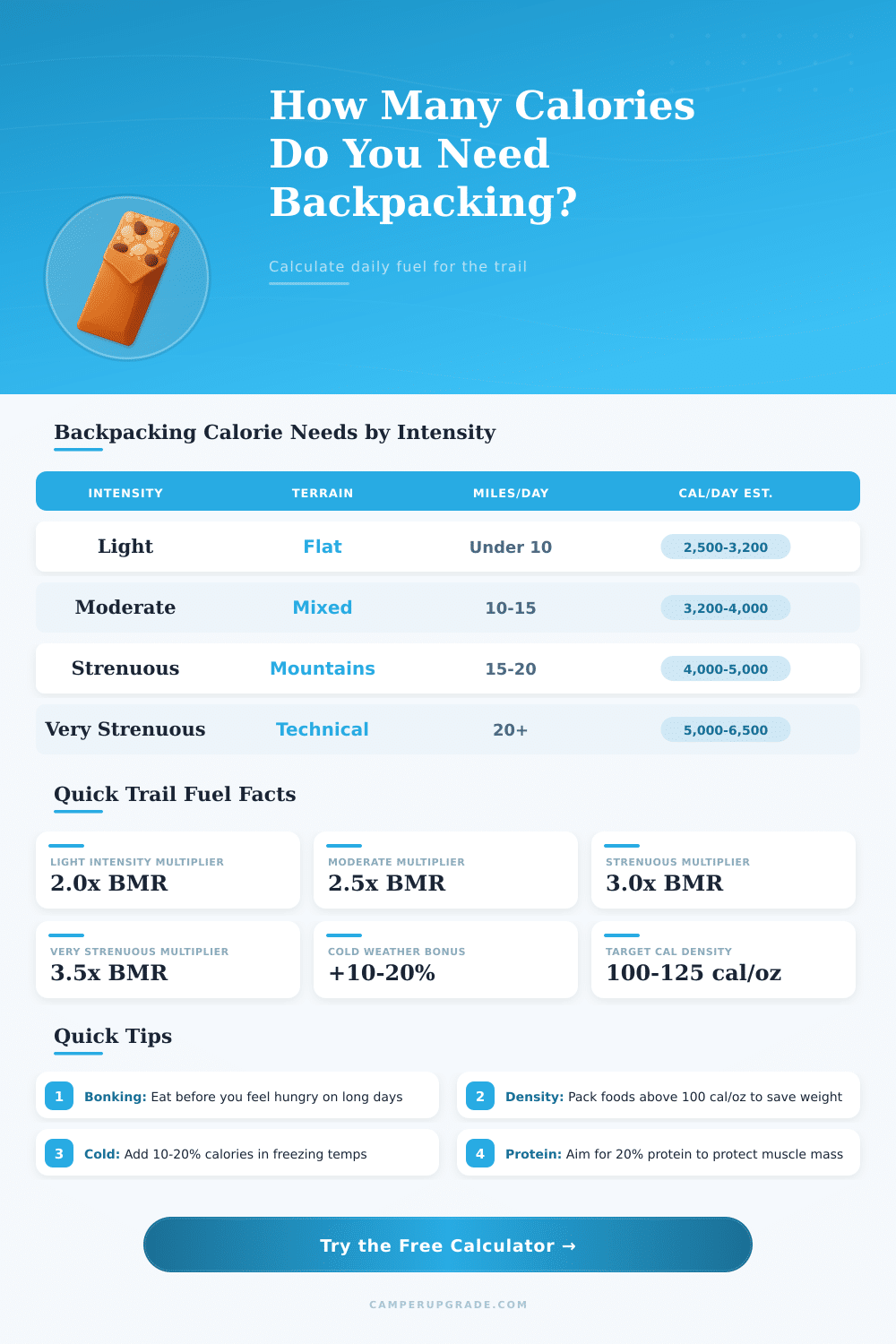
Most backpackers burn between 2,500 and 4,500 calories daily, although that depends on how hard you push, the landscape and other factors. A good starting point would be around 3,000 calories per day. Even so, every person is different.
How Many Calories to Bring on a Hike
A smaller woman on a moderate hike could require only 2,100 to 2,200 calories, while a bigger man easily could need 2,800, 3,000 or even more. The wisest move is to mind your own hunger signals during the first few days and correct the ammount from there.
The weight of the load entirely alters how much fuel your body burns. For instance, a person weighing 180 pounds that hikes three miles with a 15-pound load burns around 312 calories. If that person weighed only 150 pounds on the same way, the figure would be nearer to 264 calories.
Now, if you extend that distance to ten miles with a 30-pound load (around 120 calories per mile), you will add an extra 1,200 calories or more. The ratings can range a bit according to the calculator. Because of that, someone weighing 185 pounds that hikes during eight hours with a heavy load could burn anywhere between 4,600 calories or even reach above 6,300.
How much food you indeed carry depends on the length of the journey, the daily distance, the trouble of the terrain, the rise, the weight of the load, your body weight and your metabolism. One strategy that operates quite well is to pack 1.5 to 2.5 pounds of food per day. But that is not always reliable, because some foods are heavy but do not give many calories.
A better method? Count what you indeed require daily, which for most backpackers is between 2,500 and 3,500 calories. Foods with little water are your friends, because water only weighs you down without giving energy.
Dried meat like salami are good, cheap calorie bombs compared with costly snacks for backpackers.
You want snacks that give more than 100 calories per ounce. Nuts and chips are perfect for that. Even so, remember that calories not always transform to usable energy equally.
Peanuts have many calories, but your body does not absorb everything that you eat.
For shorter trips, for instance under 200 miles, honestly, do not care too much about the accuracy of the calories. A bit of deficit during a week or two will not destroy a healthy person. Even so, cold weather entirely alters the situation.
When the temperature falls, your food needs jump dramatically. Severe conditions and technical terrain, like mountaineering, require much more energy than a calm weekend trip.