Backpack Rain Cover Size Calculator
Size a rain cover from pack liters, loaded dimensions, external gear bulge, circumference, and storm fit.
🎒Quick Pack Presets
⚙Rain Cover Inputs
📊Rain Cover Spec Grid
📘Reference Tables
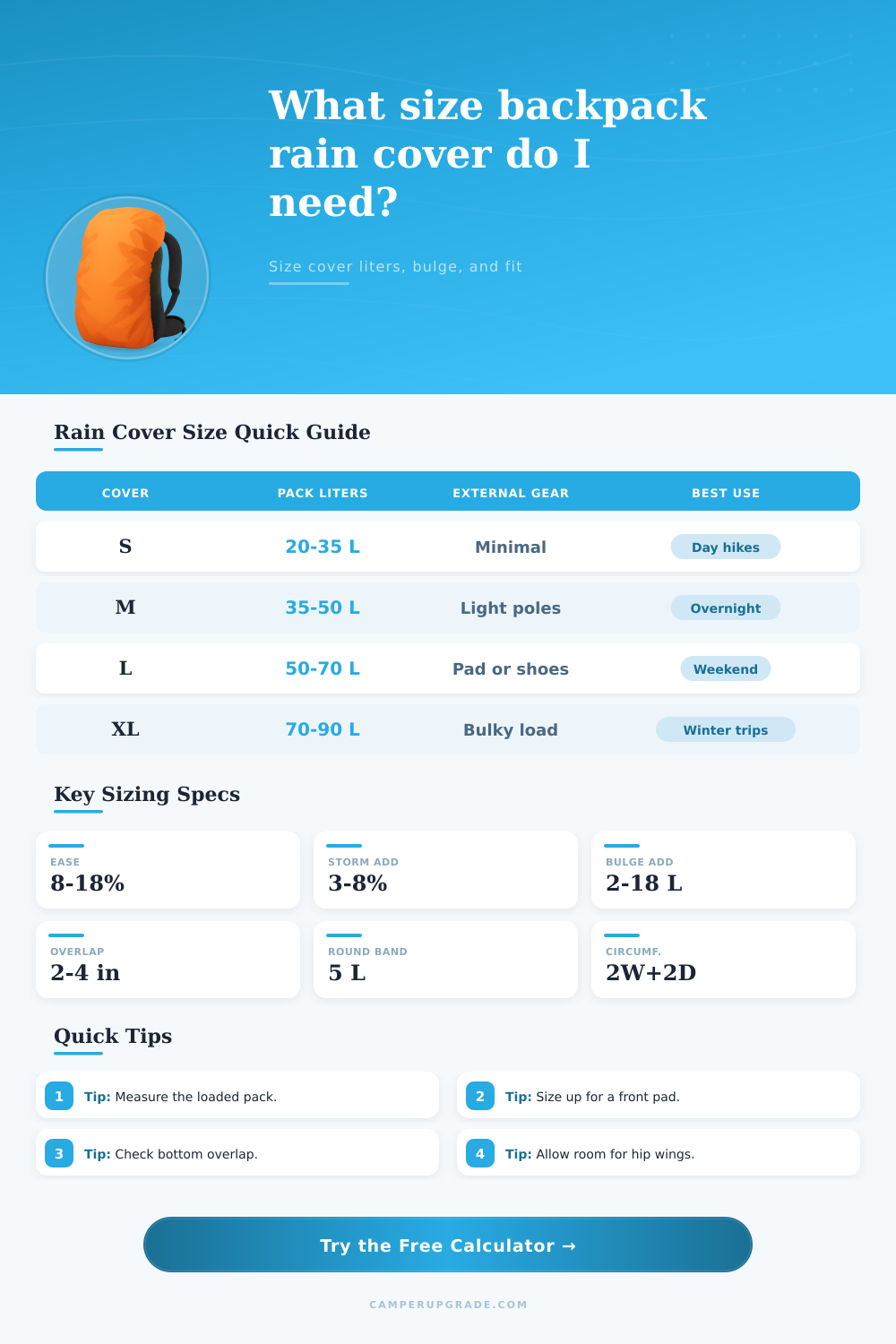
| Cover Size | Nominal Pack Range | Best Fit | Watch Point |
|---|---|---|---|
| XS | 10-20 L | Youth, summit, hydration packs | Often too short for helmets |
| S | 20-35 L | Daypacks and commuter bags | Check depth with lunch and jacket |
| M | 35-50 L | Overnight or photo packs | Tripods can push this to L |
| L | 50-70 L | Weekend backpacking loads | Foam pads may need XL |
| XL | 70-90 L | Winter and expedition starts | Avoid floppy fabric on bare packs |
| XXL | 90-110 L | Large haulers with bulky outside gear | Secure extra fabric in wind |
| External Gear | Bulge Add | Liter Add | Sizing Note |
|---|---|---|---|
| None | 0 cm / 0 in | 0-2 L | Use stated pack band |
| Poles or tripod | 3-6 cm / 1-2.5 in | 2-6 L | Mostly affects circumference |
| Foam pad or sandals | 6-12 cm / 2.5-5 in | 6-14 L | Often pushes one size up |
| Helmet or shoes | 8-15 cm / 3-6 in | 8-18 L | Needs more height and depth |
| Snowshoes or winter tools | 10-20 cm / 4-8 in | 12-26 L | Wind security matters |
| Pack Class | Typical Liters | Cover Fit Target | Common External Item |
|---|---|---|---|
| Day hike | 18-30 L | S, sometimes M | Shell or poles |
| Overnight | 32-45 L | M | Tripod or sandals |
| Weekend | 46-60 L | L | Pad or wet tent body |
| Winter | 55-75 L | L to XL | Snow tools and insulation |
| Expedition | 70-90 L | XL to XXL | Bear can or group gear |
| Measurement | Formula Used | Why It Matters | Field Check |
|---|---|---|---|
| Pack liters | max(stated L, measured L) | Prevents undersizing a puffy load | Use loaded pack shape |
| External gear bulge | W x bulge x 0.70H | Turns front gear into cover volume | Measure the largest protrusion |
| Circumference | 2 x width + 2 x adjusted depth | Checks if elastic reaches around | Run tape around the widest point |
| Cover range | effective L +/- fit band | Gives a shop-ready range | Pick the band that includes both ends |
A rain cover is a piece of gear that is used to protect a backpack from water. The rain cover should physically fit the backpack that it will be use on. Many people feel that all a rain cover needs to be is a sack that will keep the water out.
However, the rain cover must physically match the loads that is to be carried on the backpack. If the rain cover is too small for the backpack, it wont be able to fully close. Additionally, if the rain cover is too loose fitted to the backpack, it will allow for water to enter the pack.
How to Choose the Right Rain Cover Size
Therefore, the size of the rain cover is an important factor to consider when purchasing the rain cover as it will determine how well the rain cover can protect the backpack and its contents. The volume of a pack is one of the factors that can be considered when determining the size of the rain cover that is to be used on the backpack. However, the volume of the pack does not necessarily account for the external items that may be attach to the backpack.
For instance, many external items includes foam pads that are added to the front of the pack, or items like tripods that are strapped to the side of the pack. These external items can change the dimension of the pack. As a result, the dimensions of the pack may not necessarily be the same as the number of liter that the pack is labeled with.
In this case, the measurements for the rain cover should include the loaded dimension of the pack as measured with the rain cover calculator. Many people make mistake when purchasing rain covers in relation to there external gear. Items like trekking poles will add to the circumference of the backpack.
Items like helmets or shoes will add to the circumference and the depth of the backpack. In these instances, the rain cover must stretch in these different directions to cover the backpack. The rain cover calculator makes allowance for these different bulges in the backpack.
The calculator makes allowances for the volume of these items so that the individual can determine if a medium size is still appropriate for their backpack, or if they will need to purchase a larger size. Additionally, the type of weather that is likely to be encountered will change the way in which one purchase a rain cover. For instance, if the weather is likely to be light rain, a snug rain cover may work best for the individual.
However, if the individual is planning on traveling in areas that receive wind driven rain, it will be better to choose a rain cover that has more ease in the fit of the rain cover to the backpack. The rain cover with the more ease in the fit will be less likely to tear while traveling on the trail in the wind. Additionally, the rain cover will be better suited to handle heavy storms in the area in which the individual will be traveling.
The calculator will allow the individual to adjust for these different types of weather condition. The fit of the rain cover can affect the way that it perform while on the individual’s hike. For instance, a tight fitting rain cover is easier to deploy.
Additionally, it is less likely to become snagged on the branches along the trail. However, if the rain cover is too tight, it may come off of the backpack if the contents of the backpack are rounded at the bottom, such as when using a sleeping bag that is too full for the backpack. A roomy rain cover allow for easier access to the side pockets on the backpack without having to remove the rain cover.
However, a roomy rain cover may billow in high winds. The trade-offs between these two type of rain covers will ultimately determine what type of hiking the individual performs. Each type of rain cover has its advantages and disadvantage.
Finally, there are reference tables within the product descriptions for the rain covers that indicate the different categories of backpacks and external items. However, the individual should use their measurements to ensure the best fit for the backpack. For instance, a 52-liter pack may increase in size to that of a 65-liter backpack if the individual strap a tent to their backpack.
Additionally, there will be a need for the rain cover to allow for water to not enter the backpack. This increase in size is important to ensure that the backpack will properly function in the elements that it will encounter. To ensure that the rain cover has the correct fit for the backpack, it is important to take measurements of the loaded pack.
The shape of the backpack will change once it is fully load with its necessary gear. Furthermore, it is important to allow for extra height towards the bottom of the backpack in case the rain cover is to be placed onto wet ground. Additionally, because a rain cover does not have a break-in period, it must fit the individuals backpack perfect the first time the two are used together.
Getting the size of the rain cover correct will allow an individual to spend less time adjusting their rain cover in the rain and more time traveling on their hike.