Backpack Hydration Bladder Size Calculator
Estimate the bladder capacity, bottle overflow, dry-stretch carry, refill count, and water weight that fit a specific hiking route, weather window, and backpack setup.
🎒Trail Hydration Presets
📐Route And Water Inputs
This adjusts the refill target and suggested bladder size.
Many packs fit less water than the route wants, so bottles may carry overflow.
Total planned distance, including side trips and water detours.
Use moving time plus long breaks when you will still drink from carried water.
Climbing raises effort and usually raises drinking rate.
Used as a small modifier, not a medical hydration prescription.
Use the warmest part of the hiking window, not the trailhead start.
High humidity reduces cooling; very dry air also increases unnoticed loss.
Changes the base liters per hour before weather modifiers.
Open routes push water needs above the same temperature in shade.
Size the bladder for the longest time between dependable refills.
Bottle capacity reduces how much must fit inside the bladder.
Add non-drinking water that must be carried through the same dry stretch.
Reserve is applied after drinking and extra water are estimated.
Use 0 if you are choosing a first bladder.
A half-collapsed bladder can be quieter; a full bladder carries maximum water.
This calculator is a planning estimate for healthy adults. Adjust for personal sweat rate, medical needs, electrolyte plan, water quality, and route uncertainty.
Hydration Bladder Size Results
📊Calculated Spec Grid
💧Hydration Bladder Capacity Table
| Bladder size | Best use | Water weight | Planning note |
|---|---|---|---|
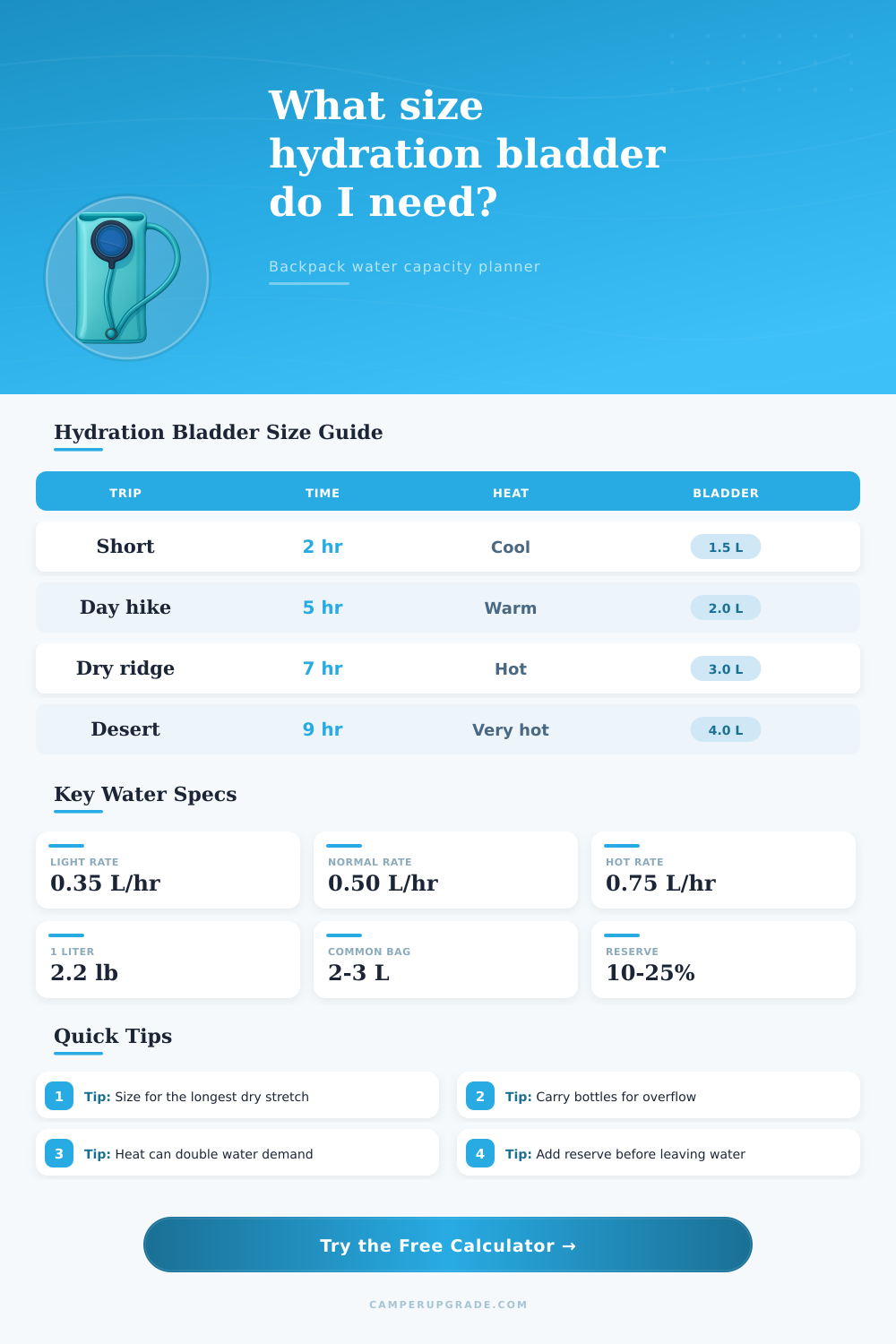
| 1.0 L | Short runs, backup water | 2.2 lb / 1.0 kg | Usually too small as the only water source for warm hikes. |
| 1.5 L | Cool short hikes or vest sleeves | 3.3 lb / 1.5 kg | Works well with one bottle on moderate routes. |
| 2.0 L | Common day-hike bladder | 4.4 lb / 2.0 kg | A flexible default when water sources are not far apart. |
| 2.5 L | Warm day hikes with modest gaps | 5.5 lb / 2.5 kg | Useful when a 3 L bladder crowds the pack sleeve. |
| 3.0 L | Dry stretches, hot weather, long climbs | 6.6 lb / 3.0 kg | The most common large backpacking bladder size. |
| 4.0 L | Desert carries or camp approach | 8.8 lb / 4.0 kg | Often better split between bladder and bottles for balance. |
☀Temperature And Effort Rate Table
| Condition | Easy pace | Steady pace | Hard climb |
|---|---|---|---|
| Cool below 55°F / 13°C | 0.25 to 0.35 L/hr | 0.35 to 0.45 L/hr | 0.45 to 0.60 L/hr |
| Mild 55 to 70°F / 13 to 21°C | 0.30 to 0.45 L/hr | 0.45 to 0.60 L/hr | 0.60 to 0.80 L/hr |
| Warm 70 to 85°F / 21 to 29°C | 0.45 to 0.60 L/hr | 0.60 to 0.80 L/hr | 0.80 to 1.00 L/hr |
| Hot 85 to 100°F / 29 to 38°C | 0.60 to 0.80 L/hr | 0.80 to 1.05 L/hr | 1.00 to 1.25 L/hr |
| Very hot above 100°F / 38°C | 0.75 to 1.00 L/hr | 1.00 to 1.30 L/hr | 1.25 to 1.50 L/hr |
🗺Common Route Preset Reference
| Route scenario | Typical time | Water pattern | Typical bladder |
|---|---|---|---|
| Cool morning loop | 1.5 to 3 hr | Water not critical if trailhead is close | 1.0 to 1.5 L plus small bottle |
| Forest day hike | 4 to 6 hr | Refill every 2 to 3 hr | 2.0 L bladder with backup bottle |
| Dry ridge traverse | 5 to 8 hr | One dry stretch of 4 to 6 hr | 3.0 L bladder plus bottle capacity |
| Desert summer route | 6 to 10 hr | Often no reliable water | 3.0 L bladder plus several bottles |
| Overnight camp approach | 3 to 7 hr | Carry camp water past last source | 2.0 to 3.0 L bladder plus storage bottle |
⚖Water Weight And Refill Planning Table
| Carry volume | Water weight | 2 L bladder refills | 3 L bladder refills |
|---|---|---|---|
| 1.5 L | 3.3 lb / 1.5 kg | 0 refill, partial bladder | 0 refill, half bladder |
| 2.0 L | 4.4 lb / 2.0 kg | 0 refill, full bladder | 0 refill, room to spare |
| 3.0 L | 6.6 lb / 3.0 kg | 1 refill or bottle overflow | 0 refill, full bladder |
| 4.0 L | 8.8 lb / 4.0 kg | 1 refill plus bottles | 1 bottle overflow likely |
| 6.0 L | 13.2 lb / 6.0 kg | 2 refills or cached water | 1 refill plus bottles |
💡Backpack Hydration Tips
When choosing your hydration bladder size, don’t pick the biggest bag that fits. Match the bladder size to the longest dry stretch you’ll go without reliable water. Most hikers overestimate what they can comfortabley carry, and underestimate the impact that changing conditions has on their needs. Half a litre is the difference between comfortable and uncomfortable carries.
A warm day, hard climb or exposed ridge all increase amount you’ll need. This is where the biggest factor (the length of the driest section of your route) come into play, as it dictates exactly how many ounces of water you need to lug from one source point to the next. How quickly do you consume? That’s dictated by several variables: exertion level, humidity, heat, sun, etc. A shady forested path will moderate your drinking speed; sunny days increases it. The algorithm in the above calculator accounts for all these variables when you input your weather window, pack sleeve capacity, and overall nature of your route. This eliminates the need to second-guess how each of these variable affects the others.
How to Choose Your Water Bladder Size
Fewer than you think: Most importantly, bottles already on your pack take precedence, each liter they account for frees up space in the pack sleeve. If there’s room for three liters in your daypack (and many are), anything beyond should of been relocated to a flask or side pocket on shoulder straps. Subtract those bottles from your grand total and see what fraction remain to fit in the bladder.
But remember, that reserve is a practical decision rather than a safety blanket. It’s a practical choice: Ten percent is sensible for short routes in familiar areas where there are easily reached bailout options. When you’re on a long route where bailing out is less simple or the weather looks dicey, 25 percent starts to make sense (the added water provides wiggle room should a filter require flushing or a spring prove sluggish). The calculator treats that reserve as applied after the drinking estimate, ensuring the number remains honest and isn’t buried within rate.
New packers are surprised by how much weight their bladders hold; about six and a half pounds of water, not counting bladder’s container (a three liter bladder). And that’s on your back all day long, shifting as the bladder empty. Some people like to offset that by carrying part of their water in bottles and part in a smaller bladder. It seems lighter different than carrying the same amount of water combined.
But then what? You have your recommended size in hand, now compare it to your existing bladder. Does it fit into your pack sleeve? Is the suggested size bigger than what will fit? In almost every case, the answer isn’t “force a bigger bladder in there,” but rather modify the route, bring more bottles, or deal with one more refilling stop. That trade-off becomes clear before you ever set foot on the trail which lets you plan for it.