🎒 Backpack Frame Size Calculator
Match torso length, carried load, and pack style to a practical frame size
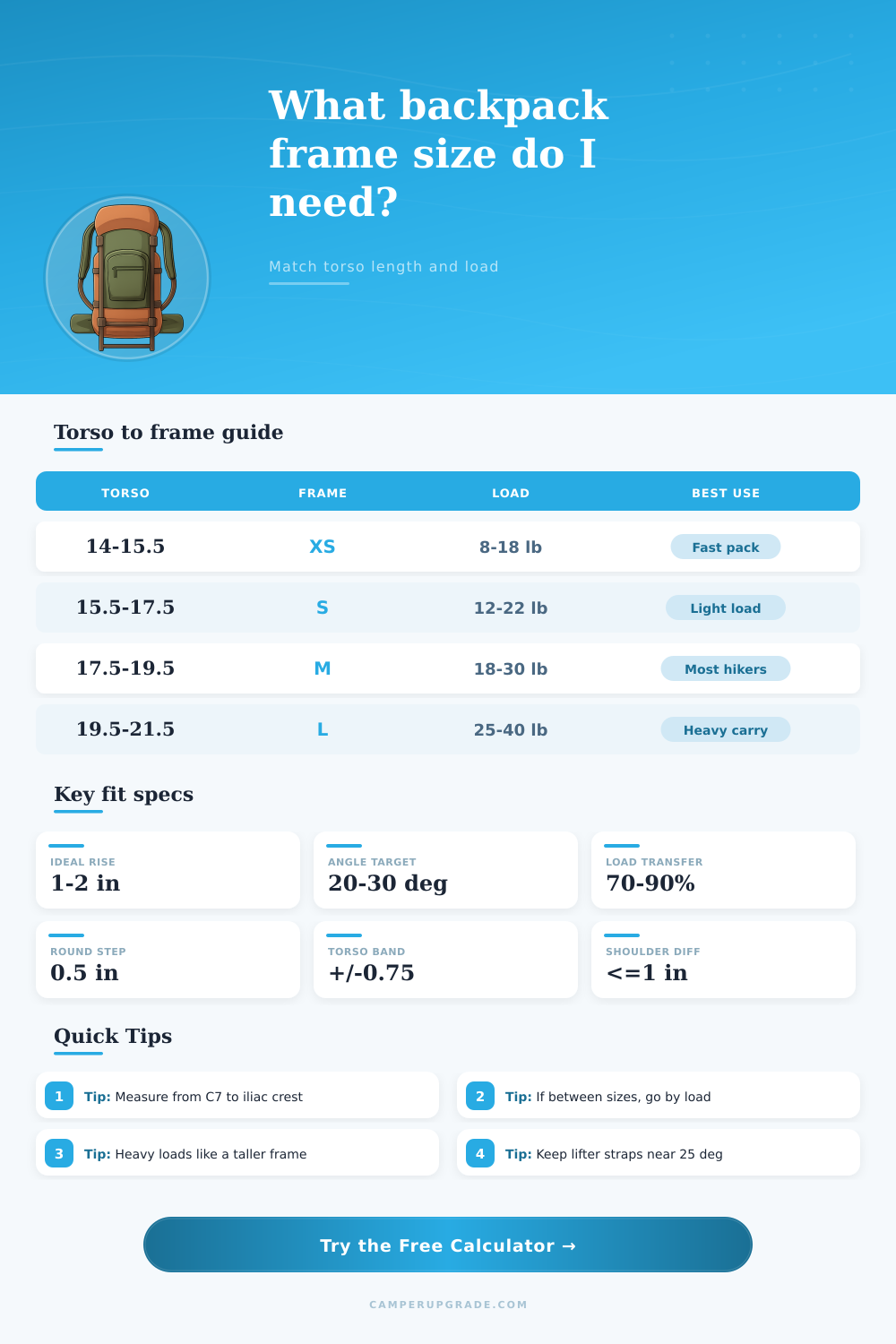
| Torso range | Frame size | Typical load | Best use |
|---|---|---|---|
| 14-15.5 in | XS | 8-18 lb | Fast carry |
| 15.5-17.5 in | S | 12-22 lb | Light load |
| 17.5-19.5 in | M | 18-30 lb | All-day hike |
| 19.5-21.5 in | L | 25-40 lb | Heavy carry |
| 21.5-23.0 in | XL | 35-50 lb | Tall torso |
| 23.0-24.5 in | XXL | 45-60 lb | Hauling load |
| 16.0-18.0 in | M-S | 16-24 lb | Compact fit |
| 18.5-20.5 in | L-M | 22-34 lb | Mixed carry |
| Style | Frame bias | Comfort band | Notes |
|---|---|---|---|
| Ultralight thru-hike pack | -0.35 in | 8-20 lb | Low bulk |
| Fast daypack | -0.25 in | 8-18 lb | Short trips |
| Trekking internal frame | 0.00 in | 20-35 lb | Balanced |
| Alpine technical pack | -0.10 in | 15-30 lb | Tighter ride |
| Travel carry-on pack | 0.15 in | 12-28 lb | Upright carry |
| Expedition load hauler | 0.45 in | 35-60 lb | More structure |
| External frame pack | 0.60 in | 30-55 lb | Big loads |
| Short-torso fit | -0.20 in | 10-25 lb | Lower anchor |
| Angle | Feel | Frame bias | Use case |
|---|---|---|---|
| 15° | Flat | -0.25 in | Very low load |
| 20° | Relaxed | -0.10 in | Short carry |
| 25° | Balanced | 0.00 in | Most packs |
| 30° | Steady | 0.15 in | Heavier load |
| 32° | Firm | 0.25 in | Load hauler |
| 35° | Very firm | 0.35 in | Big carry |
| 40° | Tall | 0.50 in | Frame boost |
| 45° | Extreme | 0.65 in | Rare use |
| Scenario | Torso | Load | Frame note |
|---|---|---|---|
| Fast ridge day | 16.5 in | 14 lb | Short and light |
| Weekend food carry | 18.0 in | 24 lb | Balanced medium |
| Winter hut mission | 19.0 in | 38 lb | Taller frame |
| Camera approach | 15.8 in | 16 lb | Snug fit |
| Alpine summit push | 16.8 in | 20 lb | Low bulk |
| Travel overnighter | 17.2 in | 22 lb | Easy carry |
| External hauler | 20.0 in | 52 lb | High support |
| Short torso fit | 15.2 in | 18 lb | Lower anchor |
A backpack frame is a rigid structure locate inside of a backpack. The backpack frame help to distribute the weights of the backpack to the body of the person that is wearing the backpack. If the backpack frame is the correct size for the individual that is wearing the backpack, the backpack frame will allow the majority of the weight to be distributed to the persons hip.
A person should aim to have between 70 and 90 percent of the weight of the backpack distributed to the persons hips, rather then to the persons spine or arms. If the backpack frame is not the correct size for the individual, the backpack frame may place the backpacks weight on the individuals shoulder or cause the individual to feel as if they may fall out of balance while wearing the backpack. To determine the proper size of backpack frame for an individual, the person should measure the length of their torso.
How to Choose the Right Backpack Frame
The length of the torso is the distance from the C7 vertebra (the bump at the base of an individuals neck) to the top of the persons hip bone. The height of an individual is not an indication of the length of their torso; tall individuals may have short torsos and short individuals may have long torsos. Thus, the length of the torso is the most important measurement for indicating what size of backpack frame an individual should have.
The weight of the load that the individual will place into the backpack may also indicate the size of frame that is necessary for the individual. If the individual is only carrying a light load (under 20 pounds), they may require a shorter backpack frame. If the individual is carrying a heavy load (under 20 pounds), they may require a taller backpack frame to provide better leverage in relation to the load.
In addition to the length of the torso and the weight of the load, other factor related to the individual may impact the size and fit of the backpack frame. Individuals with particularly wide shoulder, for example, may require to make some adjustments to the backpack frame to ensure that it does not chafe the individual during periods of prolonged wearing of the backpack. Similarly, the person may need to adjust the rise of the hip belt according to the individual.
Backpacks also tend to include load lifter straps, which are the straps located at the top of the backpack that help to pull the weight of the load towards the individuals shoulder. These load lifter straps should be positioned such that they are at an angle of between 20 and 30 degrees relative to the floor of the individuals backpack. If the angle of the load lifter straps is too flat (close to 0 degrees), the backpack may sag when the individual is carrying it.
If the angle is too steep (close to 90 degrees), the backpack may be overbuilt for the individuals task. Calculations can be performed to determine the target length of the backpack frame. The length of the individuals torso and the weight of the load can both factor into these calculations.
A fit band is a size of backpack frame that is provided for ranges of lengths of torso. For instance, one fit band may be sized for individuals whose torso length range between 36 and 38 inches, and whose loads weigh between 18 and 30 pounds. Additionally, an individual who intends to use a technical alpine pack may require a different size of backpack frame than an individual who is performing other type of tasks with their backpack.
There are mistakes that many individual make when they are attempting to measure their torso length. One mistake is to instead use the distance from the individuals collarbone to the individuals shoulder to measure their torso length. Using such a measurement will result in an incorrect measurement.
Another mistake is to disregard the weight of the load that the individual plan to carry. Such ignoring of the weight of the load may result in the purchase of an undersized backpack frame. If an individual is in between sizes, they should select a backpack frame that is taller if they are to carry a heavy load, and one that is shorter if they are to carry a light load.
Finally, there are different type of backpacks that have frames of different types. For instance, backpacks may have frames that are internal frame, external frame, or even hybrid frame. Internal frames are frames that are located within the backpack, and are often used to increase the agility of an individual while they are on the trails.
External frames are frames that are located on the outside of the individuals backpack, and individuals who is required to haul very heavy load often use them. Finally, hybrid frames include element of both internal and external frames. Regardless of the type of frame that is manufactured for the individual, the frame must be of the correct length and must be of the correct size for the load that the individual is to carry, to ensure that the individuals hip are distributing the majority of the weight of the backpack.