Backcountry Permit Days Calculator
Count permit days, trail nights, entry and exit timing, layover nights, itinerary movement days, and group quota units before submitting a backcountry permit request.
🏕Backcountry Trip Presets
⚙Entry, Exit, Nights, Layover, and Group Inputs
This calculator counts dates and planning quantities only. Always confirm the issuing agency rules for exact quota definitions, campsite names, food storage rules, stock restrictions, and permit pickup deadlines.
🗺Itinerary and Permit Spec Grid
Entry Date
--First day counted on most overnight permits, even if mileage starts late.
Exit Date
--Walk-out date closes the permit window and should match shuttle plans.
Camp Moves
--Estimated number of days where camp location changes along the route.
Review Flag
--Highlights date mismatch, group cap, layover-heavy trips, or zone complexity.
📌Permit Planning Specs
📋Backcountry Permit Day Reference Tables
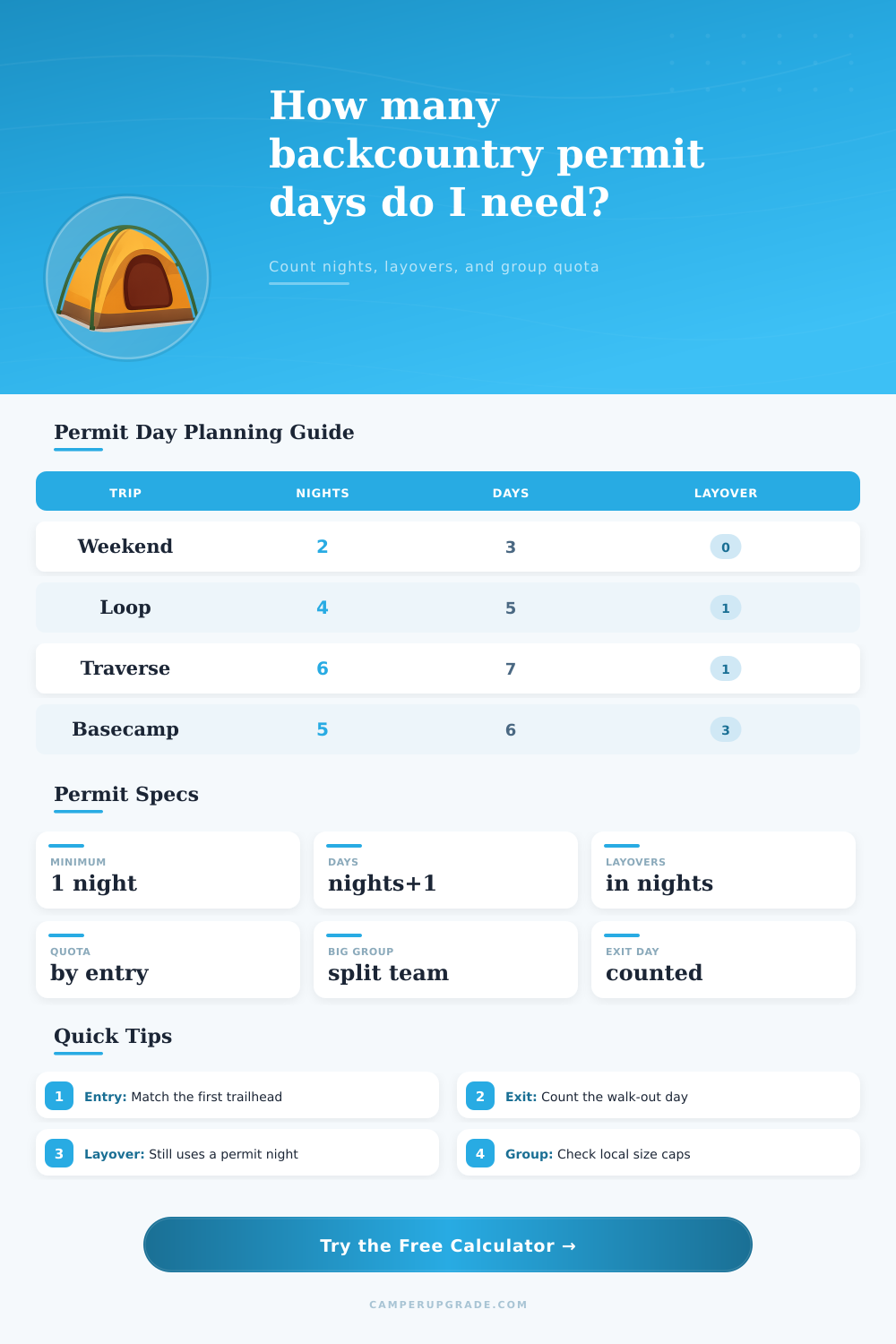
| Nights | Permit Days | Typical Use | Date Check |
|---|---|---|---|
| 0 nights | 1 day | Day registration | Same exit |
| 1 night | 2 days | Quick overnight | Next-day exit |
| 2 nights | 3 days | Weekend loop | Two camp nights |
| 4 nights | 5 days | Short traverse | Four overnights |
| 7 nights | 8 days | Long route | Full week out |
| Permit Type | Controls | Most Important Date | Watch Point |
|---|---|---|---|
| Trailhead quota | Entry slots | Entry date | Wrong first trailhead |
| Camping zone | Nightly zone capacity | Each camp night | Layover zone capacity |
| Named campsite | Specific sites | Every itinerary night | Site order mismatch |
| River corridor | Launch or segment | Launch date | Takeout timing |
| Self issue | Registration record | Entry date | Emergency contact data |
| Layover Nights | Trip Effect | Permit Effect | Itinerary Note |
|---|---|---|---|
| 0 | Move daily | No extra static camp | Simple route |
| 1 | Rest or summit day | Same campsite twice | Name same zone |
| 2 | Basecamp focus | Higher zone demand | Check stay limits |
| 3+ | Long basecamp | May hit max stay | Review agency rules |
| Weather buffer | Contingency | May require approval | Do not assume free |
| Group Setup | People | Stock | Permit Review |
|---|---|---|---|
| Solo or pair | 1-2 | 0 | Usually simple |
| Small group | 3-6 | 0 | Common cap fit |
| Large party | 7-12 | 0 | Check split rule |
| Stock assisted | 2-8 | 1-12 | Separate stock cap |
| Youth crew | 8-15 | 0 | Permit may require split |
💡Permit Day Tips
Planning a backcountry trip require an understanding of the difference between permit days and permit nights. The reason behind the need to distinguish between permit days and permit nights is due to the different ways in which land management agency calculates each. A permit day consist of the day that a group enters a specific zone and the day that a group exits a specific zone.
A permit night is the length of time that a group sleep within a specific zone. The land management agency will count the entry of a group into a zone with the agency as a permit day, therefore, a backcountry trip that consists of three permit nights may require four permit days for that group. Both the permit days and the permit nights for a backcountry trip must be accurately calculated in order to submit a valid permit application.
Permit Days and Nights for Backcountry Trips
The entry zones for a trip are important to understand because most entry zone have quotas that are set for how many individuals can enter a specific zone on a specific date. Most land management agencies will limit the number of individuals that enters a zone at the first trailhead or boundary of that zone. These limits are more restrictive for entry zones than they are for exit zones for that specific land management area.
If a group enters a specific zone, that group will have to adhere to the quota for that entry zone. Even if that group does not enter the exit zone for that land management area, they will need to have a permit to enter through the entry zone. Layover nights for a backcountry trip are nights that a group stays in the same location on the trip.
During a layover night, a group consume a unit of capacity in the zone in the same way that a moving night for that group would consume that unit of capacity. Land management agencies often place limits on how many nights a group can remain in one area, which is often set to prevent the overconsumption of capacity by a group that spends many layover nights within one specific zone. It is important for each group to track their layover nights for a trip to ensure that their trip does not exceed the maximum number of nights that they are allowed to be in one area.
A trip with many layover nights will appear differently on a permit application then a trip with many moving nights, even if the total number of nights for the trip is the same. Group size for a backcountry trip can have an impact upon the permit application form that is submitted to the land management agencies. Some land management agencies only count the number of humans within a group for the calculation of group size.
Other land management agencies count the number of humans and stock animal that are included in the group. For example, a group of eight hikers and four horses may exceed the capacity for a specific zone, even though a group of eight hikers would not exceed the capacity for that zone. If a trip is established to have a group size that exceeds the quota for a zone, then the trip can be adjusted to reduce the group size, or the group can be split into two separate groups for the permit application.
Off-trail travel for a backcountry trip can make the permit application more complex for the land management agencies. If a backcountry trip includes off-trail travel, the land management agencies will require the trip to include more specific descriptions of the zones that will be traveled, as well as the movement that will occur for that trip. Trips that include off-trail travel will often require extra time to ensure that the names and boundaries of the land management areas are correctly entered into the permit application.
Off-trail travel for a group makes the permit application more complex, thus extra time is needed to account for that type of travel. Weather buffers for a backcountry trip are used to account for the potential of bad weather for that trip. Trip plans may include weather buffers to account for storms that may prevent a group from moving to a specific location on the trip.
Land management agencies may consider these weather buffers to also account for the capacity of the zones for that trip. Some land management agencies may trim weather buffers for a trip when they are reviewing the permit applications. Therefore, it is important to account for weather buffers for a backcountry trip.
Common mistakes occur in the submission of permit applications for backcountry trips. Many people make mistakes with the understanding of the relationship between permit days and permit nights. For instance, many people may believe that the day that a group exits a specific zone will not be counted as a permit day for that group.
Many people may not account for layover nights when calculating the number of units of capacity that will be used for their trip. Additionally, many people may enter the wrong trailhead for their trip because they are focused upon the exit trailhead for that trip. These mistakes can often be avoided by performing a check upon the calculations for days and nights in a permit application.
The reference tables and the calculator can be used to verify the permit information that is to be submitted with the permit application. The reference tables can be used to determine the relationship between the number of nights, days, and layover nights for a trip. The calculator can help to determine the number of permit days, nights, and the impact that group size and layovers may have upon a permit application for a backcountry trip.
The information that is entered into a calculator should match the information for the trip that is to be undertaken. Additionally, the numbers that are entered in the calculator should follow the rules for the land management agency for which the permit is to be obtained. If the numbers match the backcountry trip that is to be undertaken, and if the numbers follow the rules for the land management agency, the land management agency is more likely to approve the permit application.