Backcountry Macro Split Calculator
Plan trail calories and daily carb, fat, and protein grams from trip length, body weight, pack load, intensity, altitude, cold exposure, macro strategy, and food density.
🏕Macro Trip Presets
⚙Inputs
📊Spec Grid
📘Reference Tables
| Macro split | Carbs | Protein | Fat |
|---|---|---|---|
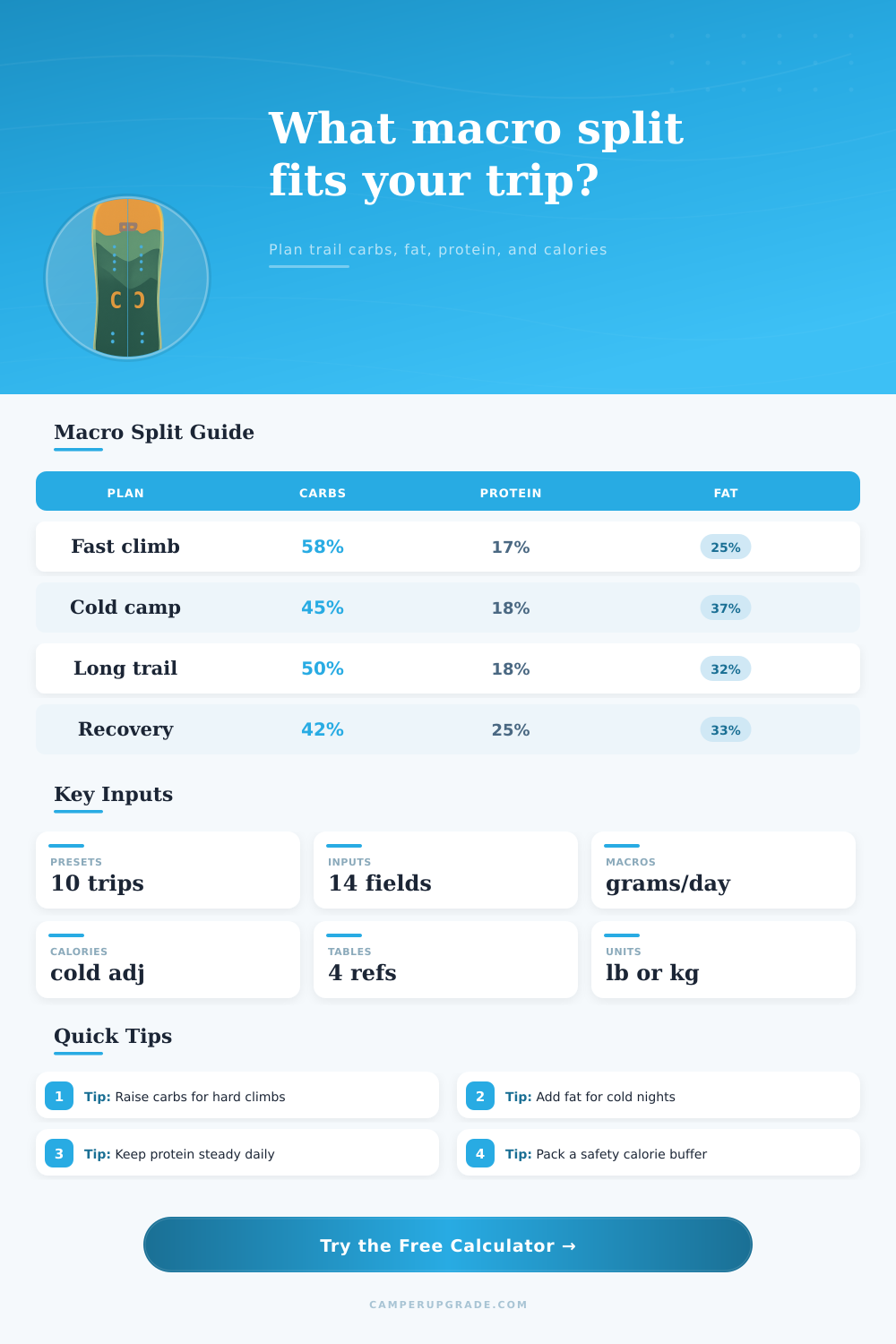
| Balanced backpacker | 50% | 18% | 32% |
| High-carb climbing | 58% | 17% | 25% |
| Cold high-fat | 45% | 18% | 37% |
| Recovery protein | 42% | 25% | 33% |
| Ultralight dense | 44% | 16% | 40% |
| Condition | Factor | What changes |
|---|---|---|
| Camp and short walks | 0.88x | Lower moving time and light effort. |
| Steady backpacking | 1.00x | Normal loaded trail day. |
| Hard climbing day | 1.14x | More carbs and total calories help pacing. |
| Technical mountain day | 1.24x | Rough terrain and stop-start movement. |
| Snow or winter load | 1.30x | Soft footing, layers, and cold exposure. |
| Daily calories | 50/18/32 grams | 58/17/25 grams | 45/18/37 grams |
|---|---|---|---|
| 2,500 kcal | 313 C / 113 P / 89 F | 363 C / 106 P / 69 F | 281 C / 113 P / 103 F |
| 3,000 kcal | 375 C / 135 P / 107 F | 435 C / 128 P / 83 F | 338 C / 135 P / 123 F |
| 3,500 kcal | 438 C / 158 P / 124 F | 508 C / 149 P / 97 F | 394 C / 158 P / 144 F |
| 4,000 kcal | 500 C / 180 P / 142 F | 580 C / 170 P / 111 F | 450 C / 180 P / 164 F |
| Food density | kcal/oz | kcal/100 g | Trail meaning |
|---|---|---|---|
| Bulky low-fat meals | 90-110 | 317-388 | Heavy but easy to eat. |
| Mixed backpacking food | 115-135 | 406-476 | Common planning range. |
| Nut-heavy food bag | 140-160 | 494-564 | Compact, higher fat. |
| Very high density | 165-190 | 582-670 | Oil, nut butter, chocolate heavy. |
This calculator is a planning tool for healthy adults. Medical conditions, altitude illness, appetite loss, diabetes, pregnancy, and extreme cold can require individualized nutrition advice.
💡Backcountry Macro Tips
In planning a trip, you will have to select a specific balance of carbohydrate, fats, and protein. A proper balance of carbohydrates, fats, and protein will ensure that you have enough energy for your movement. Additionally, a proper balance of carbohydrates, fats, and proteins will allow your body to function in the different environment that you encounter on your trip.
People often makes the mistake of choosing a single calorie number for each day of there trip. However, the calorie number for one day may not be sufficient for the requirements of the different environments on the trip. For example, sleeping in cold temperatures may require a higher calorie number because your body burn more calories to maintain its heat while sleeping.
Plan Your Food and Calories for a Trip
Additionally, if the pack weight that you will be carrying are heavy, you will require more energy. The more energy that you require to move your sleeping pack, the more energy your body will expend with each step that you take. The same is true for the number of hour that you move during the day; moving longer distance requires more energy then sleeping for hours.
The ratio of carbohydrates, fats, and proteins will be a critical part of the energy that your body will burn during your trip. Carbohydrates will be useful for your long climb because they provide fast energy to your body. Fats will be useful during the cold environment because fats contain more calories per ounce than other nutrients, and because fats will allow you to carry a smaller bag of food.
Protein is necessary for the repair of your muscles, but it isnt the most efficient source of energy for your body. The reference table will help you to understanding how the percentages of carbohydrates, fats, and proteins will work for the different type of trips that you can take. The density of the food that you eat is another variable that you will have to consider when planning your trip.
Food density is the amount of energy that is contained within a certain volume of food. If the food that you choose have low density, you will have to carry a large volume of food. This could make your pack feel bulky.
The density input will allow you to see if the foods that you choose will allow you to meet your calorie goal without having to carry a large volume of food. This will be especially useful if you want to maintain a low pack weight or if you have to fit all of your food within a bear can. The calorie plan that you create for your trip does not have to be a plan to consume the same number of calories each day.
The conditions on the trip will change; the weather may change, and your appetite may change due to the altitude of where you are sleeping. To provide for these changing variable, a percentage of food is provided as a buffer in case you need more food. This extra food is not provided for no reason, but in case you need it to allow your bodys ability to consume more calories when you are in need of the energy.
A buffer percentage will prevent you from getting too low on the number of calories that you have for the trip. Small change in the environment will have a large effect on your total energy needs. For example, if the overnight temperature change by a few degrees, this could change your cold factor.
Additionally, if the sleeping altitude changes, this may change your appetite. These small changes to the trip may seem small, but they will have a larger effect on your body over the course of a week’s trip. The calculator will allow you to see the effect of these changes.
The calculator will give you a starting point for your energy need for the trip. However, the calculator cannot provide for the way that you will feel on the trip. For instance, some people requires more snacks than others.
Your appetite and your ability to sleep in the cold is something that the calculator cant provide for. The calculator will allow you to make a plan that work with your environment, but you will have to observe whether or not the plan works for your body when you are on the trip.