Backcountry Hydration Per Hour Calculator
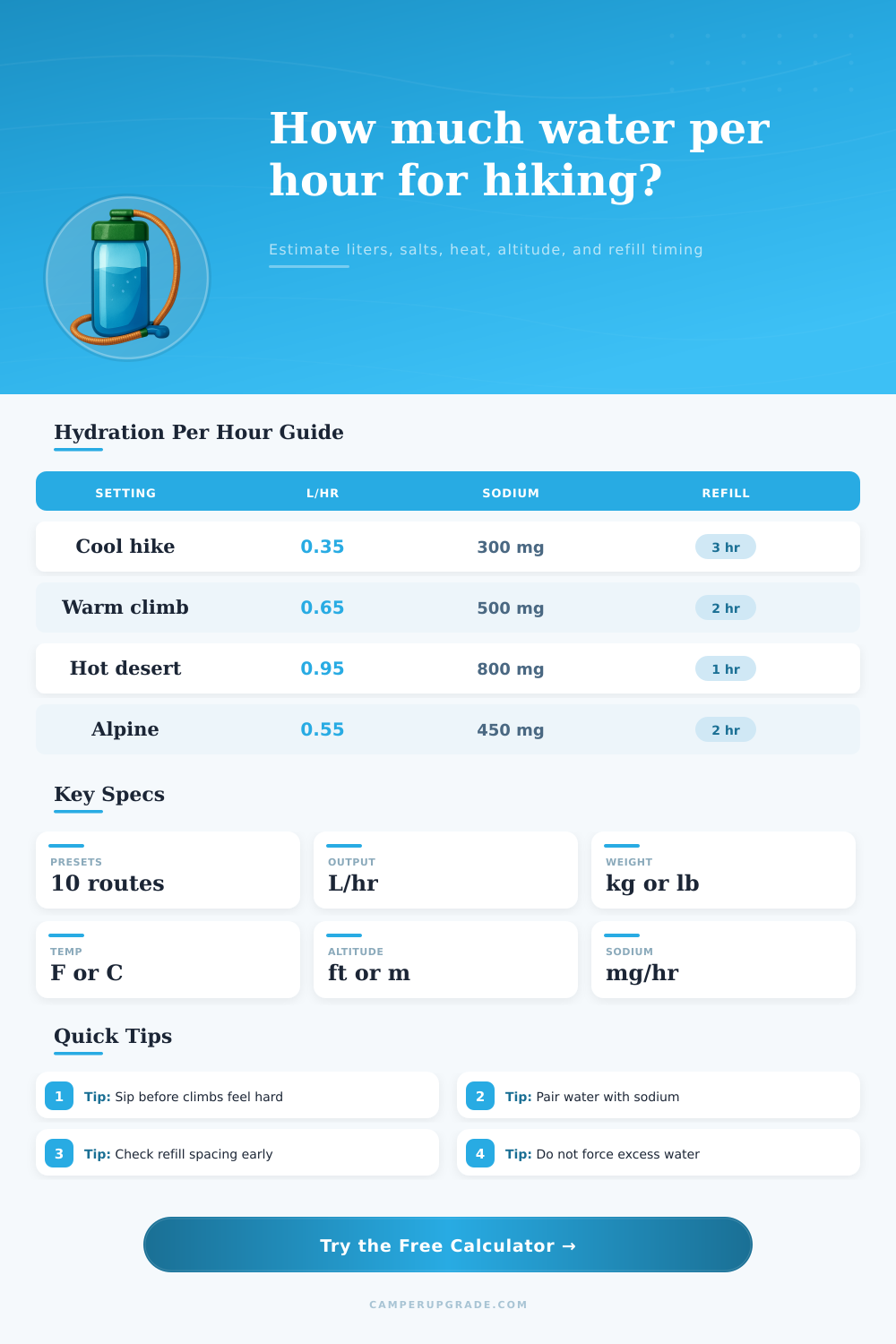
Estimate liters per hour, total carry water, electrolyte sodium, refill timing, and heat adjustment from body weight, temperature, humidity, intensity, altitude, pack load, and route time.
🏕Hydration Presets
⚙Inputs
📊Spec Grid
📘Reference Tables
| Intensity | Base L/hr | Use Case |
|---|---|---|
| Easy | 0.28-0.38 | Cool forest, gentle grade, light load. |
| Steady | 0.42-0.58 | Normal backpacking pace on mixed trail. |
| Climb | 0.58-0.78 | Long uphill or exposed ridge work. |
| Hard | 0.72-0.95 | Fast hiking, trail running, or heavy heat. |
| Heat Index | Factor | Field Note |
|---|---|---|
| Below 60 F | 0.92x | Do not skip water in cold dry air. |
| 60-79 F | 1.00x | Normal hiking water range. |
| 80-94 F | 1.15x | Drink earlier and shade breaks matter. |
| 95 F plus | 1.35x | Consider route timing and turnaround limits. |
| Sodium Level | mg/L | When Useful |
|---|---|---|
| Light | 350 | Short cool hikes with food nearby. |
| Moderate | 500 | Most backpacking days. |
| Salty | 700 | Visible salt marks or hot climbing. |
| Ultra | 900 | Long hot efforts with trained fueling. |
| Carry Water | Weight | Planning Meaning |
|---|---|---|
| 1 L | 2.2 lb | One bottle or small bladder segment. |
| 2 L | 4.4 lb | Common half-day carry in mild weather. |
| 3 L | 6.6 lb | Dry stretch or warmer exposed terrain. |
| 4 L | 8.8 lb | Heavy carry; verify refill assumptions. |
This calculator is a planning estimate for healthy adults. Medical conditions, heat illness risk, medication, acclimation, and water availability can change a safe plan.
💡Backcountry Tips
Managing your water balances is a necesary task when hiking for long periods. However, managing your water balance correctly will ensure that your hiking trip remain smooth rather than difficult to manage. Many people use rough estimate to determine the amount of water they need for there hike.
These estimates can be inaccurate because the temperature may have increased, the terrain may have become steeper, or the distance between water sources may have become longer than they had estimated. The amount of water you need for your hike will depend on the specific condition that you will face on the trek. The amount of water that you need can be measured on an hourly basis.
How much water to carry on a hike
Your body weight will impact the amount of water that you need because the more mass your body mass is, the more heat that your body will produce. Consequently, you will need to consume more water when your body weight are greater. The amount of weight that you are carrying on your hiking pack will also impact the amount of water that you need to consume.
The more weight that you have to drag along with you on the trek will affect the amount of physical work that your body must perform. Thus, if you are performing more physical work, you will require more water. Factors like the temperature and the humidity will affect the rate at which you will sweat.
Similarly, your altitude will affect the level of water loss that you experience through breathing. The calculator that has been developed for hiking trips can account for all of these variables. This tool will handle all of the calculations for you to determine your water needs without having to guess at the value of these different variables.
Another variable that you can account for is your individual rate at which you sweat. This variable is often overlooked when people attempt to calculate their needs for hiking trip. However, the rate at which different people will sweat can differ significant.
Some individuals will tend to sweat more than others. Your body will tend to release more salt when you are losing more water through sweating. Your sweat tendency will allow you to account for these differences so that you dont have to use an average rate for your bodys water loss through sweating.
Once you have set your rate at which you will drink water hourly, the tool will calculate the length of your hiking segment that you will refill your water for, as well as calculate how much water you should carry as a reserve for times when you may become dehydrated. The amount of electrolytes that you consume will have to be calculated in the same way as the amount of water that you consume. For instance, replacing sodium in your body is important, but only in relation to the total volume of fluid that you are losing from your body.
A moderate amount of sodium will be sufficient for most hiking trips, but it is also possible to increase the target amount of sodium that you consume if the hike is in hot environment or if it also includes significant physical exertion while on the hike. The tool will calculate the amount of sodium by multiplying the sodium concentration that you choose by the rate at which you will drink water on your hike. The drinking style allows you to set the rate at which you will take sips of water while on your hike.
This ensures that you wont have to think about the physiology of your body and hydration while on the hike. While the total amount of water that you will drink on your hike is a crucial value to calculate, it isnt the only number that is important. You may need significantly more water for your hike when you start in the cool of the morning, but you may need to drink significantly more water in the hot afternoon of your hiking trip.
Thus, it is best to calculate your water needs for the longest dry segment of your hike first. Then, you can calculate the total amount of water that you need to carry on your hiking trip based on that determined length of dry segment. This reserve percentage will help you in the case that your hiking trip will last longer than you had originally planned for.
It will also be helpful should you encounter dry water source on the hike. Finally, it is important to recognize that cold weather will impact the amount of water that you should drink on your hike. With the low temperatures on the hike, you may think that you do not need to drink much water.
However, you will lose fluids due to the dry air and the clothing that you wear when hiking in the mountains. The water calculator accounts for these fluid losses by ensuring that the temperature factor does not lower the hourly water rate to a point that would suggest that you should carry less water on your winter hiking trip than you would of otherwise need. It would be easy to make an error in setting the amount of water that you should carry for such trips due to the cold temperatures, so the calculator accounts for this.
The reference tables that are provided for your hiking trip will allow you to see what percentage of the hike corresponds to each of the factors that is accounted for in the calculator. These tables are not meant to replace the calculator, but they will provide you with a general idea of how each of your variables may impact the total amount of water that you will drink on the hike. Should you run a few scenario with the calculator for different variables, you can identify the impact that each variable has on your bodys water balance.
This will allow you to make adjustments to your water consumption while on the hike. The goal of the calculator is to help you determine an appropriate amount of water to carry on your hiking trip. This tool will provide a method for you to reach that goal.