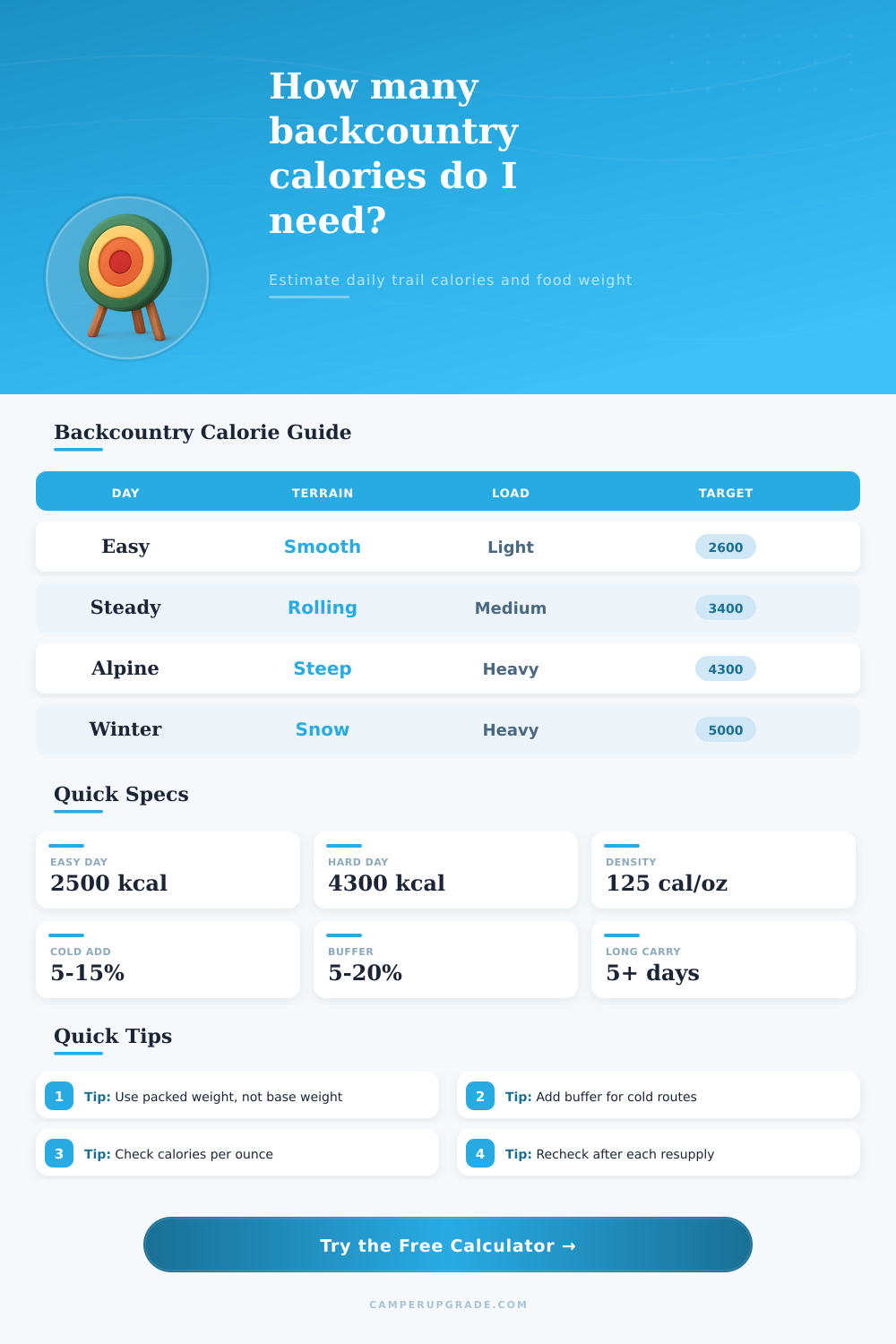
Backcountry Calorie Target Calculator
Estimate daily trail calories, full-trip food energy, calorie-dense food weight, and resupply risk from body size, pack load, route effort, weather, altitude, and safety buffer.
🏕Backcountry Calorie Presets
⚙Calorie Planning Inputs
📊Backcountry Calorie Spec Grid
📋Terrain Energy Reference
| Terrain setting | MET value | Typical route | Calculator effect |
|---|---|---|---|
| Smooth maintained trail | 4.6 | Good tread, modest obstacles, predictable footing | Lower moving calorie rate for efficient walking. |
| Rolling trail with roots or rocks | 5.4 | Normal backpacking tread with frequent small obstacles | Balanced default for three-season backpacking. |
| Steep trail or talus sections | 6.4 | Long climbs, rough switchbacks, talus, or loose tread | Raises moving calories before climb work is added. |
| Off-trail navigation | 7.4 | Bushwhack, route finding, sidehilling, or slow scrambling | Higher effort for slower, less efficient movement. |
| Snow, sand, mud, or scree | 8.5 | Soft surface travel where each step costs more energy | Highest setting for poor traction and deep footing. |
🥜Food Calorie Density Table
| Food pattern | Calories per ounce | Calories per 100 g | Best use |
|---|---|---|---|
| Low-density fresh or wet foods | 60 to 90 | 210 to 320 | Short first-day carries, basecamp extras, or appetite variety. |
| Mixed grocery backpacking food | 100 to 120 | 350 to 425 | Common range for oatmeal, tortillas, bars, dinners, and snacks. |
| Dense trail menu | 125 to 145 | 440 to 510 | Good target for multi-day routes with nuts, oils, powders, and dry meals. |
| High-fat expedition style | 150 to 180 | 530 to 635 | Useful in cold or very long carries when appetite supports it. |
| Very dense specialty mix | 180 to 220 | 635 to 775 | Mostly oils, nut butters, chocolate, or concentrated trail foods. |
| Condition | Multiplier | When to use | Planning note |
|---|---|---|---|
| Mild | 0.98 | Sheltered, cool, low wind | May slightly lower the full-day target. |
| Normal | 1.00 | Typical three-season weather | No weather adjustment beyond route effort. |
| Cool or windy | 1.05 | Chilly ridges or long exposed travel | Adds a modest thermoregulation buffer. |
| Cold shoulder season | 1.10 | Near-freezing mornings or wet cold | Raises total target enough to matter over days. |
| Winter or heat stress | 1.15 | Winter cold, deep snow, or very hot exposed travel | Use when conditions increase fatigue and food needs. |
| Route type | Daily kcal | Food/day | Common issue |
|---|---|---|---|
| Easy overnight | 2400 to 3000 | 1.2 to 1.6 lb | Overpacking dense foods for a short route. |
| Steady weekend | 3000 to 3800 | 1.6 to 2.1 lb | Snacks may be enough, dinner may not. |
| Alpine climbing days | 3800 to 4800 | 2.0 to 2.6 lb | Underestimating elevation gain and rough tread. |
| Winter or off-trail | 4500 to 5600 | 2.4 to 3.2 lb | Low appetite can hide a real calorie gap. |
💡Backcountry Calorie Tips
This calculator estimates food energy for outdoor planning. Individual needs vary with age, sex, training, altitude response, health, body composition, sleep, hydration, and total menu quality.
Planning food for your trip requires you to calculate the amount of energy your body will burn during your trip. You must calculate how much energy your body will burn because if you dont burn enough energy during your trip, you will not have enough fuel to perform the tasks that you need to accomplish with your body. However, if you burn too much energy, you will have to carry too much weight with you into the backcountry to provide fuel for your body.
To calculate the amount of energy that your body will burn during your trip, you will need to input several specific piece of information into the calculator. Your body weight will be one of the factors that you will need to calculate the amount of energy that your body will require to perform the task that you will perform each day. The weight of your pack will be another of the factors that determine the amount of energy that your body will burn.
How to Plan Food for Your Trip
Your hours and distance that you will travel will be third factor that you must include in your calculations for energy needs. The elevation gain that you will travel will be another of the factors that you must enter into the calculator. Finally, the terrain that you will travel will be the last factor that your body must include in the calculations for energy needs.
Each of these factors will allow the calculator to account for environmental factors such as the weather and the altitude of the area that you plan to travel to. Factors such as cold weather will cause your body to lose heat, which will lead to an increased amount of energy that your body requires to perform the tasks that you will perform throughout the trip. High altitudes will reduce the efficiency of the oxygen that your body use, which will change the way that your body processes it’s energy.
Additionally, including a safety buffer in your calculations will allow for extra calories for the case that you may encounter some unexpected change in your trip. Based off all of these factors, the calculator will provide you with a target calorie intake for the day and for your trip in total, and it will also show you the weight of the food that you will need to consume to meet those calorie targets. The coverage check will allow you to determine if the weight of the food that you plan to carry is enough to meet your calculated energy needs.
If the coverage check indicate that the food weight that you plan to bring is not enough to meet your energy needs, you will need to select food items with high calorie density, such as nut or oils. However, if the food weight that you plan to carry indicates a surplus for your energy needs, you can always remove some of that food weight from your plans to reduce your fatigue while traveling. The calorie density of the foods that you select will determine the amount of calories that each specific weight of food will contain.
Foods that you can find in the grocery store will contain a relatively low amount of calories per unit of weight of that food; between 100 and 120 calories per ounce. Foods like nut butters and chocolate will contain a higher amount of calories per unit of weight. Therefore, if you wish to minimize the amount of weight that you must carry on your body, you should select foods that have high calorie density.
However, you may opt for foods with lower calorie densities if you are planning for short trip. Finally, while the calculator can help to provide you with an estimate of the amount of food that you should consume on each of your trip, various individual factors will impact the way that your body utilize the energy that you consume with the food that you eat. Factors like your sleep quality, your hydration levels, and your metabolic rate will change the amount of energy that you feel that you have during your trip.
Some individuals will require more food than the calculations indicate, but many will require less food than the calculations indicate. Therefore, use these calculations as a starting point for your food planning for the trip, but adjust the amount of food that you plan to carry after your first few days on the trip. Your goal is to find a balance between carrying enough food to remain fueled throughout your trip, but not so much food that the weight of that food become a problem for your travel.