Awning Shade Angle Calculator
Estimate shade reach, side drift, awning pitch, and chair or table coverage from awning geometry and current sun angle.
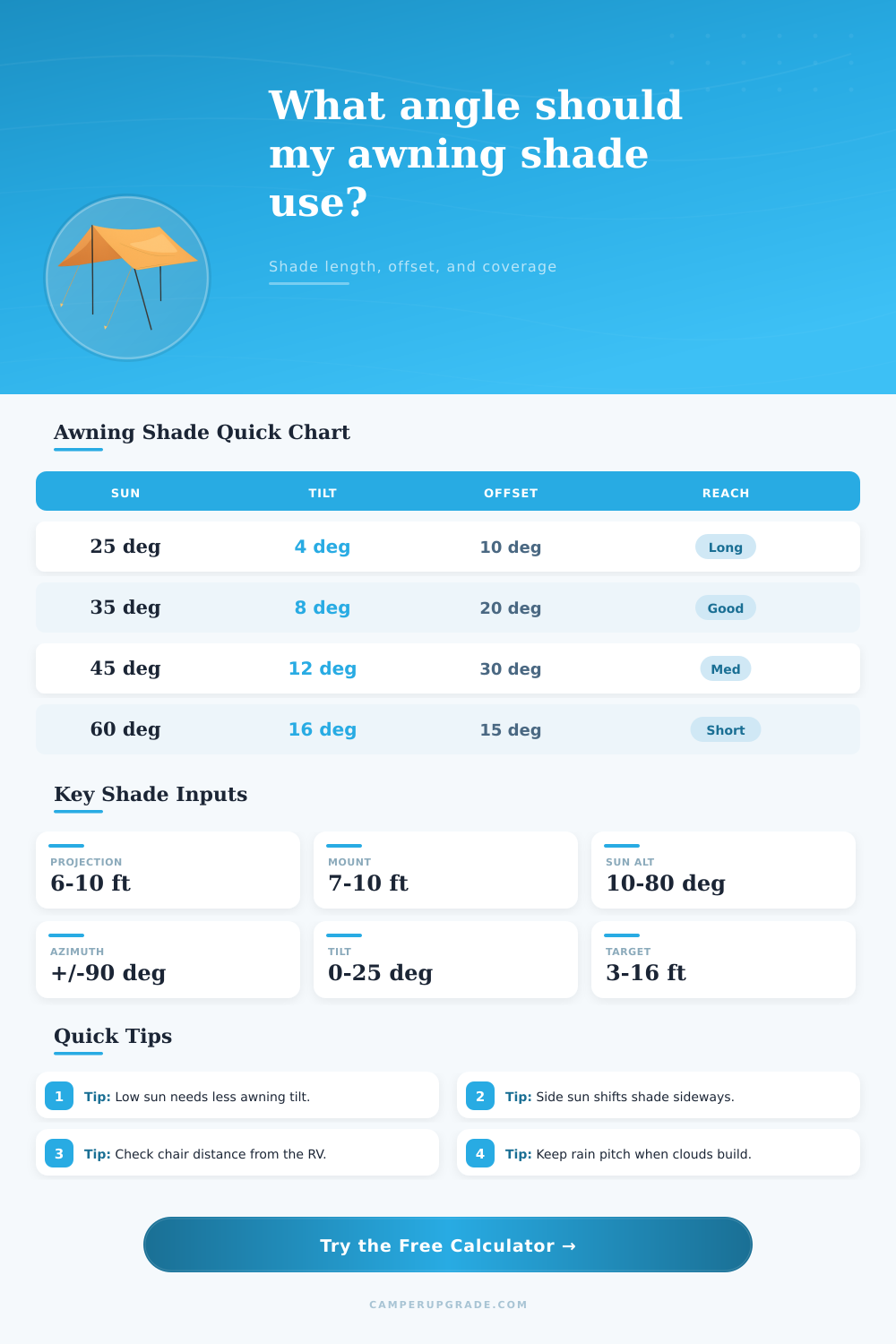
| Sun altitude | Shadow behavior | Best awning pitch | Coverage note |
|---|---|---|---|
| 10-20 deg | Very long reach | 0-6 deg | Expect strong side drift |
| 20-35 deg | Long practical shade | 4-10 deg | Good chair coverage |
| 35-55 deg | Medium shade depth | 8-14 deg | Table near awning edge |
| 55-75 deg | Short high-sun shade | 10-18 deg | Move seating inward |
| 75+ deg | Mostly under fabric | 12-20 deg | Projection matters most |
| Azimuth offset | Shade offset | Width effect | Setup adjustment |
|---|---|---|---|
| 0-10 deg | Minimal | Nearly centered | Use normal layout |
| 10-25 deg | Small drift | One chair may shift | Center table slightly |
| 25-45 deg | Clear side shift | Outer chair exposed | Rotate seating group |
| 45-70 deg | Large side throw | Awning width matters | Add side shade panel |
| 70-90 deg | Mostly sideways | Depth reach drops | Move under the fabric |
| Awning tilt | Front drop on 8 ft | Shade reach effect | Use case |
|---|---|---|---|
| 0 deg | 0.0 ft | Longest front-edge shadow | Dry shade check |
| 5 deg | 0.7 ft | Slightly shorter reach | Light pitch |
| 10 deg | 1.4 ft | Moderate reach loss | Common RV setup |
| 15 deg | 2.1 ft | Shorter but stable runoff | Rain-ready pitch |
| 20 deg | 2.7 ft | Much shorter shadow | Steep storm pitch |
| Target setup | Typical distance | Target width | Good shade goal |
|---|---|---|---|
| Single camp chair | 5-7 ft | 4 ft | 80%+ coverage |
| Two chairs | 7-9 ft | 6 ft | 75%+ coverage |
| Table lunch | 8-11 ft | 6-8 ft | 70%+ coverage |
| Family mat | 9-13 ft | 8-10 ft | 60%+ coverage |
| Low evening sun | 10-16 ft | 6-10 ft | Use side offset check |
Getting the shade right at a campsite requires understanding both how the sun move and how the awning sit relative to the ground. You must understand how the sun move and you must understand how the awning sit relative to the ground in order to be able to decide where to sit. If you dont understand how the sun move and how the awning sit relative to the ground, you may end up either too hot or too cold at the campsite.
An awning does not create a shade area in the shape of a perfect rectangle. Instead, the awning creates the shade that is based off the angle of the awning fabric. The sun will create a shadow from the front edge of the awning.
How the Sun, Awning and Ground Affect Shade
The length of that shadow may change according to the time of day that the RV is parked. For instance, in the mornings and evenings when the sun is near the horizon, the sun will create long shadows. However, if the sun is located to one side of the RV, the shadow will fall in a different direction and may place one awning chair in the shade while leaving another chair in the sun.
The height of the mounting rail for the awning is one variable that can affect the awning. The height of the mounting rail for the awning can affect the amount of spaces that is created under the awning. For example, if the mounting rail is higher off of the ground, the front edge of the awning can drop lower to the ground.
In this case, raising the mounting rail will change the pitch of the awning fabric. In addition to the pitch of the awning, the slope of the ground can also affect the awning. For example, if the ground is sloped, the height of the front edge of the awning relative to the ground can change if the RV is parked with the nose of the RV pointed up or down the slope.
Thus, the slope of the ground will impact the shade that the awning provides. The angle at which the awning is pitched will effect the amount of shade that is provided to those underneath the awning. A flat awning will provide the maximum amount of shade to those standing under the awning during clear days.
A flat awning, however, does not allow for water to run off of the awning or for the awning to resist the wind. An awning that is pitched to allow for water to run off and for the awning to better resist the wind will reduce the reach of the shade provided by the awning. Additionally, the angle of the awning may need to be adjusted throughout the day.
For instance, the pitch of the awning that provides enough shade for breakfast may not provide enough shade for lunch. Another variable of the awning that can impact the shade that is provided is the side offset of the awning. An awning’s shadow will shift to the left or right of the awning depending upon the angle of the sun.
For instance, if the sun is located along the length of the RV, the shadow created by the awning will not fall directly in front of the RV. Instead, the shadow will drop to the side. An awning that is wider will allow for more tolerance of this shift of the shadow than an awning that is narrow.
Thus, if an RV has a narrow awning, you can add side panels or the awning can be repositioned to provide the shade that is required. The ground slope can interact with both the sun angle and the awning pitch. For instance, if the ground rises away from the RV, the front edge of the awning will be lifted relative to the objects that you want to shade.
Additionally, if the ground drops away from the RV, the shadow will be lengthened. Because the ground at many camp sites is not level with the RV, the sun angle that is experienced by the RV is different then the sun angle that may be expected. Thus, the shade that an awning creates may differ at each campsite due to the difference in the ground slopes at each site.
You should decide where to place the chairs and tables at the campsite prior to determining how far you want the awning to reach the RV. For instance, if you place your chairs and tables close to the RV, those objects will be shaded under different sun angles and awning pitches. However, if you place your tables and chairs farther from the RV, the objects will require more shade from the awning and will be more exposed to the side drift of the shadow created by the awning.
Additionally, a single chair is easier to shade than a long table because the long table will cover a greater width and may move out of the shade created by the awning. You should also check the relationship between your target objects (tables, chairs), the sun position in the sky, and the awning geometry. Many campers will set the awning to the same pitch each time they go camping.
However, that same pitch of the awning may not allow the campers to remain shaded from the sun at all times of the day. If you check the relationship between the distance to your target objects and the sun position, you can prevent the shade from drifting away from you and your campsite. The calculator can help you determine the distance that your awning will need to drop from the RV to provide shade to your campsite.
The calculator will allow you to input the various dimension of your awning and the angle of the sun. The calculator will display to you how much of your seating area will be shaded. Additionally, the reference table will allow you to determine the relationship between the altitude of the sun and the shade coverage that your awning will create.
The shade that your awning creates is not fixed. The shade that you will experience at the campsite is the result of the sun angle, the awning pitch, and the position of the people at the campsite. Thus, to get the shade right, you must take into account each of these different variable.