Arrow Trajectory Calculator
Model drop, wind drift, and holdover with your bow speed, arrow specs, and wind conditions.
🏹Quick Presets
📏Shot Inputs
🧱Arrow Material and Spec Grid
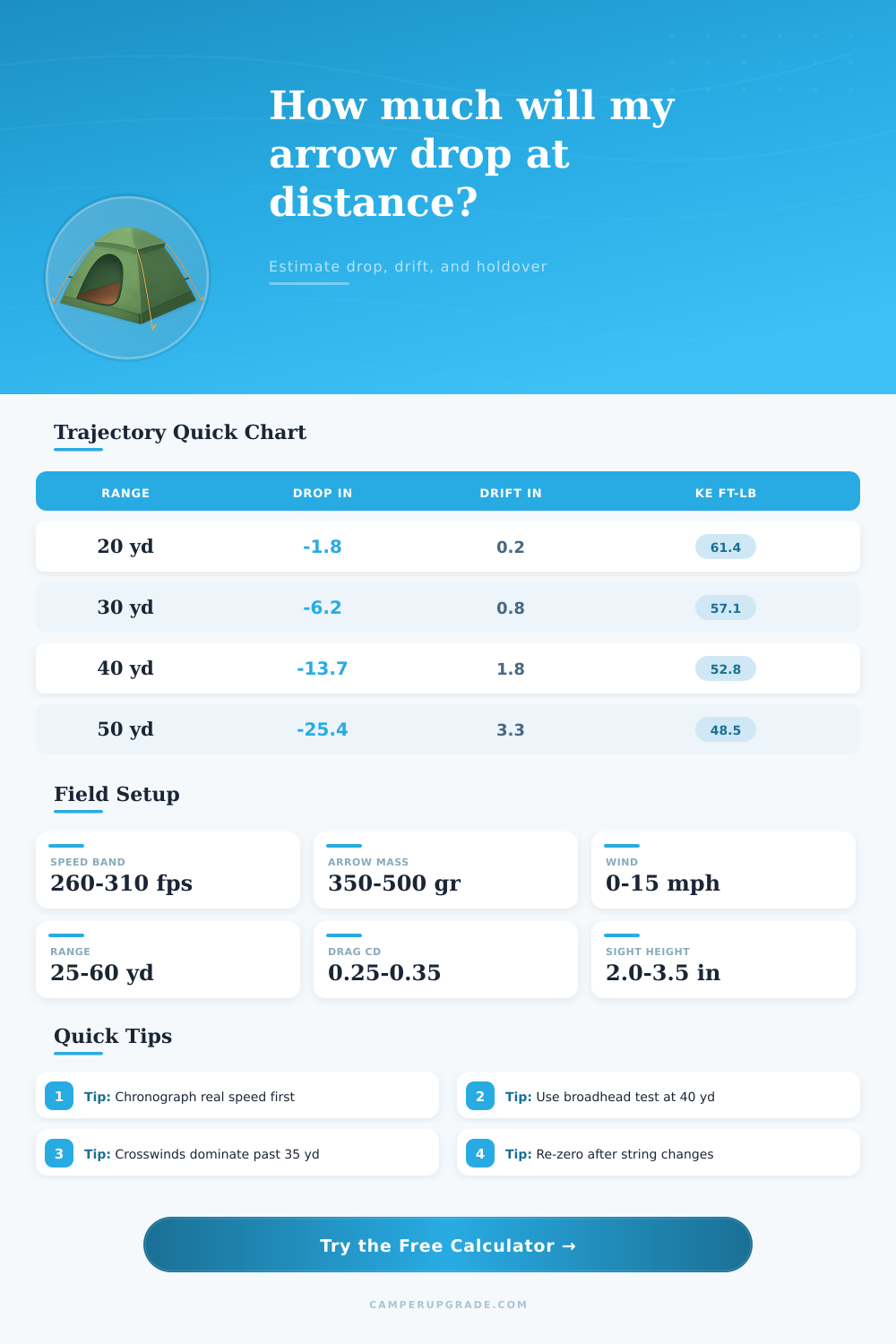
📊Reference Table: Depth of Trajectory by Range
| Range | Typical Drop (in) | TOF Band (s) | Use Case |
|---|---|---|---|
| 20 yd | 1 to 3 | 0.22 to 0.27 | Close timber shots |
| 30 yd | 4 to 9 | 0.32 to 0.39 | Most treestand lanes |
| 40 yd | 10 to 18 | 0.43 to 0.52 | Open trail crossings |
| 50 yd | 19 to 32 | 0.55 to 0.66 | Long practice only |
📐Reference Table: Sight Adjustment Guide
| Distance | 1 MOA Shift | 1 MIL Shift | Rule |
|---|---|---|---|
| 20 yd | 0.209 in | 0.72 in | Fine tune only |
| 30 yd | 0.314 in | 1.08 in | Minor tape move |
| 40 yd | 0.419 in | 1.44 in | Common correction band |
| 50 yd | 0.524 in | 1.80 in | Small errors magnify |
🌬Reference Table: Wind Drift Factors
| Crosswind | 30 yd Drift | 40 yd Drift | 50 yd Drift |
|---|---|---|---|
| 3 mph | 0.4 to 0.9 in | 0.9 to 1.6 in | 1.5 to 2.5 in |
| 6 mph | 0.8 to 1.8 in | 1.8 to 3.2 in | 3.0 to 5.0 in |
| 10 mph | 1.4 to 3.0 in | 3.0 to 5.2 in | 5.0 to 8.4 in |
| 15 mph | 2.2 to 4.4 in | 4.7 to 7.8 in | 7.8 to 12.8 in |
🔥Reference Table: Impact Energy by Arrow Mass
| Arrow Mass | 240 fps | 270 fps | 300 fps |
|---|---|---|---|
| 350 gr | 44.8 ft-lb | 56.7 ft-lb | 69.9 ft-lb |
| 400 gr | 51.2 ft-lb | 64.7 ft-lb | 79.9 ft-lb |
| 450 gr | 57.6 ft-lb | 72.8 ft-lb | 89.9 ft-lb |
| 500 gr | 64.0 ft-lb | 80.9 ft-lb | 99.9 ft-lb |
💡Shot Tips
Knowing the way of arrows is important for you that spend time bowhunting in the woods. Arrows fly in a curved line, and at bigger distances it loses energy, because of what it drops more quickly It dips already a moment after leaving the bow. The archer must send the arrow in a curve to reach the target.
The way of arrow depends only on its speed in any moment. Without wind it stays the same, and its course forms a parabola. Gravity and friction affect the energy of the bowstring just after launch.
How Arrows Fly
Gravity pulls it down, what causes the bending.
The way depends on bow and arrow setup, but usually it starts under the first pin, climbs and crosses it in about 5 yards, goes up more and zeros again in around 20 meters. For long distances the way stays climbing a bit of time, with the highest spot moving more near half of the distnace. In 20 yards with a good bow the maximum height reaches 10 yards, only some inches above the line.
Knowing that way matters for hunting in woods. From a trajectory chart the hunter can learn, that in 60 yards with leaves only 4 feet above the deer, the shot is not possible without a lower shot. In 40 yards the upper foliage and branches are no less than 14.5 inches above the aim point.
In 30 yards and closer it only sinks 4 inches. Knowing the way of arrow allows you to put it over or under blocks between archer and target.
Weight of arrow affects all that. A heavier arrow has more momentum and keeps more of its start speed. Some hunters choose a setup of 550 to 570 grains, but that extra mass causes a higher way.
If tips are heavy and center of mass is too far forward, the arrow necessarily sinks soon at the end of flight. You cannot change the way of arrow without changing something that works on its speed. Different arrows fly differently, so you must practice to feel it.
Rabbits and wild chickens do not flee from arrows. They are best caught with fire-hardened arrows made beside the campfire.