Arrow Penetration Energy Calculator
Compare arrow kinetic energy, momentum, front-of-center balance, shaft drag, impact angle, tune loss, and target backstop margin for archery range planning.
🏹Archery Setup Presets
Your Arrow Energy Snapshot
⚙Arrow, Bow, Impact, And Target Inputs
📊Shaft Material And Spec Comparison
📘Reference Tables
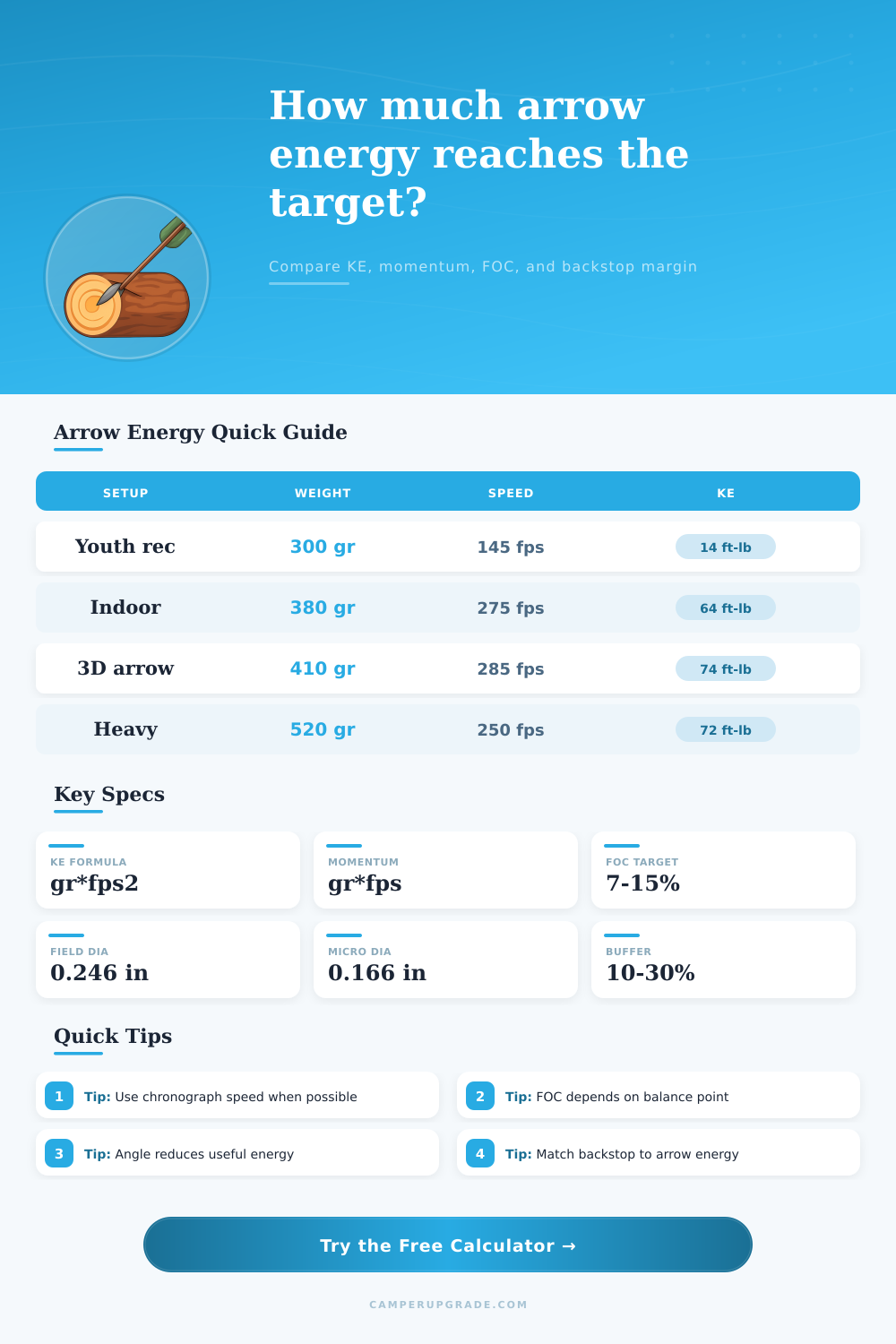
| Archery setup | Typical arrow weight | Typical speed | Approx. kinetic energy | Planning note |
|---|---|---|---|---|
| Youth recurve target bow | 250-350 grains | 120-170 fps | 8-22 ft-lb | Use youth-rated targets and close-range backstops. |
| Traditional longbow or recurve | 400-600 grains | 150-210 fps | 20-55 ft-lb | Momentum can be solid even when speed is moderate. |
| Modern compound target setup | 330-450 grains | 260-310 fps | 50-95 ft-lb | Chronograph actual speed; catalog speed is usually higher. |
| Heavy outdoor carbon setup | 475-650 grains | 230-285 fps | 55-115 ft-lb | Higher momentum and FOC may need stronger target media. |
| Crossbow target bolt | 380-500 grains | 320-420 fps | 85-195 ft-lb | Use crossbow-rated blocks or bolt-specific backstops. |
| Shaft type | Common OD | Drag factor used | Durability note | Best planning use |
|---|---|---|---|---|
| Micro carbon | 0.166-0.204 in | 1.04 | Strong with matched inserts and collars. | Outdoor target lanes and windy ranges. |
| Standard carbon | 0.244-0.246 in | 1.00 | Balanced all-around shaft size. | General compound practice. |
| Heavy carbon | 0.246-0.300 in | 0.99 | Extra wall thickness can raise total mass. | High-momentum range setups. |
| Aluminum | 0.286-0.312 in | 0.94 | Can bend after hard impacts. | Indoor paper and foam lanes. |
| Wood | 0.312-0.344 in | 0.92 | Inspect grain, straightness, and finish. | Traditional practice targets. |
| Crossbow bolt | 0.300-0.346 in | 0.96 | Use bolt-rated nocks and targets. | Crossbow-specific block targets. |
| Point or practice head | Efficiency factor | Drag behavior | Target effect | Calculator note |
|---|---|---|---|---|
| Bullet field point | 1.00 | Smooth profile, low media drag. | Clean entry into foam and bag targets. | Baseline for most target comparisons. |
| Combo field point | 0.98 | Shoulder can add slight drag. | Good general practice option. | Small reduction from baseline. |
| Blunt practice point | 0.76 | High frontal area. | Energy dissipates quickly in safe practice media. | Lower penetration index by design. |
| Judo or spring point | 0.70 | Arms increase drag immediately. | Designed to stop or grab in soft practice areas. | Use only where appropriate and permitted. |
| Fixed-blade practice head | 0.91 | Blade profile raises drag and tune sensitivity. | Needs a compatible foam target. | Good tune matters more. |
| Mechanical practice head | 0.88 | Practice collar or blades add resistance. | Use manufacturer-approved targets. | Check target rating before shooting. |
| Target or backstop type | Planning rating | Energy range | Common use | Inspection note |
|---|---|---|---|---|
| Layered foam or bag target | 75 ft-lb | Low to mid | Recurve and many compound field-point setups. | Retire when arrows pass too deeply. |
| Dense block foam target | 110 ft-lb | Mid to high | Compound target setups and practice heads. | Rotate faces to spread wear. |
| Tight straw bale | 45 ft-lb | Low | Traditional low-energy practice. | Compression and moisture change stopping ability. |
| Commercial rubber backstop mat | 120 ft-lb | Mid to high | Secondary range backstops behind targets. | Hang as specified so it can absorb energy. |
| Sand arrow trap | 160 ft-lb | High | Club range backstop lanes. | Depth and containment matter. |
| Crossbow-rated block target | 190 ft-lb | Very high | Fast crossbow bolts and high-energy setups. | Only use targets rated for bolt speed and energy. |
💡Range Planning Tips
Have you ever shot an arrow into solid piece of foam? Do you remember what kind of sound it made as it pierced through? Well, at first it sound pretty sweet.
However, if you pay attention, you’ll begin to see your backstop swell up from where it was struck. Then, most archer begin considering energy. And most archers’ analysis ends there. It is kinetic energy. The issue is most archers stop here because foot-pounds is going to reveal to you how hard your arrow strike. Not how well it penetrate.
Understanding Arrow Penetration and Safety
Raw force isn’t everything when it comes to penetration. Geometry and momentum are equally important. If you’d like to know if your set-up will bounce off something dangerous or penetrate something safely, don’t stop with the speed rating on the sticker of your bow. Speed never works as hard for you as weight will.
If you’re addicted to watching chronograph numbers spinning around, that might seem counterintuitivly. Doubling your speed quadruples the kinetic energy. But momentum depend directly on both speed and weight. Often a big arrow at a moderate pace has more forward drive than some feather-weight rocket screaming out of your riser.
The tool on this page compare momentum, front-of-center balance, and kinetic energy. It shows you what your setup really look like in terms of flight stability compared to stopping power. Once your arrow hits its mark, does it continue moving straight? Or does it fish-tail and tumble because its weight distribution are off? If that’s happening, then you’re wasting energy spinning laterally rather than penetrating forward.
Ideally, most of your target arrows should has a Front of Center (FOC) between seven and fifteen percent, measured from the tip. It doesn’t have to be dead-center; you want enough stability to maintain its trajectory while not making the arrow sluggish and nose heavy in-flight. Achieving this balance isn’t as simple as choosing a thicker arrow shaft: Instead, add some front-end weight with heavier field points or inserts.
Surprisingly, shaft diameter also play a significant part in how much energy makes it through target media. A standard, same-weighted aluminum target shaft will cut through foam easier then a micro-diameter carbon arrow. Even a tenth of an inch difference in outside diameter significantly affect the speed at which your arrow slows down within the block; the calculator takes into account that drag factor. On wider wooden shafts, you’re battling the friction of a larger surface area from the second the point hits the face. It’s a small detail but it also explains why some arrows seemingly stop dead in their tracks while others surprisingly continue on through.
Remember: Tune and impact angle The problem with an arrow that porpoises or yaws is that it’s actualy impacting the target sideways for a split second before straightening out. This burns up the energy you want driving the point forward. The energy are being lost to wobble. If you’ve got scattered groups on your bare shafts, then your field points won’t penetrate as deep either. A five-degree angle off of square greatly reduce its effective stopping power. All that momentum in the world doesn’t mean squat if it isn’t headed straight ahead.
Safety margins aren’t abstract. They’re the difference between a clean practice session and having to replace your backstop. Most “off-the-shelf” foam targets has an energy rating of about seventy-five foot-pounds of energy. Knowing you’re shooting a heavy compound setup pushing the ninety or a hundred mark means every shot you take is eating up that limit at a quicker rate then you might think. Using the included reference tables in the calculator provides some basic planning guides based off different target media types such as dense rubber mats all the way down to loose straw bales.
Check your targets regularly for any rotation and channeling. Worn-out blocks provide less resistance, so arrows will dig deeper into them. This defeats the point of having a safety margin in the first place.
To conclude. Knowing your arrow’s energy profile makes you a better shooter by helping you shoot smarter and safer. It move you away from a number-chasing mindset to a force-managing one. You should of known that knowing how it works helps. Understanding the connection between media, weight and balance puts an end to second-guessing if the next shot is going to be a good one or a bad one. Still, you get that same satisfying thwack on the string, but this time without the “what happened back there?” anxiety behind the target face.