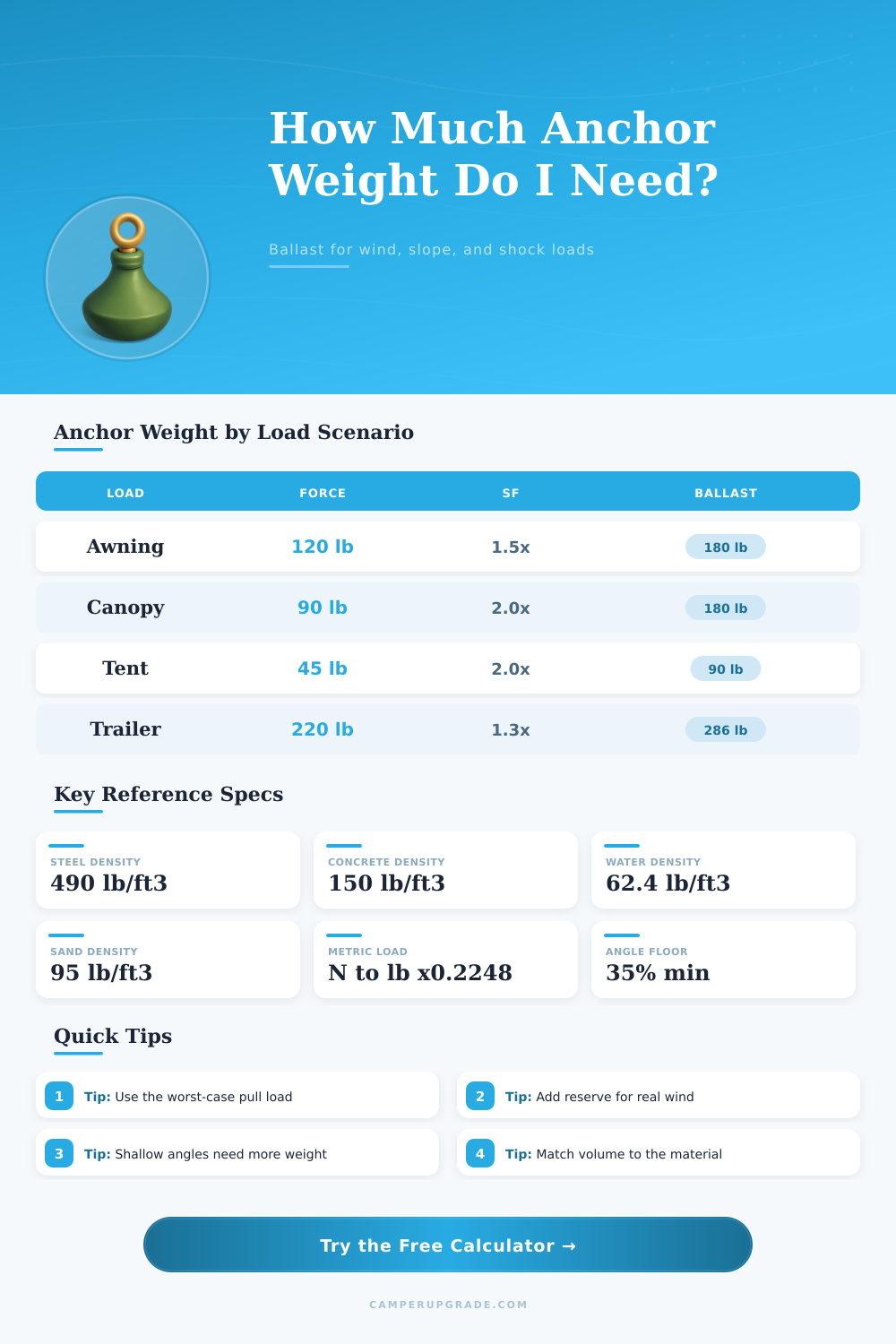
⚓ Anchor Weight Calculator
Estimate the ballast weight needed to resist pull, shock, wind, and slope loads
| Surface | Grip Factor | Holding Mood | Best Match |
|---|---|---|---|
| Dry asphalt | 0.72 | Very firm | Thin plates |
| Broom concrete | 0.68 | Firm | Blocks |
| Packed gravel | 0.52 | Moderate | Sand bags |
| Short grass | 0.43 | Soft | Mixed bags |
| Loose sand | 0.28 | Low | Water fill |
| Wet deck board | 0.24 | Slippery | Steel stack |
| Soft mud | 0.18 | Very low | Heavy block |
| Powder metal | 0.20 | Low | Rubber base |
| Angle | Eff. Factor | Uplift Risk | Use Case |
|---|---|---|---|
| 0° | 1.00 | Very low | Flat ballast |
| 10° | 0.98 | Low | Gentle tie |
| 20° | 0.94 | Low | Awning line |
| 30° | 0.87 | Moderate | Canopy edge |
| 45° | 0.71 | High | Storm hold |
| 60° | 0.50 | High | Ridge line |
| 75° | 0.35 | Very high | Edge case |
| 89° | 0.35 | Extreme | Avoid if possible |
| Scenario | Typical Load | Safety Factor | Notes |
|---|---|---|---|
| Light canopy | 80-120 lb | 1.4x | Short tie |
| Camp awning | 120-180 lb | 1.5x | Wind spikes |
| Screen room | 100-160 lb | 1.7x | Mixed anchors |
| Trailer cover | 180-260 lb | 1.8x | Wide spans |
| Beach tent | 40-90 lb | 2.0x | Loose sand |
| Rooftop tarp | 180-280 lb | 2.0x | Gust exposure |
| Dock line assist | 220-340 lb | 1.6x | Shock loads |
| Market stall | 130-200 lb | 1.7x | Sidewall drag |
| Material | Density | 1 ft3 Weighs | Quick Use |
|---|---|---|---|
| Dry sand | 95 lb/ft3 | 95 lb | Soft bag |
| Wet sand | 110 lb/ft3 | 110 lb | Tighter fill |
| Gravel | 105 lb/ft3 | 105 lb | Drainable |
| Soil | 88 lb/ft3 | 88 lb | Cheap fill |
| Concrete | 150 lb/ft3 | 150 lb | Block weight |
| Water | 62.4 lb/ft3 | 62.4 lb | Portable |
| Steel | 490 lb/ft3 | 490 lb | Compact load |
| Rubber | 75 lb/ft3 | 75 lb | Gentle base |
Anchors is necessary to secure tent, canopies, and tarps to the ground to prevent the wind from moving these structures. If insufficient weight are used for the anchor, then the wind will move the tent, the canopy, or the tarp. An anchor is defined as the weight or stake that is use to hold the structure in place.
The anchor must be strong enough to resist the pull that the wind may exert upon the tent, the canopy, or the tarp. The force that moves the tent, the canopy, or the tarp is referred to as a pull load. The wind create the pull load by hitting the fabric of the canopy or the tent.
How to Choose and Use Anchors for Tents, Canopies, and Tarps
The pull load must be calculate to ensure that the anchor can withstand this force. The pull load increases with the increasing force of the wind. Many times, people makes the mistake of calculating the pull load for steady wind only.
However, it is important to calculate for wind gusts as well, because wind gusts contain more force than steady winds. Using a safety factor will allow for the extra weight of the anchor to compensate for the possible force of the gusty winds. Using a safety factor mean adding extra weight to the anchor to ensure that the anchor will be able to withstand forces greater than the calculated pull load.
The type of surface upon which you place the anchors will affect the weight that you need to use to secure your structure. Using firm surfaces, such as asphalt or gravel, will allow the anchor to exert more friction upon the structure than soft surfaces, like sand or mud. Friction is the force that hold the anchor in place.
The firmness of the surface will allow for less weight to be used for structures on firm surfaces. Soft surfaces, like sand, will allow the anchor to shift or sink into the ground. Therefore, more weight will be require for the anchor to prevent the structure from shifting.
If the angle upon which the lines of the tent or tarp are placed are shallow, meaning close to the ground, then the lines will rely upon friction to prevent the wind from move the structure. For angles that are made up steeply to the point of being greater than 45 degree to the ground, the lines will create an uplift force that will attempt to pull the structure in an upward direction. Therefore, if your lines are made up at steep angles, you will need to use more weight for the anchor to fight against the force of the uplift.
The material that is use to create the weight for the anchor is referred to as ballast. The density of the ballast will affect how much space the ballast will take up to create the required weight. For instance, steel will be very dense and take up little space.
Sand will not be as dense as steel. Water is also a form of ballast that can be used, especially in metal barrels to create heavy anchors for the structure. The ballast that is use should match the environment in which the structure will be erected.
For instance, sandbags can be used on gravel to conform to the shape of the ground. However, steel plates will not slide on a metal roof. There are specific multipliers that should be use to ensure that your anchors are safe.
For exposed locations, use a gust multiplier of 1.4. This means that your calculated load will increase by 40%. On soft surfaces, ensure that you use a reserve of at least 15% of the total weight.
For rooftop tarps, ensure that you use a safety factor of 2.0 because rooftop tarps are at a higher elevation where the wind is more strong. For trailers on asphalt, ensure that you use a safety factor of 1.8. The placement of the anchor is also important.
The anchors should be cluster together. Additionally, the edge of ballast bags should be buried in the ground to prevent them from sliding. Furthermore, prior to erecting your structure, test the anchor by firm tugging on the lines.
If they move, then you must use more weight or a different angle to the lines. Through the calculation of the pull load, the decision of the ballast material, and the use of the safety factor, you will be able to ensure that your anchors will keep your structure secure.