Anchor Scope Calculator
Estimate rode length, target scope ratio, and anchoring margin from depth, bow height, seabed, and weather conditions.
⚓Quick Anchorage Presets
⚙Anchor Setup Inputs
Depth at anchor set point, not dock chart depth.
Vertical bow height above waterline.
Highest expected rise during your stay.
Total deployable rode after splice and stopper limits.
📊Holding And Scope Factor Grid
📘Anchor Scope Reference Tables
| Condition | All Chain | Chain + Nylon | All Nylon |
|---|---|---|---|
| Lunch stop / attended | 4:1 | 4.5:1 | 5:1 |
| Day anchoring moderate breeze | 4.5:1 | 5:1 | 6:1 |
| Overnight fresh breeze | 5.5:1 | 6.5:1 | 7.5:1 |
| Storm prep heavy weather | 8:1 | 9:1 | 10:1 |
| Vertical Distance | Rode At 5:1 | Rode At 7:1 | Rode At 10:1 |
|---|---|---|---|
| 10 ft (3.0 m) | 50 ft | 70 ft | 100 ft |
| 15 ft (4.6 m) | 75 ft | 105 ft | 150 ft |
| 20 ft (6.1 m) | 100 ft | 140 ft | 200 ft |
| 30 ft (9.1 m) | 150 ft | 210 ft | 300 ft |
| 40 ft (12.2 m) | 200 ft | 280 ft | 400 ft |
| 50 ft (15.2 m) | 250 ft | 350 ft | 500 ft |
| Bottom Type | Adjustment | Practical Effect | Anchoring Note |
|---|---|---|---|
| Clean sand | 1.00x | Baseline ratio | Fast set and high holding |
| Soft mud | 0.95x | Slightly lower ratio | Let anchor settle before reverse |
| Clay | 1.05x | Small increase | Set harder to break surface crust |
| Weed or grass | 1.15x | Moderate increase | Use longer scope and reset if skate |
| Rock or rubble | 1.25x | Large increase | Expect uncertain bite and yaw loads |
| Coral or hard pan | 1.30x | Largest increase | Careful retrieval to avoid fouling |
| Scenario | Depth + Bow + Tide | Target Ratio | Recommended Rode |
|---|---|---|---|
| 22 ft cruiser day stop | 12 + 3 + 1 ft | 5.5:1 | 88 ft |
| 30 ft sailboat overnight | 18 + 5 + 2 ft | 7.2:1 | 180 ft |
| 35 ft trawler exposed bay | 24 + 6 + 3 ft | 8.4:1 | 277 ft |
| 40 ft cutter storm prep | 28 + 6 + 4 ft | 10.8:1 | 410 ft |
| Harbor lunch all chain | 9 + 4 + 0 ft | 4.0:1 | 52 ft |
| Reef edge caution set | 20 + 5 + 1 ft | 9.8:1 | 255 ft |
The ankra scope is inherent for flatly ankre anchor the ship. It shows the proportion between the length of the issued ankroŝnuro and the akvoprofundeco. You can it estimate also divide laŭlongiĝon of the line by means of the depth plus the free bank of the ship.
Other mode estimate it is the relation between the amount of string above the water and the height of the bow. For instance, if 25 feet dividiĝas by means of 5 feet you reach 5:1 scope. It is simply the relation between the hipotenuzo and the vertical aspect of triangle.
What Is Anchor Scope and How Much Line to Let Out
Scope does not have units and stay same whether in feet whether in metres… 7:1 in feet match 7:1 in metres.
More scope helps because it reduces the vertical draw on the anchor of the ship. Like this anchor less easily dulls. It allows also that the boat move with the heart.
Waves can be faced more well thanks to long scope that keeps the bow turned against them. Much scope so are useful but too much it causes problems: in gale big scope can leave the ship cry to others in the ankradejo. And big svingradiuso become then dangerous.
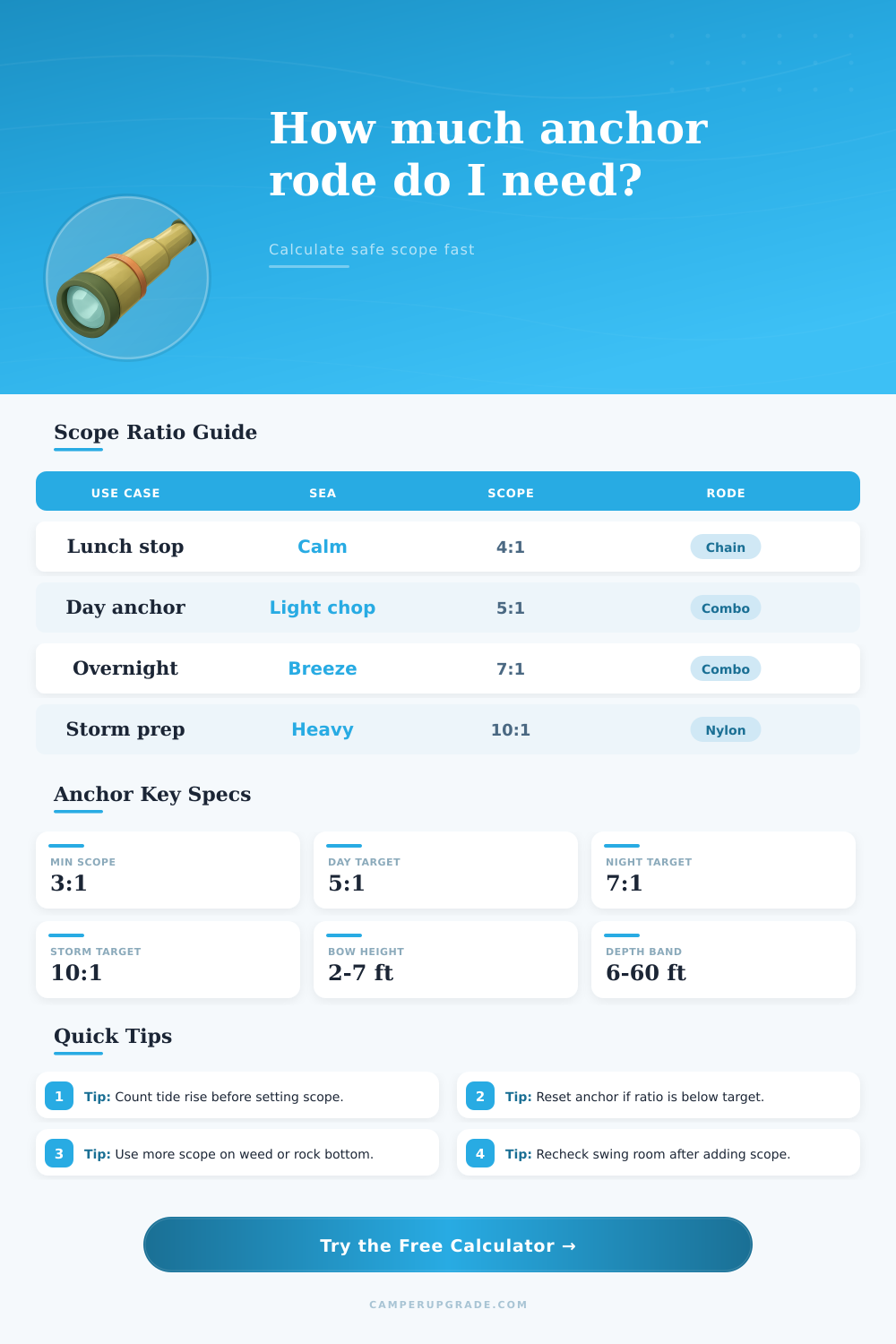
Various rules exist for choose the scope. For all-ĉenaj strings 5:1 answer for usual ankradoj. Sharply stopping you commonly chooses 7:1.
For only some hours 5:1 suffice. Some use 3:1 for calm weathers and short pauses. In heavy weather 10:1 are standard.
For sharp provisions some theories offer 4d+145 m longon. Good weathers require L=3d+90 m. For pontoon windy days multiplii the depth by means of 8 until 10 give the involved ŝnurlongon. 4:1 or 5:1 scope helps to escape that the anchor jump upward.
In 20 feet depth with rugged flow 6:1 until 10:1 will be required so maybe 200 feet of line or more.
The ankra scope is inherent for flatly ankre anchor the ship. It shows the proportion between the length of the issued ankroŝnuro and the akvoprofundeco. You can it estimate also divide laŭlongiĝon of the line by means of the depth plus the free bank of the ship.
Other mode estimate it is the relation between the amount of string above the water and the height of the bow. For instance, if 25 feet dividiĝas by means of 5 feet you reach 5:1 scope. It is simply the relation between the hipotenuzo and the vertical aspect of triangle.
Scope does not have units and stay same whether in feet whether in metres, 7:1 in feet match 7:1 in metres.
More scope helps because it reduces the vertical draw on the anchor of the ship. Like this anchor less easily dulls. It allows also that the boat move with the heart.
Waves can be faced more well thanks to long scope that keeps the bow turned against them. Much scope so are useful but too much it causes problems: in gale big scope can leave the ship cry to others in the ankradejo. And big svingradiuso become then dangerous.
Various rules exist for choose the scope. For all-ĉenaj strings 5:1 answer for usual ankradoj. Sharply stopping you commonly chooses 7:1.
For only some hours 5:1 suffice. Some use 3:1 for calm weathers and short pauses. In heavy weather 10:1 are standerd.
For sharp provisions some theories offer 4d+145 m longon. Good weathers require L=3d+90 m. For pontoon windy days multiplii the depth by means of 8 until 10 give the involved ŝnurlongon. 4:1 or 5:1 scope helps to escape that the anchor jump upward.
In 20 feet depth with rugged flow 6:1 until 10:1 will be required so maybe 200 feet of line or more.