Anchor Rope Length Calculator
Estimate recommended rope and total rode length from depth, chain, tide rise, and holding conditions so your anchor scope stays secure.
⚓Anchoring Presets
📏Rode Inputs
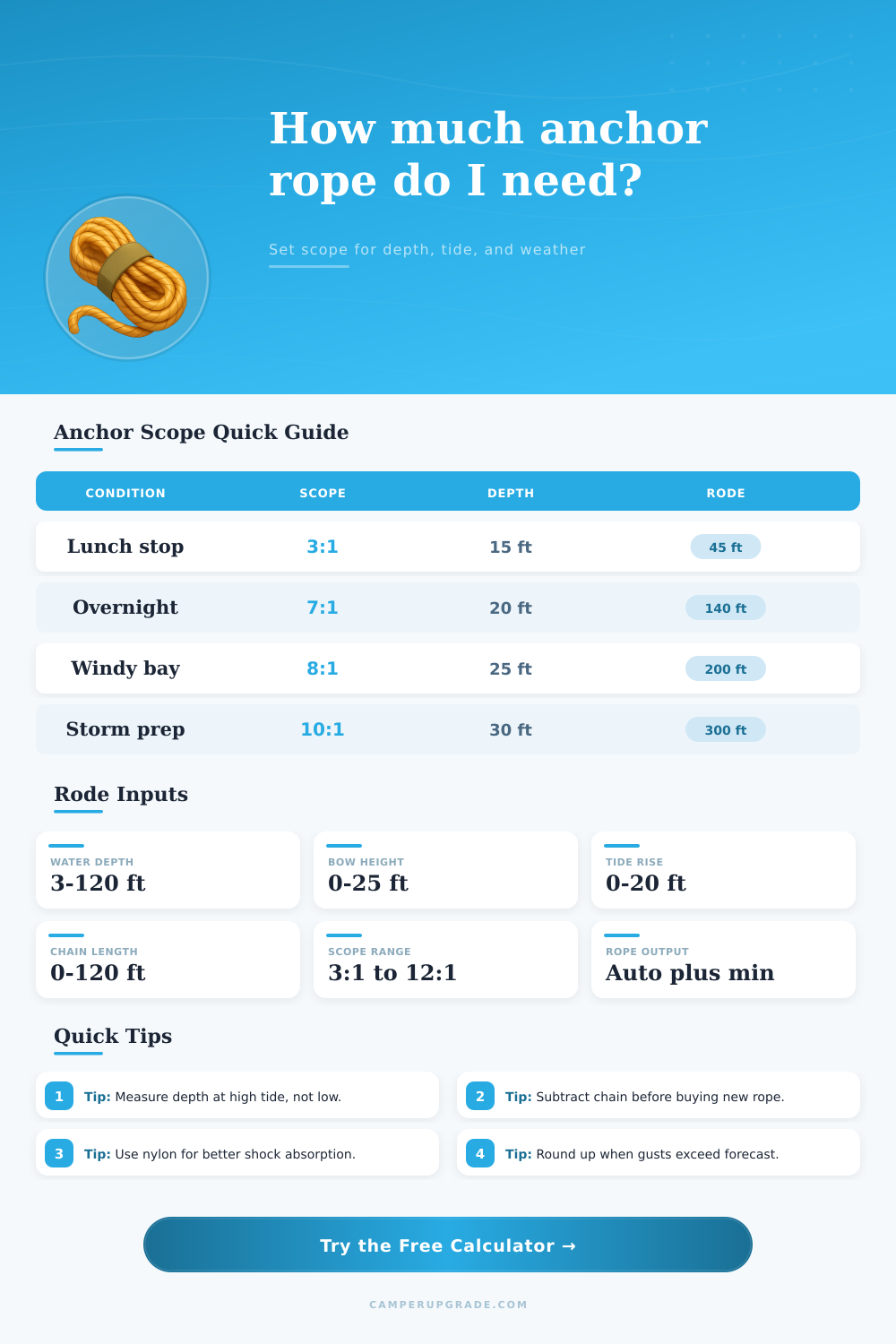
| Wind and Bottom | Typical Scope | Use Case | Watch Item |
|---|---|---|---|
| Calm, clean sand | 3:1 to 4:1 | Short lunch stop | Recheck if tide builds |
| Moderate wind, mud | 5:1 to 6:1 | Afternoon anchoring | Allow for veering swings |
| Breezy mixed bottom | 7:1 | Overnight common target | Set anchor with reverse load |
| Windy plus current | 8:1 to 9:1 | Open roadstead hold | Monitor yaw and snatch loads |
| Storm exposure | 10:1 to 12:1 | Blow prep only | Check room before deploying |
| Effective Depth | 7:1 Rode | With 20 ft Chain | Rope to Mark |
|---|---|---|---|
| 15 ft | 105 ft | 85 ft rope | 90 ft mark |
| 20 ft | 140 ft | 120 ft rope | 125 ft mark |
| 25 ft | 175 ft | 155 ft rope | 160 ft mark |
| 30 ft | 210 ft | 190 ft rope | 200 ft mark |
| 40 ft | 280 ft | 260 ft rope | 270 ft mark |
| Nylon Rope Size | Working Load Band | Stretch at 20% | Typical Boats |
|---|---|---|---|
| 3/8 in | 900-1300 lb | 8-10% | Small day boats |
| 1/2 in | 1600-2500 lb | 7-9% | Cruisers 24-30 ft |
| 5/8 in | 2500-3800 lb | 6-8% | Cruisers 30-40 ft |
| 3/4 in | 3500-5200 lb | 5-7% | Heavier vessels |
Scope is the ratio of a length of your anchor rode to the depth of the water. You must calculate the scope because the amount of anchor rode that you deploy with your boat will determine how well the anchor will hold your boat in place. Using too little anchor rode will cause your anchor to drag across the seabed.
Using too much anchor rode will cause your boat to swing into other boats or obstacle. The angle of the anchor rode play a major role in how the anchor will function. A shallow angle will allow the anchor to pull the shank of the anchor flat against the seabed.
How Much Anchor Rope to Use
Additionally, a shallow angle will allow the flukes or scoops of the anchor to dig deep into the seabed. Using too steep an angle for the anchor rode will cause the boat to pull the anchor upward. Additionally, if the anchor is pulled upward like this, it will lose it’s grip on the seabed.
If the scope that you use for your anchor rode allow for a deeper angle for the rode to deploy, it will be better able to handle the force of the wind. You must calculate the total depth of the water in order to properly set your anchor. The depth of the water is not just the depth that is read on the nautical chart.
The height of the bow roller must be accounted for in the calculation of depth. The height of the bow roller is the point at which the anchor rode depart from the boat. Additionally, the tide must be accounted for in calculating the depth of the water.
The depth of the water change with the tide. If the tide is high, there is more depth to the water. If the depth to the water is increased, the length of the anchor rode that is deploy from the boat will increase, as well.
The length of the anchor chain must be considered when calculating the total length of anchor rode that must be deployed from the boat. The anchor chain will lie flat on the sea floor and will add to the weight of the anchor. The weight of the anchor chain will create a curve in the rode known as the catenary.
This catenary will help to absorb the shock of the waves or the wind. The type of seabed upon which the anchor will land will impact the scope that you use. If the seabed is firm sand, the scope that you use will be relatively small.
This is because the scoop portion of the anchor will easily dig into the sand. If the seabed contain grass or coral, the scope that you use will be relatively larger. This will allow the anchor to find the firm portion of the seabed without becoming stuck in the grass or coral.
Additionally, different anchor style will require different scopes. For instance, a Danforth anchor work well on mud bottoms but may require a different scope to be effective on rock bottoms. There are various preset that can be used to calculate the length of anchor rode that should be deployed from the boat.
A preset allows you to input variables like the depth of the water, the height of the bow roller, the height of the tide, and the length of the anchor chain. For instance, if the anchor is to be deployed into a mud bottom that has eighteen feet of depth, four feet of height for the bow roller, and two feet of tide, you can calculate the total depth. Additionally, using a seven-to-one scope for this preset will allow the anchor to require a specific length of total anchor rode to be deployed from the boat.
This calculation tool will tell you the amount of rope that is required for the anchor to deploy properly and it will also tell you if you have enough of this rope as part of your inventory. There are some common mistake that may occur when you are anchoring your boat. One of the most common is measuring the depth of the water at low tide only.
The depth of the water change with the tide. Another common mistake is ignoring the swing radius of the boat. The swing radius is the radius of the circle that the boat will travel in when it swings on the anchor rode.
If the scope is seven to one in twenty feet of depth, the boat will travel in a circle with a radius of approximately 130 feet. In this case, it is likely that the anchor will hit another boat or reef. It is important to ensure that the boat has clear space to swing in a circle.
The type of rope that is used to deploy the anchor is important. The most common type of rope for anchor rode is nylon rope. The elasticity of nylon will help it to absorb the impact of the wind.
Additionally, using the correct size of nylon rope for your boat will prevent the rope from breaking when dealing with heavy load of wind or waves. It is also important to mark your anchor rode at regular intervals (every 25 feet, for instance). This will allow you to know how far the anchor has deployed during the night.
Weather change will impact the amount of scope that you should use for your anchor rode. If the weather is likely to develop strong wind, you should use more scope for your anchor rode. This will allow for a better angle for the anchor and it will be able to absorb the force of the wind.
If there are changes to the weather condition while the boat is anchored, you will need to adjust the scope of your anchor. For instance, if the weather report indicate that there will be increased wind, you should add more rode to your scope. If the direction of the wind change, the boat will swing to that new direction; you must ensure that you have enough room for the boat to swing.
Use the reverse throttle to “bed” or set the anchor into the seabed. Ease out the rode gradually to ensure that the anchor is secure. Using the proper scope and the proper length of rode to your anchor will help to ensure that your boat remains in a stable position.
You should of used more rope if the wind gets strong. It is actualy better to be safe.