Anchor Load Calculator
Estimate total anchor load, force per leg, angle multiplier, and safety margin for tarp, awning, guyline, and camp rigging anchors.
⛺Anchor presets
📏Load and anchor inputs
Anchor load results
🧱Anchor material/spec grid
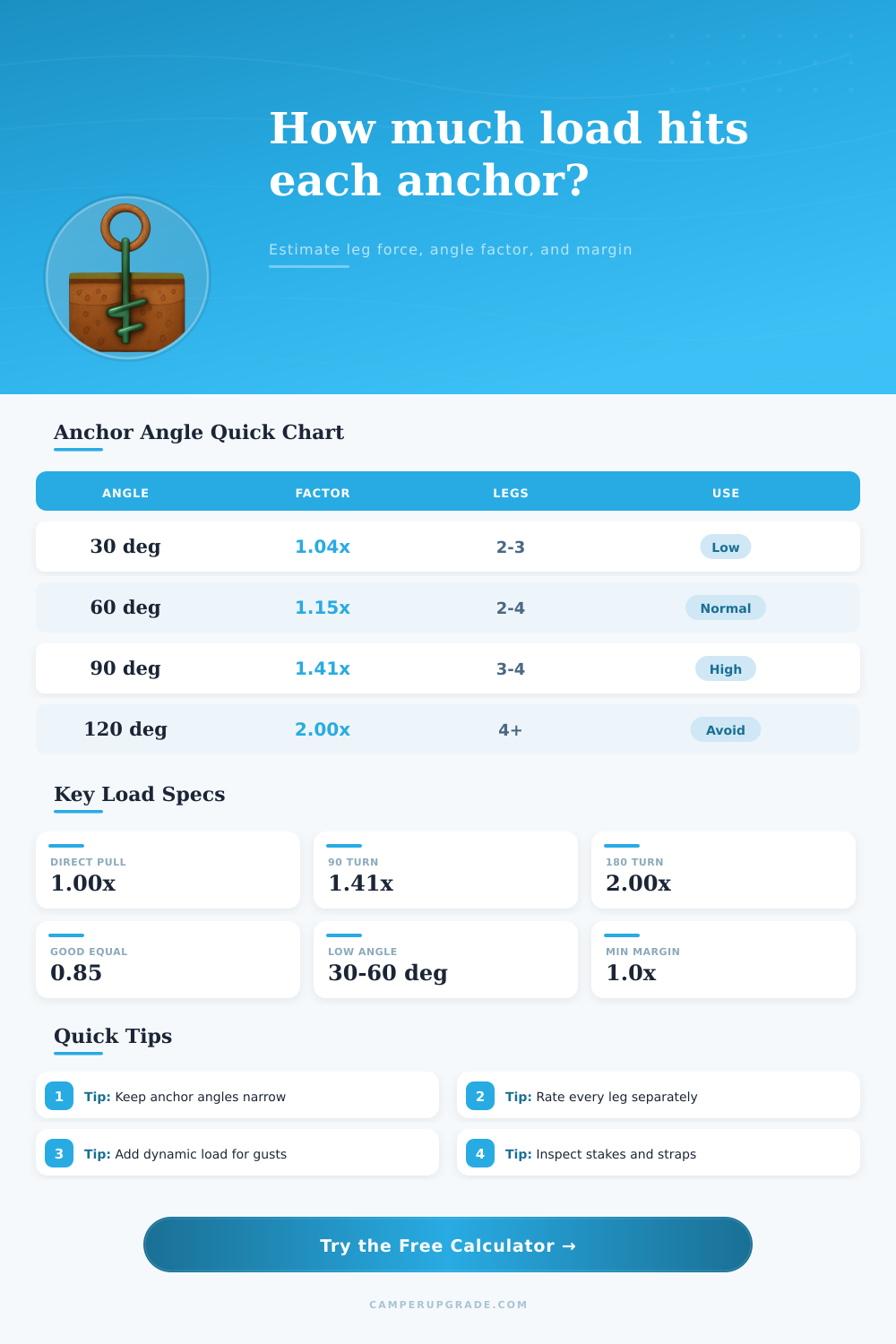
📊Anchor angle multiplier table
| Included angle | Leg angle factor | Two-leg share | Practical note |
|---|---|---|---|
| 0° | 1.00x | 50% each before quality factor | Nearly straight, most efficient |
| 30° | 1.04x | 52% each before quality factor | Excellent for balanced anchors |
| 60° | 1.15x | 58% each before quality factor | Common target for field setups |
| 90° | 1.41x | 71% each before quality factor | High leg force, check margin |
| 120° | 2.00x | 100% each before quality factor | Avoid unless anchors are very strong |
| 150° | 3.86x | 193% each before quality factor | Very poor geometry for shared anchors |
↪Direction change and friction table
| Direction change | Resultant load factor | Typical use | Friction allowance |
|---|---|---|---|
| 0° direct | 1.00x | Straight guyline or tie-out pull | 0-10% for clean alignment |
| 60° bend | 1.00x | Light corner bend | 5-15% for surface drag |
| 90° redirect | 1.41x | Corner pull or side-loaded line | 10-25% for wraps or edge contact |
| 120° redirect | 1.73x | Wide redirected tension | 15-35% if line rubs |
| 180° turnaround | 2.00x | Full return around a point | 20-50% if not on a pulley |
🔧Equalization quality table
| Quality setting | Effective share factor | What it assumes | When to use it |
|---|---|---|---|
| Poor | 0.55 | One leg may take most of the load | Mismatched lengths, loose legs, bad alignment |
| Fair | 0.70 | Some load sharing but not balanced | Hand-tied field anchors with visible unevenness |
| Good | 0.85 | Most legs share after adjustment | Aligned anchors with careful tensioning |
| Excellent | 0.95 | Near-even sharing across legs | Measured, symmetric, or well-equalized systems |
⚓Anchor reference table
| Anchor type | Planning rating | Best load direction | Common weak point |
|---|---|---|---|
| Aluminum tent stake | 250 lb per stake | Low-angle guyline pull | Soft soil or bending |
| Steel ground stake | 500 lb per stake | Axial pull with deep set | Loose soil or shallow placement |
| Sand or snow deadman | 600 lb per anchor | Buried broadside pull | Poor burial depth or weak fill |
| Snow picket T-slot | 900 lb per picket | Buried horizontal pull | Soft snow and angle creep |
| 3/8 in expansion bolt | 1,500 lb per bolt | Rated axial or shear direction | Unknown substrate or bad install |
| 1/2 in forged eye bolt | 2,200 lb per eye | In-line pull through eye | Side loading and thread engagement |
| Tree strap anchor | 3,000 lb per strap | Broad wrap around sound trunk | Bark slip, abrasion, or buckle rating |
| Rated rigging anchor | 5,000 lb per point | Manufacturer rated direction | Connector mismatch or side loading |
💡Anchor load tips
When you set up a tarp or a ridge line in the wind, you must think about how the force of the wind travels to each anchor point. The force of the wind dont just push against the tarp or ridge line; it also travels the distance to the anchor points. Many times, people will guess at how much force the anchor points will hold.
People will select a stake based off the feeling of the stake in their hand, not on the force that it can hold. Anchor systems can multiply the force that is applied to them in ways that is difficult for people to understand. For example, if the wind applies the force equally to two legs of an anchor system, each leg will experience half the force of the total force of the wind.
Keeping Your Tarp Anchors Safe in Wind
If the same force is applied to three legs, each leg will experience one-third the total force of the wind. The tension in each of these legs will increase with the angle between each leg. The calculator in this article can help you determine the force that will be placed on each leg of your anchor system by entering the angle of your setup, the number of legs, and the quality of the equalization system that you use.
The strength of the soil that your anchors will be placed into will also impact the force that they can hold. For example, if a tent stake is rated for a certain amount of weight when placed into firm ground, it may not hold that same force if it is placed into sandy or wet loam soil. If you use tree straps to anchor your tarp or ridge line, they may fail if the straps either buckle or the bark slip.
A reference table of the different types of hardware is provided for planning your anchor system. The values in that table are ideal values only and will usually be lower in your actual situation. Use the safety factor input in the calculator to provide some room for the force of the wind to be greater than expected and for the strength of the soil to be less than expected.
Dynamic loading is another type of loading that people often do not consider. The force of the wind may be steady while everyone is standing still on the ground. However, if the wind gusts the tarp or if someone stumbles into a hammock, that force will temporarily increase.
The dynamic load multiplier field in the calculator can help you account for such an increase in force. For instance, if you expect gusts of that strength on your tarp, a multiplier of 1.4 is applied to the force of the wind. Higher multipliers can be used for other dynamic loads such such as people moving in the tarp.
The friction allowance accounts for the force loss that occurs when the line runs over the edge of a tarp or hammock or across tree bark. These losses are cumulative along the length of the line. The quality of the equalization system will impact the force that each of the anchor points will experience.
If each of the anchor legs is not of equal length or tension, each of the anchor points will not experience an even distribution of the force of the wind. Use the quality factor in the calculator to set the quality of your equalization system. For example, if you have a three-leg system and the tension between each of the legs is not even, one of the legs will experience more force than the others.
If the system uses three legs of unequal tension, it is as if the system is using only two legs to support the tarp or ridge line. This will show up in the calculator in the effective leg count after the quality factor is entered. Changes to the direction of the lines will create a multiplier to the force that is placed onto each anchor point.
If each of the lines are redirected 90 degrees from the direction of the wind load, the anchor points will experience a roughly doubling of the force that is placed onto each point. The same can be said for lines that are redirected 180 degrees. These values are shown in the direction change table in the calculator.
Many people do not consider the forces that are placed onto the anchor points created from these line changes. The calculator includes the angle of each of these changes in its force calculations before it distributes the calculated force onto each leg of the anchor system. The geometry of the anchors will determine the force that is placed onto each of the anchor points.
If a leg of a tarp or ridge line system is overloaded, you can lower the force on each anchor point by moving the anchors farther down the line. This narrowing of the angle between each line will lower the force more quickly than adding another leg to the system. In addition to moving the anchor points, you can upgrade the weakest components of the system to provide enough force to handle the load of the tarp or ridge line.
The safety margin output will show you whether or not the force calculations of the system are above the safety factor that was selected for that system. If the safety margin is below 1.5, then small changes in the force of the wind or the placement of the anchors may push the system past its limit. Field conditions will degrade the strength of the system over time.
Force placed into soil that is wet, frozen, or subjected to repeated loading will reduce the capacity of that anchor system over time. It is a good idea to check the anchors after the first night of weather conditions. Checking the anchors is more useful than any calculation provided in this article.
However, the calculations that are provided before setting up the stakes will help you to understand the different variables of your system. The force calculations can then be compared to the hardware components in your current kit. Actualy, the calculations should of helped you to understand the different variables of your system.
Check the anchors after the first night of weather conditions, checking them is more useful than any calculation provided in this article. Its important to make sure you’re anchors are secure. Youll want to make sure the soil isnt too soft for the luxurius tent setup.
The furnitures weight might also matter.