Oxygen at Altitude Calculator
Estimate ambient pressure, oxygen partial pressure, humidity effects, and cylinder runtime across mountain, cabin, and rescue scenarios.
📍Scenario Presets
⚙Oxygen Inputs
📊Reference Spec Grid
📘Altitude And Oxygen Reference Tables
| Altitude | Pressure | O2 Partial | Sea-Level O2 |
|---|---|---|---|
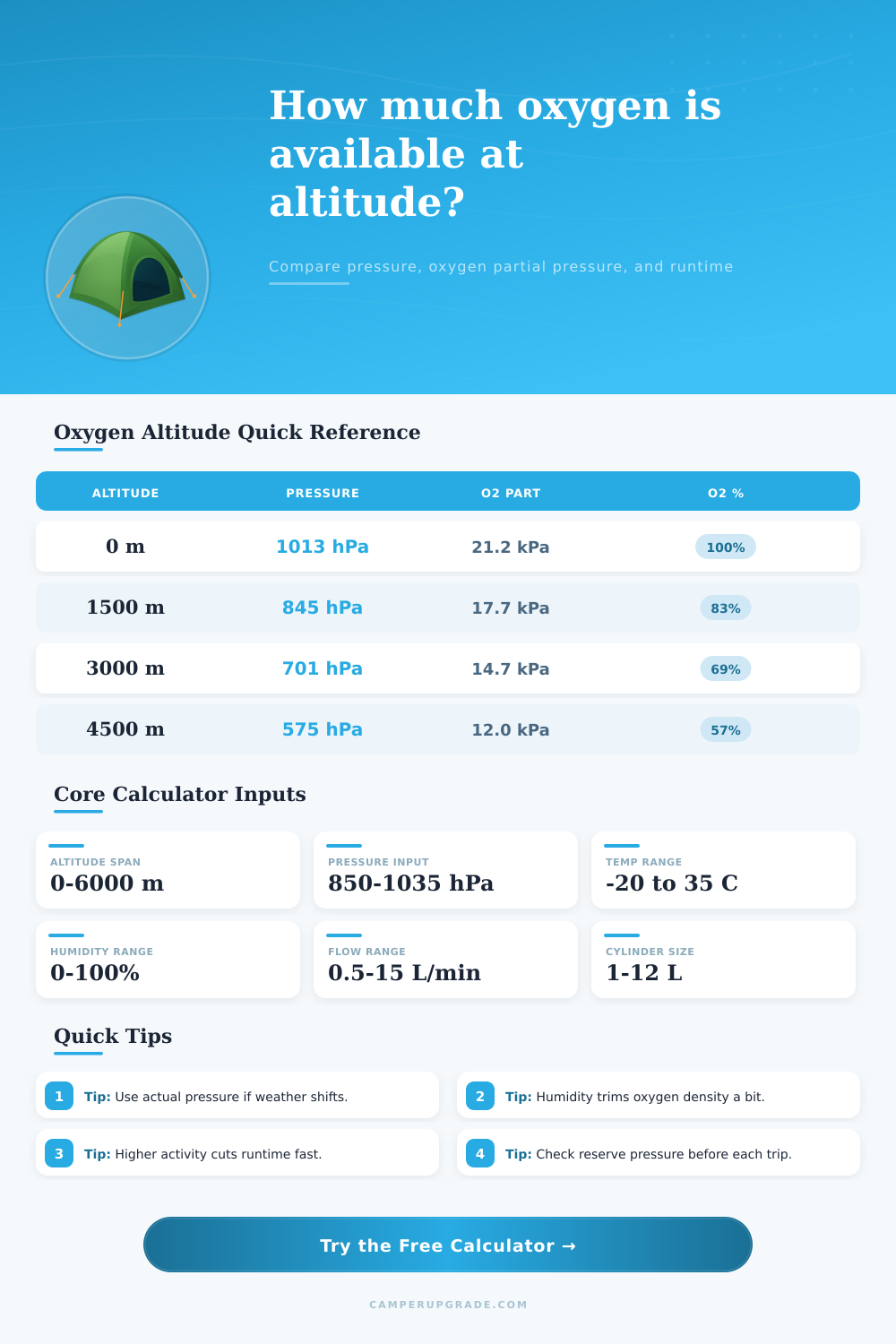
| 0 m | 1013 hPa | 21.2 kPa | 100% |
| 1500 m | 845 hPa | 17.7 kPa | 83% |
| 3000 m | 701 hPa | 14.7 kPa | 69% |
| 4500 m | 575 hPa | 12.0 kPa | 57% |
| Activity | Factor | Use Case | Flow Note |
|---|---|---|---|
| Quiet rest | 1.00 | Seated or sleeping | Lowest demand |
| Light walk | 1.15 | Easy movement | Small buffer |
| Moderate hike | 1.35 | Trail travel | Typical midrange |
| Hard climb | 1.60 | Steep ascent | Reserve fast |
| Cylinder | Fill - Reserve | Usable Gas | 2 L/min Runtime |
|---|---|---|---|
| 2 L at 200 bar | 180 bar | 360 L | 180 min |
| 4 L at 200 bar | 180 bar | 720 L | 360 min |
| 6 L at 200 bar | 180 bar | 1080 L | 540 min |
| 10 L at 200 bar | 180 bar | 1800 L | 900 min |
| Humidity | Temp | Vapor Loss | O2 Drop |
|---|---|---|---|
| Dry air | 10 C | 0.12 kPa | 0.03 kPa |
| 30% RH | 15 C | 0.51 kPa | 0.11 kPa |
| 60% RH | 25 C | 1.89 kPa | 0.40 kPa |
| 90% RH | 30 C | 3.81 kPa | 0.80 kPa |
When you are at an altitude of 3,000 meter, the air is thinner than the air at sea level. Although the air at high altitude contains 21 percent oxygen, the atmospheric pressure decrease with altitude. Because the atmospheric pressure decreases, there are few oxygen molecules in a given volume of air.
Therefore, it is harder for your lung to pull the oxygen in your body. You must understand how altitude affect the amount of oxygen that enters your bloodstream. Only then can you plan your activity and your oxygen supplies.
Oxygen at High Altitude and How to Use It
The availability of oxygen at high altitudes is due to the partial pressure of oxygen in the air. The partial pressure of the oxygen in the air at sea level is 21 kilopascals. As you go up the mountain, the partial pressure of the oxygen decreases.
While the percentage of oxygen in the air is 21 percent at all altitude, the amount of oxygen decreases due to the reduction in the total atmospheric pressure at high altitudes. Your body compensate for low levels of oxygen by breathing fast and deeper. However, breathing deep and quickly at high altitudes can cause headache or nausea.
You must monitor the environment to which you are exposed. Only then can you decide whether you need to move more slow or turn back from the ascent. The amount of oxygen available to you at high altitudes also depend on the humidity of the air.
High humidity mean that the air contains alot of water vapor. Water vapor molecule take up the same volume as other gases in the air. Therefore, high humidity at high altitudes will reduce the amount of oxygen available to breathe.
For instance, the amount of oxygen that you breathe at a tropical ridge will feel higher than the actual altitude due to the high humidity. The effect of humidity on oxygen availability also involve the effect that high humidity has on the temperature of the air. You must consider these two variable when you calculate the amount of oxygen that you will use at high altitudes.
The runtime of the oxygen cylinder that you use at high altitudes also depends on a few factor. First, the oxygen cylinders contain a specific volume of oxygen. When you use an oxygen cylinder, you must never allow the pressure of the oxygen in the cylinder to reach zero.
You must leave some pressure in the cylinder as a reserve for emergency such as when you must make a descent from the altitude at which you are breathing the oxygen or when you must delay your descent for some reason. You can calculate the runtime of your oxygen cylinder by subtracting the reserve pressure in the cylinder from the total pressure in the cylinder. Multiply the result by the volume of the cylinder.
Divide that total amount by your flow rate. Your flow rate depends on the physical activity that you are performing. At rest, your flow rate will be lower than when you are, for instance, climbing mountains.
As you use more oxygen performing more physical activity, the amount of oxygen in your cylinder will be depleted more quickly. Weather pattern will also have an effect on atmospheric pressure and, thus, on the availability of oxygen. High atmospheric pressure will increase the oxygen availability to you, while low atmospheric pressure will decrease the availability of oxygen.
If stormy weather move in on the area where you are performing your activity at high altitudes, the atmospheric pressure will drop. This drop in atmospheric pressure will make your altitude feel higher than it actually is. In order to calculate atmospheric pressure accurate, you will need to use tools that allow you to input the atmospheric pressure reading for your area at this time.
Many people make mistake when planning high-altitude activity and the amount of oxygen to use. One of the most common mistake is to ignore the humidity of the area in which you plan to perform your activity. Another mistake is to set the flow rate of the oxygen too low for the physical activity that you plan to perform.
Another mistake is to not leave enough reserve pressure in your oxygen cylinder. This could be deadly in the case of an oxygen leak from your apparatus or an increase in your breathing rate. Finally, you must ensure that the oxygen that you are using is pure oxygen; oxygen mixture containing a lower percentage of oxygen will last for a shorter period than the same volume of medical grade oxygen.
Rescue operation are different from other activity types because you will need high flow rate of oxygen to supply multiple patient with oxygen. Furthermore, you will also have to perform extreme physical activity during a rescue. For instance, at 3,000 meters, 10 liter of oxygen can supply a person with oxygen for 90 minutes while walking at a steady pace.
However, if you move to an altitude of 4,500 meters, that same amount of oxygen will last you for a shorter period of time. During a rescue operation at these altitude, you should monitor the percentage of oxygen at sea level that is equivalent to the altitude at which you are breathing the oxygen. You should ensure that the percentage of oxygen does not fall below 60 percent of the sea level oxygen content in the air.
Below 60 percent, you will begin to feel the effects of hypoxia that can impair your judgment. To manage the oxygen that you breathe at high altitudes, you can use several method. One method is to acclimatize your body to the low availability of oxygen at high altitudes.
You can also hydrate yourself to avoid dryness of the mouth caused by the supplemental oxygen that you breathe at these altitudes. Finally, you can also use oxygen table to calculate the amount of oxygen that your oxygen cylinder will yield at different altitudes. These tables have rows for humidity and activity factor so that you can calculate your oxygen needs accurately.
By understanding the drop in the availability of oxygen at high altitudes, you can ensure that you have enough oxygen to complete your task and descend from the high altitude where you are performing your activities.