Altitude Boiling Point Cooking Calculator
Estimate water boiling temperature, pressure, cook-time multiplier, adjusted meal time, and stove heat load for high-elevation camping meals.
Altitude Cooking Results
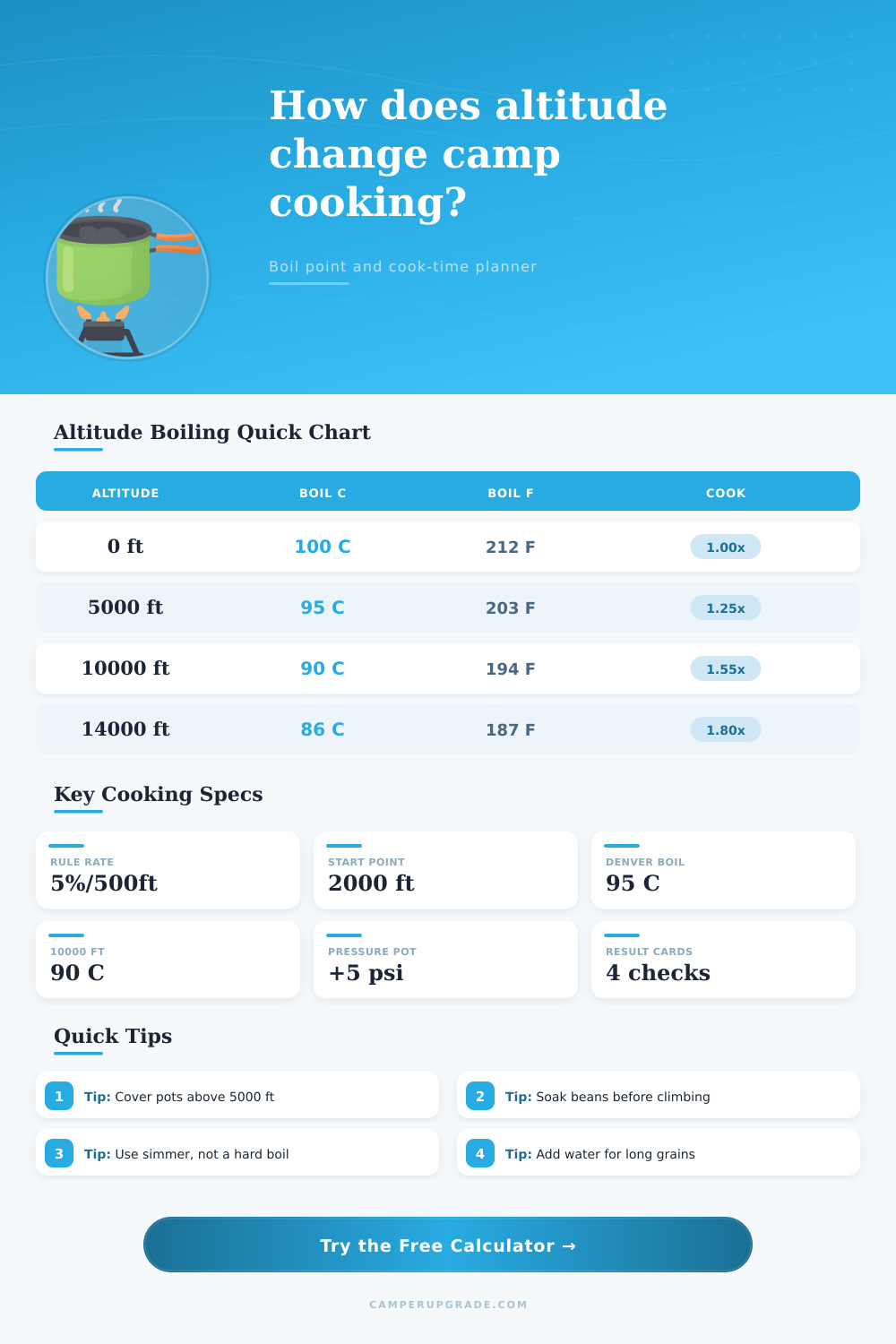
| Altitude | Pressure | Boiling Point | Typical Cook Effect |
|---|---|---|---|
| 0 ft / 0 m | 101.3 kPa / 14.7 psi | 100.0°C / 212.0°F | Recipe time unchanged |
| 3,000 ft / 914 m | 90.8 kPa / 13.2 psi | 97.0°C / 206.6°F | Small increase for rice and beans |
| 5,000 ft / 1,524 m | 84.3 kPa / 12.2 psi | 95.0°C / 203.0°F | About 20% to 30% longer for many simmered meals |
| 8,000 ft / 2,438 m | 75.3 kPa / 10.9 psi | 91.9°C / 197.4°F | Noticeably slower starch hydration |
| 10,000 ft / 3,048 m | 69.7 kPa / 10.1 psi | 89.8°C / 193.6°F | Long grains and beans need planning |
| 14,000 ft / 4,267 m | 61.6 kPa / 8.9 psi | 86.3°C / 187.3°F | Pressure cooking or soak methods help |
| Food Type | Altitude Sensitivity | Good Camp Method | Calculator Factor |
|---|---|---|---|
| Hot drinks and soup | Low; only heat-up temperature changes | Bring to boil, then serve or steep | 0.55 |
| Oatmeal and quick cereal | Low to moderate hydration change | Covered simmer or short soak | 0.75 |
| Pasta and noodles | Moderate starch gelatinization change | Covered boil with water check | 0.95 |
| Rice and dry grains | High; center stays firm longer | Covered simmer plus rest | 1.25 |
| Dry beans or lentils | Very high; cell walls soften slowly | Pre-soak or pressure pot | 1.55 |
| Dehydrated meals | Moderate; depends on pouch thickness | Boil, seal, insulate, and wait | 0.85 |
| Cooking Method | Time Effect | Evaporation Effect | Best Use |
|---|---|---|---|
| Rolling boil | Can reduce timer slightly | High water loss | Pasta when water is plentiful |
| Covered simmer | Balanced baseline | Moderate water loss | Rice, grains, and camp meals |
| Gentle simmer | Slower but efficient | Lower water loss | Soups and delicate foods |
| Boil then insulated soak | Less flame time, more wait time | Very low water loss | Oats, dehydrated meals, couscous |
| Camping pressure pot | Strongly reduces altitude penalty | Low water loss | Beans, rice, and high camps |
| Common Camp Location | Approx Elevation | Boiling Point | Cooking Note |
|---|---|---|---|
| Sea-level coastal camp | 0 ft / 0 m | 100.0°C / 212.0°F | Use package directions |
| Denver area trailhead | 5,280 ft / 1,609 m | 94.7°C / 202.5°F | Add time to rice and pasta |
| Grand Canyon South Rim | 7,000 ft / 2,134 m | 92.9°C / 199.2°F | Cover pots to protect simmer |
| Leadville, Colorado | 10,152 ft / 3,094 m | 89.6°C / 193.3°F | Long-cook foods need a plan |
| Mount Whitney Trail Camp | 12,000 ft / 3,658 m | 88.0°C / 190.4°F | Insulated soak helps fuel use |
| Himalayan trekking lodge | 16,500 ft / 5,029 m | 84.2°C / 183.6°F | Pressure cooking becomes valuable |
Water bubbles as though it is boiling, yet still your breakfast sits, calmly lukewarm. Why didn’t the recipe work? Is there something wrong with the stove? With the food? It turns out not. It turns out: physics. Up here at elevation, the air doesn’t press quite as much onto the water surface, so it can evaporates at a cooler temperature. Water boils at two hundred twelve degrees Fahrenheit at sea level, but up in the Rockies, it gets way down from that. You’re not using hotter water; you’re just using cooler water, even as it sputters and boils furiously.
The app handles the science of heat for you. You do not need to memorize pressure curves. It will estimate the true boiling point based off your camp elevation. It then use a multiplier to adjust your estimated cooking time. The input fields may appear technical, however they directly align with your gear selection. Choosing a pot type tells the application whether heat is escaping via an open flame or being trapped beneath a snug-fitting lid. This will change how much energy are needed to elevate the water, and keep it elevated. Steam rising from a loose-fitting lid removes latent heat. The increased interior pressure in a pressure cooker raises temperature within the vessel.
Why Cooking Takes Longer at High Altitude
For example, if we look at some big trailheads from the reference table on the page, it’s laid out pretty well. For instance, Denver, which sit around 5,000 ft., has a boiling point dropping to about 95 degrees Celsius. This doesn’t seem like much until you remember that there is a threshold at which starches slow down dramaticly when they begin to gelatinize. Pasta and rice need to soak up water and soften their structure with the help of heat. So, if the water is a couple of degrees lower, it will take them longer to do so. But its not linear.
What kind of food are you preparing? Instant soup powders is way more resilient to temp drops than beans. Dehydrated meals simply require hot water to hydrate. The boiling point isn’t as important as the first few seconds of dumping heat into your food. There’s one other wrinkle: wind and cold morning creek water. Because it takes more fuel to heat ice-cold meltwater rather then warming up already lukewarm cache water, you can input your starting water temperature into the tool. Stove efficiency goes down a bit in the thin air, too but it’s not nearly as big a loss as evaporation.
Boiling a roll on high at elevation wastes precious water that may be needed later in the day. A covered pot or gentle simmer will retain both water and heat better. You can choose your cooking method here, and the calculator tweaks accordingly. Selecting a pressure pot gives it the five psi boost. This effectively restores some of the lost cooking temperature, so it accounts for that, too.
Hikers also commonly believe that hotter means quicker. When water reaches the boiling point, adding more heat will not increase the temperature of the water: it’ll only make it boil away more quickly. This adjusted cook time output shows how long you should really let it simmer. So if the tool tells you that your pasta (which takes a dozen minutes) needs an additional six minutes, go ahead and believe in math. It’s better to plan for extra fuel and time than to eat chalky dinner while the sun goes down.
You can test your food at home with the simulated altitude setting to adjust accordingly, but expect some tweaks out on trail. If you’re expecting high camps, pre-hydrate those grains before heading out. It’s one less thing to worry about on-trail. And here’s the math: When does soaking save you more time then burning fuel? Check this number.
As elevation increases so does thinning air. This means tight margins, and every 1,000 feet of gain adds another layer of complication. There are many variables in this equation. Including caloric requirements, the weight of water, and wind chill. Knowing how pressure impacts heat will help you work with the environment rather than fight against it.
To enjoy good eats up high doesn’t require a degree in physics. Just know this: Slow cook = cool water. Plan accordingly, cover your pots, and let the physics take over.