
Alpine ski waxing refer to the treatment of the bases of alpine skis before skiing. Alpine ski waxing is important because wax with the correct properties will reduce the friction that develops between the ski and the snow. If the ski base isnt waxed proper, the friction between the ski and snow will drag the skis and reduce the ability of the ski wearer to move quick on the snow.
The single most important factor to consider when waxing alpine skis is the snow temperature. You must measure the snow temperature, not the air temperature. The snow temperature is the temperature of the snow crystals at the ski base height.
How to Wax Alpine Skis
Different snow temperatures requires different types of wax. For example, cold snow will require the use of hard waxes that will not stick to ice crystal. Warm snow will require the use of soft waxes that will shed water from the snow to allow for the ski to glide smooth on wet snow.
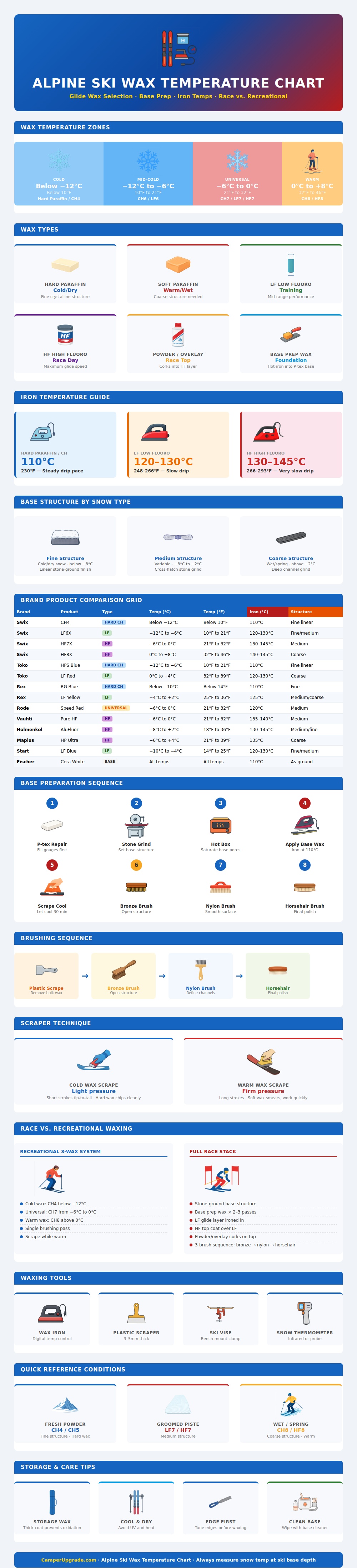
There are four main temperature zones for snow. The first is for snow temperatures below minus twelve degrees Celsius. The second is for snow temperatures between minus twelve and minus six degrees Celsius.
The third zone include snow temperatures around zero degrees Celsius. The fourth and final zone is for snow temperatures in positive numbers on the Celsius scale. Each type of snow will require a certain type of wax to allow for the ski to glide smooth on snow of that temperature.
There are different types of wax that are used on alpine skis for different purpose. Hard paraffin wax is used on very cold snow. Recreational skiers use low-fluoro wax during training.
Low-fluoro wax allows for decent skiing speeds and is less expensive than high-fluoro wax. Racers use high-fluoro wax to increase there skiing speed. Elite racers use overlay powders on the top layer of the ski base to increase the non-stick properties of the ski base.
Base prep wax is the first wax that should be applied to the ski base. This wax soaks into the pores of the P-tex of the ski base to allow the other waxes to adhere to the ski base properly. If the base prep wax is skipped, the other waxes will not adhere to the ski base.
The temperature of the waxing iron is another important factor in the alpine ski waxing process. If the wax iron is too hot, it will burn the wax on the ski base. This will create drag on the ski base as it moves through the snow.
If the wax iron is too cool, the wax will not penetrate the pores of the P-tex of the ski base. Waxes that are hard will require an iron temperature of 110 degrees Celsius. Low-fluoro wax will require a higher setting on the wax iron to properly melt the wax at a slow pace.
High-fluoro wax will require the highest temperature on the wax iron and the fastest rate at which the wax melts on the ski base. The melting rate of the wax will determine the temperature of the wax iron. Another important factor in the alpine ski waxing process is the base structure of the ski.
The base structure is the pattern of grooves on the ski base. For cold and dry snow, the base will feature a fine linear grind so that the ski can slice through the snow. For variable snow temperature, medium cross-hatch structure are used on the ski base.
For wet snow, coarse channels will be carved into the ski base so that the ski can push the water away from the ski. These structures will be carved into the ski base through a process known as stone grinding. The structure of the ski base will determine if the ski will trap snow on the base or shed it as it moves on the snow.
In order to achieve good alpine ski waxing result, there are steps that should be followed. First, any damage to the ski base that is caused through skiing should be repaired using P-tex. Second, the ski base should be stone ground to carve structure into the base.
Third, using a hot box can open the pores of the ski base. Fourth, the base wax should be ironed into the ski base with the wax iron. Fifth, the ski base should be allowed to cool and the excess wax should be scraped from the ski base.
Sixth, a bronze brush should be used to open the wax on the ski base followed by a nylon brush to refine the wax and a horsehair brush to polish the wax. The order of these three steps should be follow in that particular order: scrape, bronze, nylon, and horsehair. Depending on the type of skier that one is, there are different method to waxing alpine skis.
Recreational skiers will use three different waxes to cover the temperatures of cold, universal, and warm temperatures and will use only one brush pass. Racers will use a more complex waxing process because racers desire maximum skiing speeds. Racers will use a three-layer wax system that uses base wax, low-fluoro wax, high-fluoro wax, and overlay powder on elite racers skis.
Additionally, racers will perform the three-brush ritual on their skis. In order to wax alpine skis properly, specific tools should be used. A digital iron will allow for better control over the wax temperature.
A thick plastic scraper will remove the excess wax from the ski base. A vise will hold the ski in place while the wax iron is in use. An infrared thermometer will provide the snow temperature reading.
Before waxing the alpine skis, the ski base should be cleaned and the ski edge should be tuned. After waxing, the skis should be stored in a dry place with a thick coat of wax to prevent oxidation of the ski base. Another factor to consider before waxing alpine skis is the age of the snow.
Fresh snow will require a harder wax than older snow. This is because fresh snow is often grabby and requires a ski base that will not adhere to the snow crystals. Old snow tends to sinter and be easier to glide on skis, so a softer wax should be used on skis that will be skiing on aged snow.
Small patches of each type of wax can be waxed on the ski before committing to using that type of wax. Depending on the type of skiing that will be performed, waxing will occur every few days. If the snow is wet, the waxing process should be performed more frequent.
If the waxed skis feel fast and chatty when skiing, the wax is applied correctly. If the skis feel like they have a silent drag to their movement, the skis should be re-waxed.