Alcohol Stove Fuel Calculator
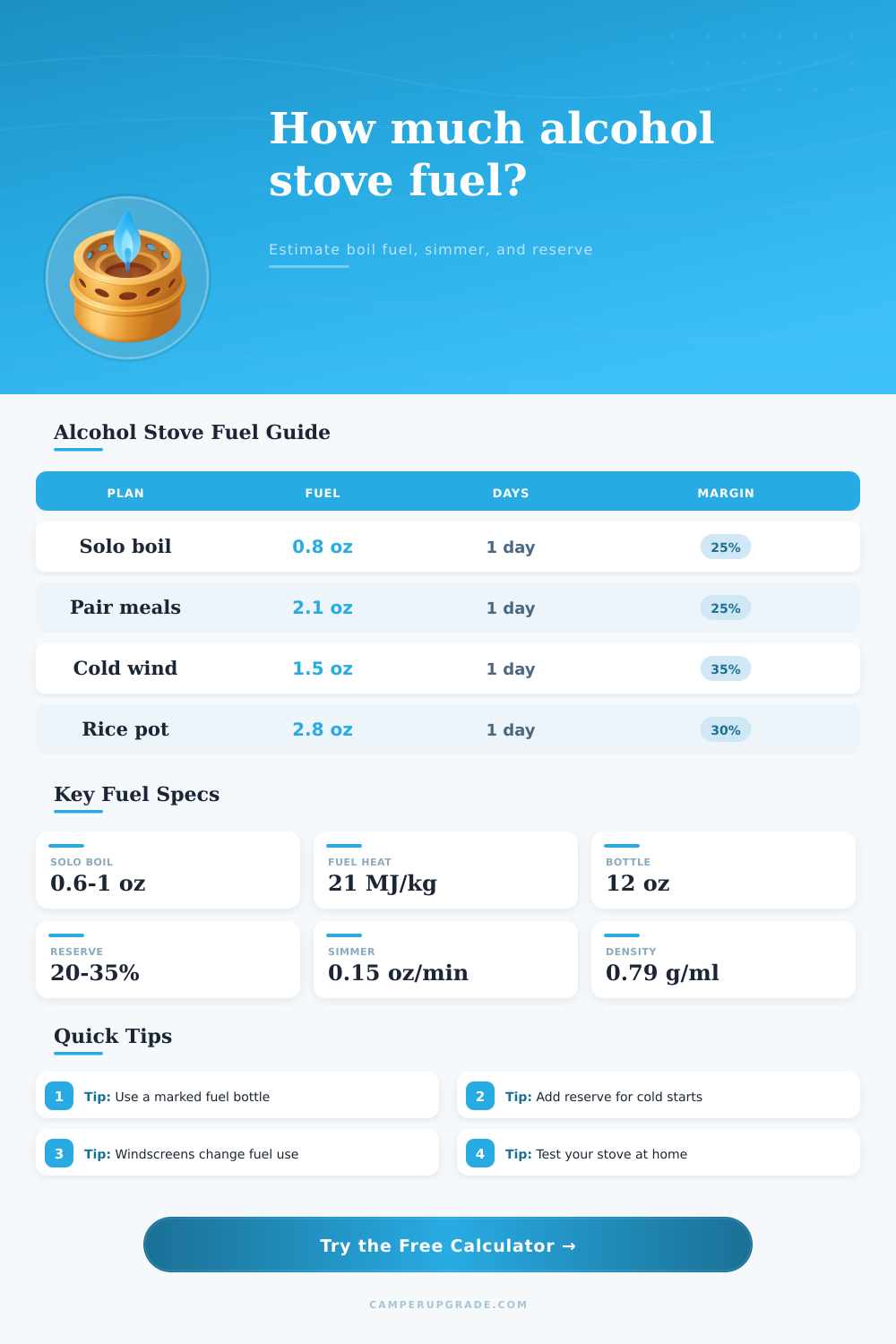
Estimate alcohol stove fuel for a backpacking, bikepacking, paddling, or camper trip from hot-water volume, stove setup, temperature, altitude, simmer time, wind exposure, reserve margin, bottle size, and fuel already packed.
🏕Alcohol Stove Fuel Presets
⚙Trip, Water, Stove, Weather, and Bottle Inputs
Formula uses water heat energy, estimated alcohol stove transfer efficiency, wind loss, fuel energy density, measured simmer burn rate, reserve margin, bottle sizing, and remaining-fuel days.
📊Alcohol Fuel Spec Grid
📋Alcohol Fuel Type Reference
| Fuel option | Energy used by calculator | Density used | Planning note |
|---|---|---|---|
| Denatured alcohol, ethanol blend | 21.1 MJ/kg | 0.79 g/ml | Clean common baseline for backpacking alcohol stoves. |
| Methanol or yellow bottle fuel | 19.9 MJ/kg | 0.792 g/ml | Often needs a little more volume for the same boil work. |
| 70% isopropyl alcohol | 20.0 MJ/kg | 0.87 g/ml | Water content can soot and slow many open alcohol burners. |
| 91% isopropyl alcohol | 27.0 MJ/kg | 0.81 g/ml | Higher energy, but stove design affects flame cleanliness. |
| Bioethanol fireplace fuel | 21.0 MJ/kg | 0.79 g/ml | Usually close to ethanol blend if additives are minimal. |
🔥Stove Setup Efficiency Reference
| Setup | Useful efficiency | Best fit | Fuel planning effect |
|---|---|---|---|
| Open cup stove, basic pot | 25% | Simple fair-weather boils | Largest fuel load for the same hot water. |
| Side-burner with windscreen | 32% | Most trail alcohol kits | Good baseline when pot fit is reasonable. |
| Cone stove with tight pot fit | 42% | Efficient solo boil kits | Lower daily fuel if airflow is not over-restricted. |
| Remote-fill burner with snuffer | 35% | Measured fuel control | Reduces leftover burn after water is hot. |
| Wide pot, lid, priming pan | 38% | Cold mornings and wider meals | Improves heat capture in chilly starts. |
| Tiny cup pot, exposed flame | 22% | Emergency drink water | Small diameter loses heat around the cup. |
🧪Common Alcohol Stove Fuel Scenarios
| Scenario | Daily hot water | Typical fuel per day | Suggested reserve |
|---|---|---|---|
| Solo coffee and one freezer-bag meal | 26 fl oz | 0.8 to 1.2 fl oz | 20% |
| Two hikers, breakfast and dinner | 80 fl oz | 2.1 to 3.1 fl oz | 25% |
| Cold stream water with breeze | 32 fl oz | 1.3 to 1.9 fl oz | 30% |
| Rice or pasta with simmer time | 48 fl oz | 2.5 to 3.6 fl oz | 30% |
| Minimal bikepacking cook kit | 16 fl oz | 0.5 to 0.8 fl oz | 20% |
📏Bottle and Volume Conversion Table
| Fuel volume | Metric volume | Approx ethanol-blend weight | Common use |
|---|---|---|---|
| 4 fl oz | 118 ml | 3.3 oz / 93 g | Short solo overnight or backup bottle. |
| 8 fl oz | 237 ml | 6.6 oz / 187 g | Two to five solo days depending on meals. |
| 12 fl oz | 355 ml | 9.9 oz / 280 g | Common bottle size for longer solo legs. |
| 16 fl oz | 473 ml | 13.2 oz / 374 g | Pair trips, cold routes, or more simmer meals. |
| 1 liter | 1000 ml | 27.9 oz / 790 g | Large group refill supply kept away from flames. |
💡Fuel Planning Tips
Alcohol stoves are useful tools for backpackers due to the fact that alcohol stove are lightweight, alcohol stoves are quiet, and alcohol stoves is reliable even in changing weather conditions. One must determine how much fuel is required for the trip, and the amount of fuel that is required for a backpacking trip is based off a number of different factors. Factors such as the temperature of the water to be boiled, the altitude of the location of which the backpacker will be camping, the meals that will be cooked, the type of stove that will be used, and the type of pot that will be used will impact the rate at which the alcohol stove consumes the fuel.
Thus, by entering these factors into the calculator, the calculator will allow a backpacker to determine the amount of fuel that is required to complete the trip without having to make guesses as to how much fuel will be consumed during such a trip. To determine the amount of fuel that will be consumed during the camping trip, the amount of water that will need to be boiled each day must first be calculated. Each hot meal that will be prepared during the camping trip will require fuel from the fuel bottle that is provided with the alcohol stove.
How Much Fuel Do You Need for an Alcohol Stove on a Trip
The fuel bottle will be used to heat water to the required temperature for drinking, cooking meals, or simply for drinking. The colder the water that is to be boiled, the more fuel that will be required to heat the water to it’s boiling point. Additionally, the altitude at which the water is to be boiled will impact the amount of fuel that the alcohol stove consumes; the higher the altitude at which the water is to be boiled, the lower the boiling point of the water.
Thus, the fuel that the alcohol stove consumes will decrease at higher altitudes, which is why the fuel requirements calculator includes both the altitude and the water temperature as factors in the calculation of the amount of fuel that will be consumed. The type of stove and the type of pot that is used during the camping trip will impact the amount of fuel required to boil the water during the camping trip. If the alcohol stove’s flame is allowed to heat water in a cup, the heat that is emitted by the flame will dissipate into the cup and into the surrounding air; however, if the stove is set up in a cone or if a windscreen is established around the pot and stove, more of the heat that the stove emits will be applied to the water that is to be boiled.
Thus, the fuel requirement calculator incorporates a reference table that reflects the efficiency of different types of stoves and pots. Additionally, if the alcohol stove is exposed to the wind during the camping trip, more fuel will be required to boil the water; the more exposed the alcohol stove is to the wind, the more fuel the stove will require to effectively heat the water. Another factor that must be considered when calculating the amount of fuel that will be required for a camping trip is the length of time that the water is to be boiled.
Simmering foods such as rice will require the stoves flame to be on for extended periods of time, and thus fuel will be consumed at a higher rate then if the water were to simply be boiled to its boiling point. To account for simmering, the fuel requirement calculator will calculate the length of the camping trip, and will include the fuel required for simmering in the calculation of the total amount of fuel that will be required for the camping trip. A margin of fuel may be added to the calculation to provide for unexpected use of fuel.
A twenty percent margin of fuel may be sufficient to allow for an average camping trip; however, a thirty or forty percent reserve margin of fuel is better suited to a trip that is to take place in a remote location or in potentially unsettled weather conditions. Based upon the amount of fuel that the fuel requirement calculator determines will be required to complete the camping trip, it is possible to calculate in what type of fuel bottles will be required. The fuel requirement calculator will determine the total amount of fuel that will be required for the camping trip as well as the number of fuel bottles of a specific size that will be required.
Additionally, the calculator will indicate how many stove days will remain based upon the amount of fuel that the backpacker already possesses. As with any plan for any camping trip, the actual trip will be different than the original plan. Factors such as the simmering time for rice, the amount of coffee that may be brewed during the camping trip, and the wind that may be blowing during the camping trip can influence the actual amount of fuel that is consumed by the alcohol stove.
The reserve margin for fuel was established to account for these types of unforeseen circumstances, but the fuel margin will be most efficient if the alcohol stove is measured under conditions similiar to those that will exist during the camping trip. Thus, the camping trip at home with the actual alcohol stove will allow the backpacker to determine if the windscreen for the stove will be suited to the pot that will be used during the camping trip. Now that all of the factors that influence the fuel requirement for a camping trip have been considered, it is possible for the backpacker to determine if the savings in fuel that may be achieved through the use of a tighter cone for the stove or waiting for the water to warm from the sun will be worth the effort and complexity of implementing those steps into the camping trip.
Thus, it is not a goal for the backpacker to minimize the amount of fuel that the alcohol stove consumes during the camping trip; instead, the fuel that the backpacker uses should be enough to cook dinner during the camping trip even if the weather that is encountered during such a trip is not ideal. You should of used the calculator to ensure you dont run out of fuel. Making sure you have enough fuel can be a bit tricky, but the calculator makes it easyer for everyone.
One should of checked the weather before they goes out. It is a moddern way to plan. There is alot of things to think about.
If you dont prepare, you might not recieve the results you want. It’s better to be safe. The furnitures in the tent should be moved before you start.
You’re plan should be solid.