Alcohol Stove Burn Time by Volume Calculator
Estimate flame time, usable cooking time, fuel reserve, refill count, and trip cooking cycles from your alcohol stove and measured fuel volume.
⚡Named Stove Presets
📏Fuel and Stove Inputs
Burn rates are planning estimates. For best accuracy, run one timed boil with your pot, stand, windscreen, and fuel, then enter the measured ml/min value.
🧪Fuel Specification Comparison
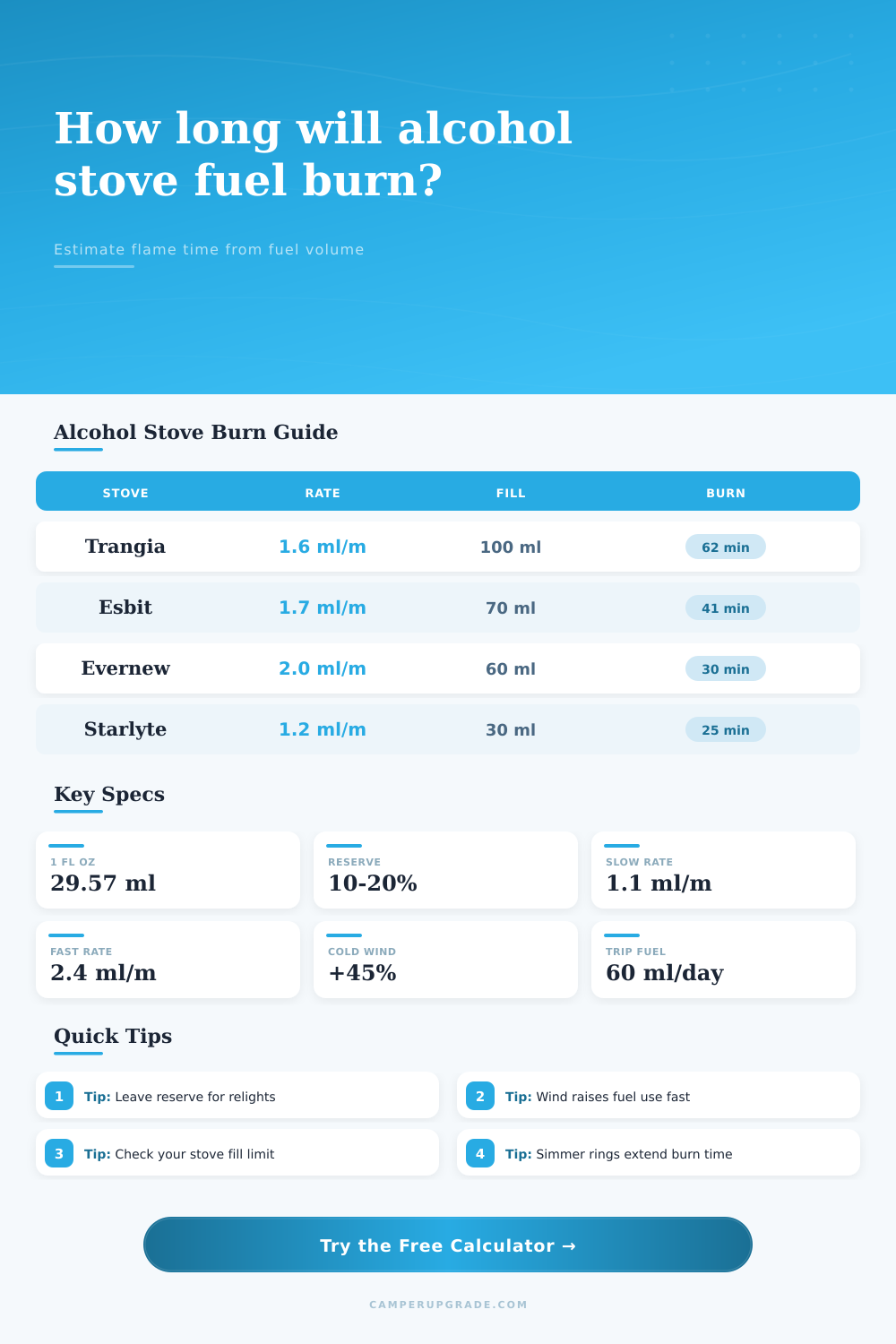
🔥Named Stove Burn Rate Reference
| Stove or Burner | Planning Rate | Common Fill | Full-Fill Burn | Best Use in Calculator |
|---|---|---|---|---|
| Trangia Spirit Burner | 1.60 ml/min | 100 ml | 62 min | Steady meals and simmer-ring cooking |
| Esbit Alcohol Burner | 1.70 ml/min | 70 ml | 41 min | Compact solo kits with screw-cap storage |
| Evernew Titanium Alcohol Stove | 2.00 ml/min | 60 ml | 30 min | Fast boil estimates and wide flame pots |
| TOAKS Siphon Alcohol Stove | 1.80 ml/min | 80 ml | 44 min | Lightweight canister-style alcohol setups |
| Vargo Triad Alcohol Stove | 1.50 ml/min | 44 ml | 29 min | Small titanium stove planning |
| Solo Stove Alcohol Burner | 1.65 ml/min | 100 ml | 61 min | Backyard tests and fire-pit compatible kits |
| Zelph Starlyte Burner | 1.20 ml/min | 30 ml | 25 min | Absorbent low-spill solo stove cooking |
| White Box Alcohol Stove | 2.35 ml/min | 90 ml | 38 min | High-output open-jet boil planning |
💧Fuel Volume Conversion Table
| Fuel Volume | Milliliters | At 1.2 ml/min | At 1.6 ml/min | At 2.2 ml/min |
|---|---|---|---|---|
| 0.5 fl oz | 14.8 ml | 12.3 min | 9.2 min | 6.7 min |
| 1.0 fl oz | 29.6 ml | 24.6 min | 18.5 min | 13.4 min |
| 1.5 fl oz | 44.4 ml | 37.0 min | 27.7 min | 20.2 min |
| 2.0 fl oz | 59.1 ml | 49.3 min | 36.9 min | 26.9 min |
| 3.0 fl oz | 88.7 ml | 73.9 min | 55.4 min | 40.3 min |
| 4.0 fl oz | 118.3 ml | 98.6 min | 73.9 min | 53.8 min |
🌬Field Condition Adjustment Table
| Condition | Rate Multiplier | Fuel Use Change | Example Effect |
|---|---|---|---|
| Sheltered bench test | 1.00x | No change | 90 ml at 1.6 ml/min burns about 56 min |
| Good windscreen, light breeze | 1.12x | 12% more fuel | The same 90 ml burns about 50 min |
| Cool air or loose pot stand | 1.25x | 25% more fuel | The same 90 ml burns about 45 min |
| Cold and windy camp kitchen | 1.45x | 45% more fuel | The same 90 ml burns about 39 min |
| Tight simmer with heat exchanger pot | 0.90x | 10% less fuel | The same 90 ml burns about 63 min |
🎒Trip Fuel Planning Reference
| Cooking Pattern | Cycles per Day | Minutes per Cycle | Daily Fuel at 1.6 ml/min | With 15% Reserve |
|---|---|---|---|---|
| Coffee only | 1 | 6 min | 9.6 ml | 11.0 ml |
| Solo dehydrated meals | 2 | 10 min | 32.0 ml | 36.8 ml |
| Two-person hot drinks and dinner | 3 | 12 min | 57.6 ml | 66.2 ml |
| Cold weather melt-and-cook | 4 | 14 min | 89.6 ml | 103.0 ml |
📌Calculator Tips
Because you did some quick mental math on volume, you pour in the fuel and watch blue flame dance around inside brass burner. And that’s typically where wind, altitude, and imperfect sealing come along to ruin your evening plans. With an alcohol stove, it turns out that volume alone will tell you next to nothing about time without accounting for how quickly the liquid get out of the container under real conditions.
It’s more than a matter of chemistry; its also a matter of fluid dynamics that vary each time you switch from your sheltered kitchen table to that breezy ridge line. Most campers treat fuel usage as something that stay the same: “A hundred milliliters should make the same amount of heat no matter what.” Or at least they think this. Then they realize their stove use twice as much when it is out in the elements compared to the steady burn they had in their garage.
Why Fuel Math Matters for Camping
The calculator does all the complicated math for you, between flow rate, flame setting, and environmental factors, so you can stop guessing whether your meal will still be hot or cold when the fire goes out. It turns it from a vague sense of having enough into an actual number of minutes you can expect to have on the flame.
Think of it like a reserve margin. That’s your buffer from disappointing situations: “Sure, I could save 10 or 20 percent of my fuel…but then what if a big gust comes through and blows out my main flame? How else am I going to get enough heat back on to simmer the sauce?” If you don’t have any wiggle room, you’re either facing bad weather when it comes time to top off (or you’ll be serving up cold food).
With this tool, all you do is set that buffer aside, and you can see exactly how many cooking cycles your tank will hold. Does that mean you’ll run out at some point during the trip? Or should of you pick up additional bottles along the way? And most folks will be surprised how much more the makeup of fuel plays a role, ethanol blends vs denatured alcohol for instance.
You may have more total joules, but it burn faster and hotter, leading to less total burn time. Or maybe it smells horrible if there’s no wind? Or worse yet, it just makes a ton of soot. Knowing the trade-off lets you decide whether you want efficiency or whether you want a pleasant campsite ambiance. And those tables make things clear; you’ll know what to expect from each fuel before you buy one.
Wind sucks up your fuel too, big time. It take the heat out of the pot and makes the flame work harder to compensate. This means you’re eating through your fuel at 40 percent or higher rates under extreme circumstances. A quality windscreen helps, but it comes at a price: added bulk and weight, things many ultralighters loathe lugging around.
That’s why the calculator factors wind into play with multipliers to adjust for your starting burn rate (nature doesn’t follow lab results). Want to know how much it’ll mess with your dinner plans? Run both scenarios: a calm night under an imaginary shelter and a nasty gusty night outdoors on your own.
So there you go: some things to think about when calculating how much fuel fits in your tanks. Keep in mind that these are just estimates and averages based off “standard” conditions. These factors include the shape of your pots, where you set up the stand, and how dirty your burners is. These things will affect the flow rate and what works for you.
A better way to find out is to take a known volume of fuel and test yourself at home, you’ll then know your own personal starting spot as opposed to someone’s best case scenario from a generic table. Then use their calculator to plug in your real world number and see how much it shows you could really do.
Simple is good: Alcohol stoves are easy to use but require careful planning, as carelessly managing fuel will result in poor stove performance. Think of each drop as a tick on the clock instead of merely a substance in a container. Knowing precisely how much time remains until the flame goes out can be the margin between a leisurely meal or a hurried one. It’s naturaly better to plan ahead so you dont end up with less fuel than you need. If you are livig in the wild, you should of checked your supplies twice. Most people finds that planning is easier than a luxurius meal at home.