Air Mattress Inflation Time Calculator
Estimate fill time from mattress dimensions, target pressure, pump CFM or LPM, pump efficiency, valve restriction, altitude and temperature, top-off volume, and battery draw.
Calculation breakdown
| Pump or airflow source | Typical airflow | Typical pressure | Planning note |
|---|---|---|---|
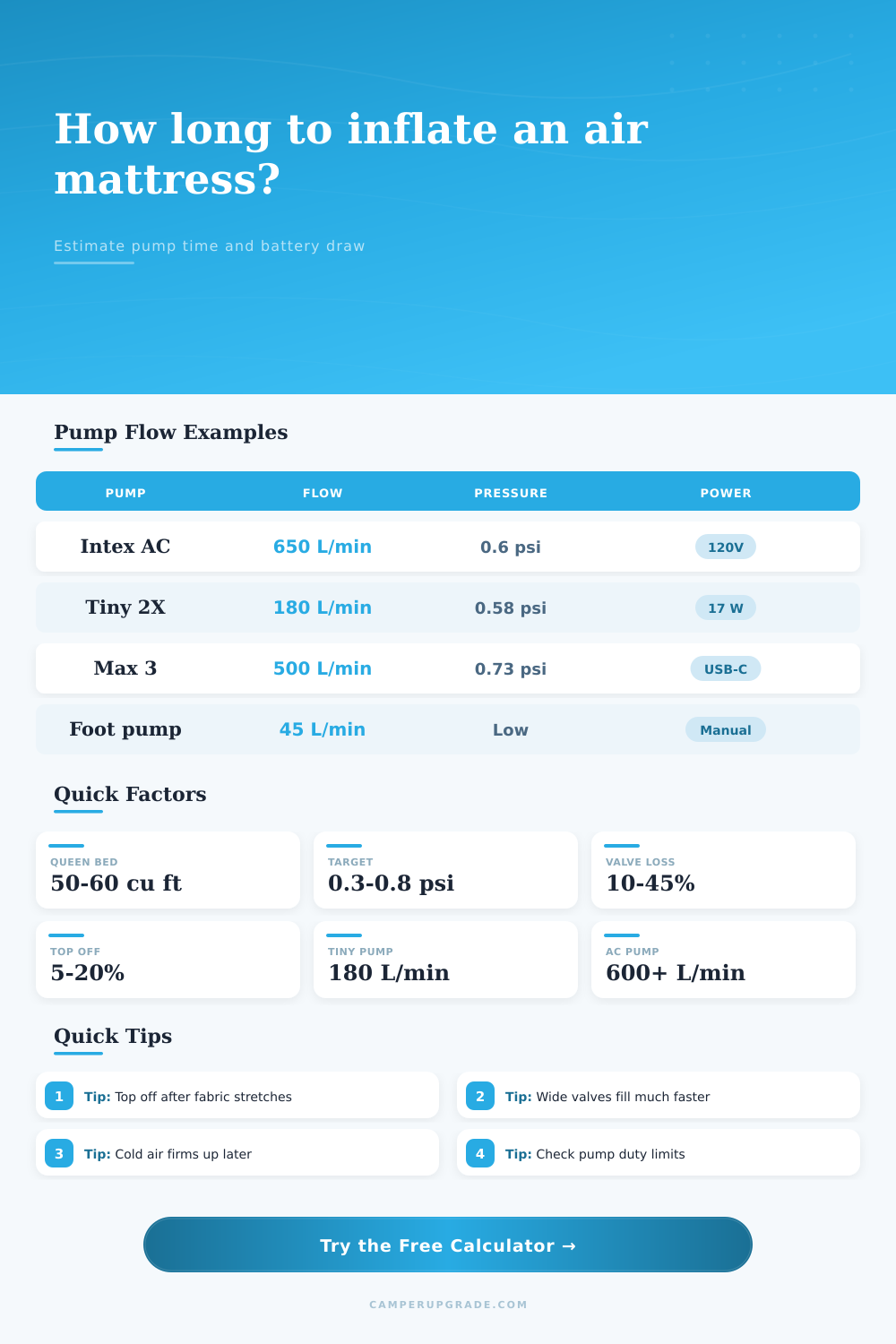
| Intex Quick-Fill AC pump | 600 to 650 L/min | Low pressure | Fast for queen airbeds when the valve adapter seals well. |
| Flextail Max Pump 3 | 500 L/min | 5 kPa / 0.73 psi | Strong rechargeable option for pads, floats, and camp mattresses. |
| Flextail Tiny Pump 2X | 180 L/min | 4 kPa / 0.58 psi | Compact pump; useful for pads and smaller low-volume mattresses. |
| Built-in raised-bed pump | 350 to 550 L/min | Low pressure | Usually tuned to fill the matching mattress in about 3 to 5 minutes. |
| Manual foot or hand pump | 30 to 90 L/min | Varies | Good backup, but valve losses and fatigue matter on tall beds. |
| Mattress style | Example size | Air factor | Estimated internal air |
|---|---|---|---|
| Double-high queen airbed | 80 x 60 x 18 in | 82% to 92% | 1,160 to 1,300 L before pressure allowance |
| Low queen camping airbed | 80 x 56 x 6 in | 70% to 78% | 440 to 500 L before pressure allowance |
| Double-wide foam mat | 80 x 60 x 4 in | 30% to 45% | 160 to 240 L of top-off air |
| Backpacking pad XL | 77 x 30 x 4 in | 50% to 65% | 75 to 100 L before pressure allowance |
| Truck or SUV air mattress | 74 x 55 x 5 in | 60% to 75% | 200 to 250 L before pressure allowance |
| Target feel | Gauge psi | Pressure multiplier | Use case |
|---|---|---|---|
| Soft first fill | 0.20 psi | 1.014x | Initial expansion before lying down or letting foam recover. |
| Medium camp comfort | 0.35 psi | 1.024x | Typical low-pressure mattress feel for side sleepers. |
| Firm raised airbed | 0.55 psi | 1.037x | Common finished feel for taller guest-style airbeds. |
| Very firm pad | 0.80 psi | 1.054x | Useful only when the pad or bed is rated for it. |
| Do not exceed rating | 1.00+ psi | 1.068x+ | Check the product label before using high-pressure pumps. |
| Pump draw | 5 minute fill | 10 minute fill | 12 V amp-hour use |
|---|---|---|---|
| 17 W mini pump | 1.4 Wh | 2.8 Wh | 0.12 to 0.24 Ah |
| 45 W rechargeable pump | 3.8 Wh | 7.5 Wh | 0.31 to 0.63 Ah |
| 90 W AC or DC pump | 7.5 Wh | 15 Wh | 0.63 to 1.25 Ah |
| 130 W high-flow pump | 10.8 Wh | 21.7 Wh | 0.90 to 1.81 Ah |
| Manual pump | 0 Wh | 0 Wh | No battery draw, only time and effort. |
Built-In AC Pump
Fastest setupBest when shore power is available. The pump and valve are matched, so restriction losses are usually modest.
High-Flow External
FlexibleGood for multiple inflatables. Adapter fit decides whether the rated flow turns into useful mattress flow.
Mini USB Pump
Tiny packExcellent for sleeping pads and short top-offs, but tall queen airbeds can outrun small battery capacity.
Manual Pump
No powerReliable backup for remote camps. Use a wide hose and expect a slower pace as the mattress firms.
internal liters = length x width x thickness x air factor x 0.016387.pressure-adjusted free air = internal liters x ((14.696 + target psi) / 14.696) x altitude/temp factor.top-off liters = internal liters x top-off percentage.effective L/min = nominal pump L/min x pump efficiency x (1 - valve restriction).minutes = (pressure-adjusted free air + top-off liters) / effective L/min. Battery Wh = pump watts x minutes / 60.
Air beds are frustrating because of how air moves. Plug it in. Nothing happens. The mattress stays flat. Then you has a party in your pajamas as you fiddle with your wheezy pump.
It’s personal, but it isn’t. Typically it’s a problem of misunderstanding the nature of air. It’s not that your pump are broken; it’s that air obeys rules of math, specifically pressure and volume and restriction. Most people treat air as if it were water, but air is actualy compressible and reactive. Fill up a bucket with air? Sure, no problem. But air is reactive and compressible. You don’t fill a mattress. You stretches the vinyl, compress the foam, and fight against air around you.
Why Air Beds Are Hard to Inflate
That’s why the Air Bed Calculator does all that math for you. Simply enter your mattress dimensions along with your pump specs and it’ll spit out an estimated time to inflate… Helping you know if your power bank will get you through the night.
But I think the greatest trap here is believing the flow rating on the package. Let’s say it says: “Six hundred liters per minute“. That’s a very big claim, and it’s made under ideal conditions; zero load and a wind tunnel. After that air must push against walls of your queen-sized bed, the effective flow decreases. To handle this, the tool allows you to dial down for both valve restriction and pump efficiency. A narrow adapter can chokes even a powerful pump. You get trickle instead of high-speed airflow. It is a small bottleneck, but it matters.
There’s an even quieter, but no less vital, part played by temperature. Warm air is expansive; cool air contracts. Inflate your mattress in a warm car trunk and it’ll be firm. Leave it out in cool mountain air overnight and its internal pressure decrease. Your mattress sags. It is not because it is leaking. It is simply a matter of physics.
Temperature and altitude are accounted for by the calculator. It will explain how your bed felt soft in the mountains at ten thousand feet, yet hard back down on the flatlands at sea level. There aren’t enough air molecules to make it as hard in thin air. That’s what the top-off feature is for. Most of the time, you need another quick shot of air to correct for temperature changes and fabric stretch.
The silent price of speed is battery draw. That high-flow pump moves lots of air, which means it sucks down juice like a vacuum. Especially on a small portable power station, that’s a big chunk out of your battery after inflating for just ten minutes. This calculator gives you an estimate of draw in both amp-hours and watt-hours. So there’s the trade-off. An efficient, slow pump will save you battery life at the expense of twenty minutes of time. A fast pump will get you to sleep faster but ask more from your battery. It’s up to you what you value.
To put all of that into perspective, there are some reference tables available on the page. It has common air flow rates for various types of pumps. These range from small USB models to full-blown AC-powered ones. And there is common air factors for each type of mattress. A low profile camping mat will hold less air than a boxy raised airbed. Maybe they look like the same thing on the ground, but they’re not. Filling one can take a few minutes while another takes just seconds. You’d should of want to understand this so you have realistic expectations. A backpacking pad might be filled in half a minute. A double high queen would take five minutes or longer.
Inflating a mattress is all about variables. Pushing a button isn’t enough. Fullness isn’t enough; you also need firmness. You has to choose your priority between power conservation and comfort. But after figuring out how volume, pressure, and restriction work together, this no longer feels like a mystery. This no longer feels like a waste of time. This no longer feels like fighting the pump. This starts feeling like working with the pump.
And when you lay down on a bed whose back support actualy makes a difference, you know all of those calculations was worth it. Because if you don’t know what to measure until after you’ve unrolled the vinyl, you’ll never figure it out.