Absolute Humidity Calculator
Convert temperature and moisture readings into grams of water vapor per cubic meter, dew point, and useful moisture load checks.
💧Scenario Presets
⚙Absolute Humidity Inputs
📊Formula Spec Grid
📘Absolute Humidity Reference Tables
| Temp | 50% RH | 80% RH | Feel |
|---|---|---|---|
| 0 C | 2.4 g/m3 | 3.9 g/m3 | Dry cold air |
| 10 C | 4.7 g/m3 | 7.5 g/m3 | Cool room air |
| 20 C | 8.6 g/m3 | 13.8 g/m3 | Comfort zone |
| 30 C | 15.2 g/m3 | 24.3 g/m3 | Sticky air |
| Temp | Sat AH | 100% RH | Risk note |
|---|---|---|---|
| -10 C | 2.3 g/m3 | Full frost air | Very low load |
| 0 C | 4.8 g/m3 | Cold boundary | Fog prone |
| 15 C | 12.8 g/m3 | Indoor spring | Moderate load |
| 25 C | 23.0 g/m3 | Warm summer | High load |
| Altitude | Pressure | Pressure note | Use case |
|---|---|---|---|
| 0 m | 1013 hPa | Sea level | Default math |
| 500 m | 954 hPa | Small drop | Hill camp |
| 1500 m | 845 hPa | Noticeable | Mountain site |
| 3000 m | 701 hPa | Thin air | High camp |
| Mode | Input | AH Path | Best use |
|---|---|---|---|
| RH | Percent | Fastest | Room checks |
| Dew pt | Temp | Stable | Condensation work |
| Wet bulb | Temp | Field use | Mixed air |
| Vapor p. | hPa | Direct | Lab readings |
Absolute humidity and relative humidity are two term that are often used to describe the amount of moisture within the air. Relative humidity is a measurement of the amount of water vapor that is within the air compared to the maximum amount of water vapor that the air can hold at a specific temperature. Because warm air can hold more water vapor than cool air, relative humidity can change even if the amount of water vapor within the air dont change.
Absolute humidity is a measurement of the mass of water vapor within a specific volume of air, and it is measured in grams per cubic meter. This measurement determines how many gram of water vapor are within each cubic meter of air. Unlike relative humidity, absolute humidity does not change with alterations in air temperature.
Difference Between Absolute and Relative Humidity
Most individual often consider and use relative humidity as a measurement. This is due to the fact that weather reports use relative humidity as the standard measurement. If the relative humidity within a given environment is 50 percent, that air is holding half of the amount of water vapor that it is capable of at that temperature.
However, the relative humidity within an area can be misleading when considering how moist or dry an individual might feel within that area. Warm air can hold more water vapor than cool air. If an area is cooled, the relative humidity within that area will increase even if no water vapor are removed from that area.
Absolute humidity is far more precise in measuring the amount of moisture vapor in an area because it does not use variable like temperature to calculate it’s value. There are a couple of different method of calculating the absolute humidity within an area of air. One of the most common method is through the use of the dew point of the air.
The dew point is the temperature at which the air within a specific area will become saturated with water vapor, causing the water vapor within that area to condense into liquid form. Using the dew point and the current air temperature in that area, one can calculate the absolute humidity of the air. Another method is to use the relative humidity of the area along with the saturation water pressure of the air, which the Magnus formula can calculate.
Additionally, the wet bulb temperature of the area can be used to calculate the absolute humidity of the air. Field psychrometers often use wet bulb temperatures to determine the absolute humidity of the air. Each of these variables can be used to find the absolute humidity of the air.
Each of these measurements can help to determine the amount of water vapor that is within the air. The atmospheric pressure and the altitude of an area can impact the density of the air within that area, which has an impact upon the volume of that air. Standard atmospheric pressure is 1013 hectopascals at sea level.
However, atmospheric pressure will decrease as the altitude of the area increase. People often ignore these variables when performing the calculations for absolute humidity. However, these variables will become important for individuals who live in mountain area or aircraft hangars.
Additionally, one must also consider the temperature of the surface within which the air is circulating. If the temperature of the surface within which the air is circulating is near or at the dew point of the air within that area, moisture will condense upon the surface of that area. If the temperature of the surface is within two degrees of the dew point of the air in that area, moisture will condense upon the surface of that area, such tent walls, RV fixtures, or industrial pipe.
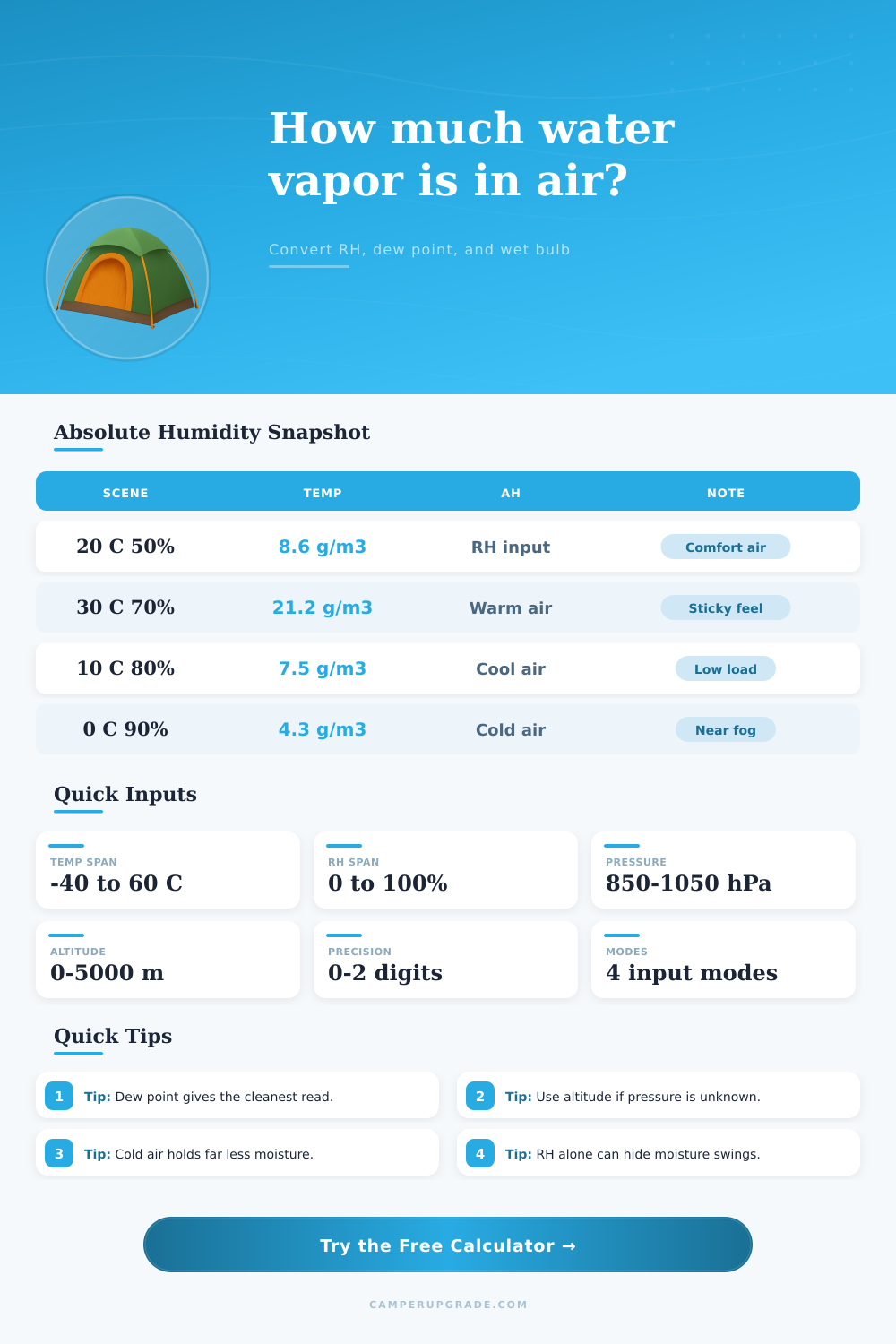
By comparing the absolute humidity within different area, it is possible to determine how absolute humidity can change in areas of different relative humidity levels. For instance, an area with a temperature of 78 degrees Fahrenheit and a relative humidity level of 72 percent has an absolute humidity of 12 grams of water vapor per cubic meter of air. An area within a greenhouse with a temperature of 85 degrees Fahrenheit and a high wet bulb temperature has an absolute humidity of more than 25 grams of water vapor per cubic meter of air.
In contrast, an area with a temperature of 0 degrees Celsius and a relative humidity level of 90 percent contain only 4 grams of water vapor per cubic meter of air. As a result, these examples show how relative humidity does not provide an accurate measurement for the amount of water vapor within an area of air. Instead, one should of consider the absolute humidity.
There are a variety of different task for which it is important to understand the absolute humidity of an area. For instance, an RV that contains 15 grams of water vapor per cubic meter of air will experience its window fogging quickly. In other instances, growers use the absolute humidity of the air to prevent mold from forming within humidifiers for plants.
Additionally, HVAC technicians use the absolute humidity of an area to determine the amount of moisture that a heating and cooling unit must remove from a specific area to balance the indoor climate. Furthermore, in the art of baking, it is important for flour to maintain a balance of moisture from the air. If the amount of grams of water vapor within the air changes, this will impact the properties of the dough that is produced using that flour.
For these reasons and others, it is essential for individuals to understand and calculate the absolute humidity within an area. The ability for absolute humidity to accurately reflect the true mass of water vapor within an area of air makes it the most reliable and accurat measurement of humidity.