Buddy Heater Runtime Per Tank Calculator
Estimate propane runtime from Buddy heater BTU setting, tank capacity, usable fuel, cycling duty, reserve, and planned hours per day.
Runtime Estimate
| Buddy heater model | Named setting | Input BTU/hr | Typical tank connection | Coverage rating |
|---|---|---|---|---|
| Little Buddy MH4B | Fixed | 3,800 | One 1 lb cylinder | Up to 95 sq ft |
| Portable Buddy MH9BX | Low | 4,000 | One 1 lb cylinder or remote tank | Up to 225 sq ft |
| Portable Buddy MH9BX | High | 9,000 | One 1 lb cylinder or remote tank | Up to 225 sq ft |
| Hunting Buddy MH12HB | Low | 6,000 | One 1 lb cylinder or remote tank | Up to 300 sq ft |
| Hunting Buddy MH12HB | High | 12,000 | One 1 lb cylinder or remote tank | Up to 300 sq ft |
| Big Buddy MH18B | Low | 4,000 | Two 1 lb cylinders or remote tank | Up to 450 sq ft |
| Big Buddy MH18B | Medium | 9,000 | Two 1 lb cylinders or remote tank | Up to 450 sq ft |
| Big Buddy MH18B | High | 18,000 | Two 1 lb cylinders or remote tank | Up to 450 sq ft |
| Tank size | Propane weight | Approx gallons | Total fuel energy | Usable at 95% minus 10% reserve |
|---|---|---|---|---|
| 1 lb disposable cylinder | 1 lb | 0.24 gal | 21,569 BTU | 18,329 BTU |
| Two 1 lb cylinders | 2 lb | 0.47 gal | 43,138 BTU | 36,667 BTU |
| 5 lb refillable cylinder | 5 lb | 1.18 gal | 107,846 BTU | 91,669 BTU |
| 10 lb refillable cylinder | 10 lb | 2.36 gal | 215,693 BTU | 183,339 BTU |
| 20 lb grill cylinder | 20 lb | 4.72 gal | 431,387 BTU | 366,679 BTU |
| 30 lb RV cylinder | 30 lb | 7.08 gal | 647,080 BTU | 550,018 BTU |
| 40 lb RV cylinder | 40 lb | 9.43 gal | 862,774 BTU | 733,358 BTU |
| BTU setting | Propane burn | 1 lb cylinder | Two 1 lb cylinders | 20 lb cylinder |
|---|---|---|---|---|
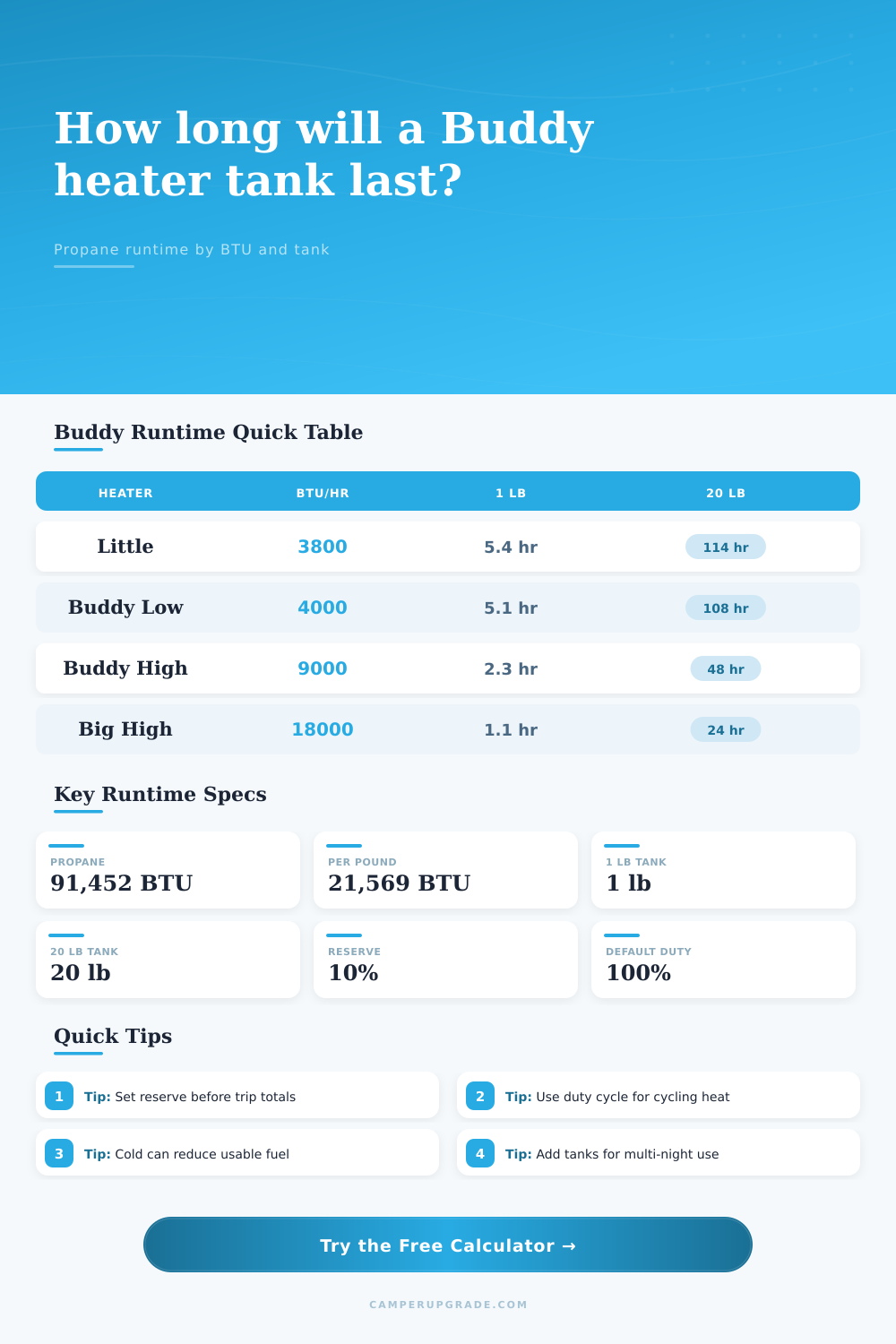
| 3,800 BTU/hr | 0.176 lb/hr | 5.7 hr | 11.4 hr | 113.5 hr |
| 4,000 BTU/hr | 0.185 lb/hr | 5.4 hr | 10.8 hr | 107.8 hr |
| 6,000 BTU/hr | 0.278 lb/hr | 3.6 hr | 7.2 hr | 71.9 hr |
| 9,000 BTU/hr | 0.417 lb/hr | 2.4 hr | 4.8 hr | 47.9 hr |
| 12,000 BTU/hr | 0.556 lb/hr | 1.8 hr | 3.6 hr | 35.9 hr |
| 18,000 BTU/hr | 0.834 lb/hr | 1.2 hr | 2.4 hr | 24.0 hr |
Table runtimes are theoretical continuous burn to empty. Use the calculator controls for reserve, fill level, cold derate, and cycling duty cycle.
| Scenario | Heater setting | Tank plan | Daily use | Estimated trip coverage |
|---|---|---|---|---|
| Small tent morning warmup | Little Buddy 3,800 | One 1 lb cylinder | 2 hr/day | About 2.4 days with reserve |
| Van shoulder-season evenings | Portable Buddy low | One 20 lb cylinder | 6 hr/day at 65% duty | About 78 days with reserve |
| Ice shelter high output | Portable Buddy high | Two 1 lb cylinders | 4 hr/day | About 1.0 day with reserve |
| Hunting blind dawn sit | Hunting Buddy low | One 5 lb cylinder | 3 hr/day | About 5.1 days with reserve |
| Big shelter heat burst | Big Buddy high | One 20 lb cylinder | 5 hr/day at 80% duty | About 5.1 days with reserve |
How long will it last on one bottle? Calculate your propane runtime and plan accordingly so that you can keep warm through the night. While propane is a good fuel source, it’s not possible to know how much propane you have left in your tank. Planning ahead of time how many bottles you’ll need prevents you from running out before daylight.
Here’s how it works with propane: Propane is roughly 21,000 BTUs per pound. Depending on the setting on your heater, it will draw a certain amount of that. The page has a calculator which runs the numbers for you. Knowing what the inputs mean help you to make more informed choices.
How to Plan Your Propane Use
For instance, it doesn’t take a full tank to last all night. Regulators can also freeze up in extreme cold and cause loss of pressure. It’s rare to have tanks filled to capacity either, since they are rarely filled to the brim. Having some reserve in the tank avoid a mess.
Total fuel isn’t the same as usable fuel. If you buy a 20 pound tank, you might only plan to use 95% of its contents. Reserve some for your safety. That’s a 10% reserve. So really you’re working with less than sixteen pounds of usable fuel.
Those reserves are what separate theoretical runtime from actualy runtime. They’re the margins that inform your decision about carrying another cylinder or not. After accounting for typical reserves, the table below shows how much energy each cylinder provide.
Fuel consumption also depends on your duty cycle. If you leave the heater running all day long you’ll burn through your fuel. However, most people only turn their heaters on when necessary and then turn them down or shut them off while sleeping. That means it reduce the average hourly consumption. By accounting for your intended duty cycle, the tool can adjust its burn rate accordingly. It provides an even more accurate prediction of how many days your fuel should of last. A rough estimate becomes a solid number.
The cold also presents problems. As it gets colder, propane doesn’t vaporize as effective. This results in lower pressure, which stops the fuel from reaching the burner at all. Build this decreased efficiency into your plan and factor it based off accordingly. Don’t depend on fuel remaining in the tank due to an inability of the regulator to provide it to you. Knowing this will allow you to determine whether a bigger tank is necessary or simply more trips to refill the tank.
Any decision around heat needs to be a safe one. Remember that carbon monoxide is no joke and make sure to ventilate properly. Managing fuel comes down to reliability and comfort, within safe limits.
Ideally, you don’t need to fret about running out of fuel when waking up warm in the morning. Having a reserve helps you avoid running the tank bone dry. It gives you a buffer for the last day or night, or for a surprise cold snap.
Without a plan for your heater run time your trip is full of anxiety. Do I have enough fuel? How many gallons do I use? When should I fill up? Running the numbers out in advance takes away that worry. This gives you peace of mind that you will know how long your heaters last. That way when it gets cold, you’ll know how long until they goes out.