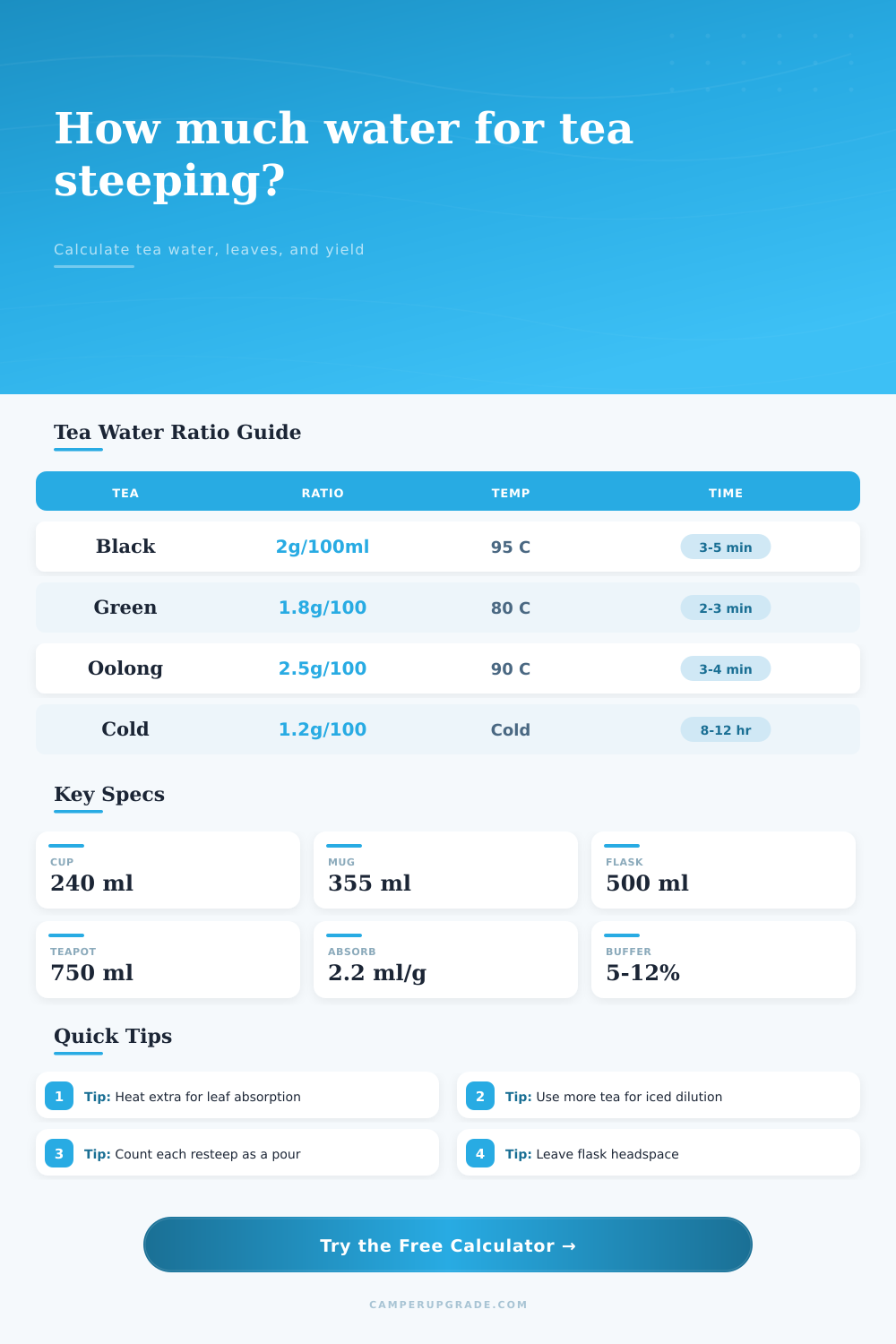
Tea Steep Water Volume Calculator
Size the pour water, finished tea yield, dry leaf grams, and kettle volume for mugs, flasks, teapots, cold brew bottles, and multi-infusion sessions.
☕Named Tea Presets
🫖Steep Inputs
Formula Breakdown
🧪Tea Spec Comparison Grid
📊Reference Tables
| Tea type | Baseline ratio | Water temperature | Typical steep time |
|---|---|---|---|
| Black tea | 2.0 g per 100 ml | 90 to 96°C / 194 to 205°F | 3 to 5 minutes |
| Green tea | 1.6 to 2.0 g per 100 ml | 70 to 85°C / 158 to 185°F | 1.5 to 3 minutes |
| Oolong tea | 2.0 to 3.0 g per 100 ml | 85 to 96°C / 185 to 205°F | 2 to 4 minutes |
| White tea | 1.3 to 1.8 g per 100 ml | 75 to 85°C / 167 to 185°F | 3 to 5 minutes |
| Pu-erh tea | 2.5 to 4.0 g per 100 ml | 95 to 100°C / 203 to 212°F | 20 sec to 3 minutes |
| Herbal infusion | 1.2 to 2.0 g per 100 ml | 95 to 100°C / 203 to 212°F | 5 to 7 minutes |
| Vessel | Nominal capacity | Practical fill at 90% | Best calculator use |
|---|---|---|---|
| Tasting cup | 60 to 90 ml | 54 to 81 ml | Flights, gongfu pours, split tastings |
| Standard cup | 240 ml / 8.1 fl oz | 216 ml / 7.3 fl oz | One measured serving |
| Large mug | 355 ml / 12 fl oz | 320 ml / 10.8 fl oz | Breakfast tea and desk mugs |
| Travel flask | 500 to 750 ml | 450 to 675 ml | Camp, commute, trail tea |
| Teapot | 600 to 1000 ml | 540 to 900 ml | Shared pours and second infusions |
| Cold brew bottle | 750 to 1500 ml | 675 to 1350 ml | Overnight chilled tea |
| Finished yield target | Tea at 1.5 g/100 ml | Tea at 2.0 g/100 ml | Tea at 3.0 g/100 ml |
|---|---|---|---|
| 250 ml mug | 3.8 g | 5.0 g | 7.5 g |
| 500 ml flask | 7.5 g | 10.0 g | 15.0 g |
| 750 ml pot | 11.3 g | 15.0 g | 22.5 g |
| 1 liter bottle | 15.0 g | 20.0 g | 30.0 g |
| 1.5 liter pitcher | 22.5 g | 30.0 g | 45.0 g |
| Common setup | Serving plan | Pour water before loss | Likely kettle volume |
|---|---|---|---|
| Solo camp mug | 1 x 300 ml at 95% | 285 ml | 325 to 360 ml |
| Two-person teapot | 2 x 240 ml at 95% | 456 ml | 520 to 580 ml |
| Three-cup flask | 3 x 240 ml at 90% | 648 ml | 735 to 820 ml |
| Gongfu session | 1 x 100 ml, 6 rounds | 600 ml | 700 to 780 ml |
| Cold brew bottle | 4 x 250 ml, no heat | 1000 ml | 1080 to 1180 ml |
💡Calculation Tips
It’s happened to all of us at one time or another: you poured scalding-hot water on your leaves, waited a while, and then drank the resulting brew, which tasted as if you’d boiled grass. It wasn’t the tea that was at fault (though I do admit it can be). The culprit is this.
It is the unseen math of absorption and volume that you don’t bother with because it seems too technical to apply to such a basic task. You figure that by filling teapot to fill line, you’ve got enough tea for each persons cup. But leaves are like sponges; they soak up liquid, and the water that spills out of kettle spout evaporates, while what sloshes around during transportation is lost to splashes. By the time you’re reaching for the cup of the last guest, it’s watery and tepid.
How to Make Perfect Tea Every Time
Before you even pick up the kettle, get your water volumes correct, and you’ll never again feel as though drinking tea are work. Plug in your vessel size (how many ounces or cups is in it) and number of servings, and the calculator does the math for you, no more guesswork as to just how much water gets lost among those leaves.
First, choose how many folks will be pouring and how big their mug are compared to how much they actualy hold. Three-hundred-fifty milliliters is roughly the size of a standard mug, though of course we tend to over-estimate when filling up; we leave some head space between the lid and the beverage to avoid spilling it on our way back to the office. Set a realistic fill target: ninety-five percent? The tool takes that into account, working backwards from that full volume to tell you precisely how much water to warm.
Leaves also absorb quite a bit of liquid, particularly while they’re expanding in the infusion; this is one input that throws people off. Rolled oolongs and compressed pu-erhs will holds more water than loose black teas. If you forget about how much water the leaves themselves drink, your output will be lower then expected. You can set the absorption rate on the calculator (often around two milliliters per gram of leaf). It may not seem like much, but when you’re planning on getting five infusions out of a single serving, every little thing counts. If you don’t factor in how much water the tea itself is drinking, by the time you get to your third pour you’ll only have steam and hot air.
The other key knobs are temperature and ratio. Because green teas should be brewed at lower temperatures and for shorter periods of time (lest they become bitter) while black teas require closer-to-boiling hot water to pull out their bolder flavors, this means those who choose green over black should use less leaf and/or hotter water. A chart on the page spells out basic brewing ratios, which basically says that, in general, the stronger the brew you prefer, the higher the number of grams of leaf for each hundred milliliters of water. Changing any variable change the overall amount of tea leaves needed. For a strong cup, add more grams to whatever amount you use; however, using more leaf also means it will absorb more water. Everything must be balanced because every small change affects the final result.
If you’re brewing iced tea or chai concentrate, it’s all about dilution from there. Adding melting ice, milk, or even a simple syrup to a normally brewed pot will change the concentration and can make it taste watery. There’s a dilution field built into the calculator, where you can account for addition of water via melting ice, milk, or sugar syrup. So instead of just guessing at a ratio, you’ll have a firm idea of what your original steep needs to be to make up for the additional ingredient and still arrive at your target taste profile.
And then there’s the real-world problem of transferring loss: Some water remains with every kettle-to-pot and pot-to-mug movement. A bit sticks to the ceramic surface; another bit evaporates into air. If the tool encourages you to heat just a smidgen more than the perfect amount, it serves as a buffer for this unavoidable waste.
It’s not precision for precision’s sake, but predictability. Ideally, you want to know that when the kettle beeps, your hot-water supply will suffice to fill all cups without leaving any dry mid-stream. And when you get those variables down, you don’t have any anxiety about your morning routine anymore. You won’t have to think, “Oh my god, did I heat enough water? Did I use too many leaves?” You know how it works.
And so does your cup of tea: it’s perfect, every time, all the way to the bottom. You reach for the kettle for one last pour and find it is still hot and strong. That’s when you realize that great tea isn’t some mystical thing. It’s simply paying attention to water.