Breaker Size for 12V Calculator
Size a camper, van, or RV 12V DC breaker from actual load, surge current, wire gauge, run length, derating, and voltage drop.
🚗 Camper Circuit Presets
⚙ Circuit Inputs
📊 Wire Ampacity and Resistance Grid
📋 Standard 12V Breaker and Fuse Sizes
| Standard rating | Typical camper use | Common minimum wire | Notes |
|---|---|---|---|
| 5A / 7.5A | LED lighting, sensors, small controls | 18-16 AWG | Good for small branch circuits with short runs. |
| 10A / 15A | Fans, USB sockets, water pump branches | 16-14 AWG | Use 3% voltage drop for motors and electronics. |
| 20A / 25A / 30A | Fridge feeds, outlets, compact compressors | 12-10 AWG | Check startup surge and the device maker's max fuse. |
| 40A / 50A / 60A | DC-DC chargers, solar controller outputs | 8-6 AWG | Long runs often need larger wire for voltage drop. |
| 80A / 100A / 125A | Small inverter feeds and subpanel feeders | 4-1 AWG | Use high-interrupt DC rated protection near the battery. |
| 150A / 175A / 200A | Large inverter or battery main protection | 1/0-2/0 AWG | Confirm cable, lugs, busbars, and terminals all match. |
⚡ Voltage Drop Targets for 12V Loads
| Target | 12.0V drop limit | Best for | Why it matters |
|---|---|---|---|
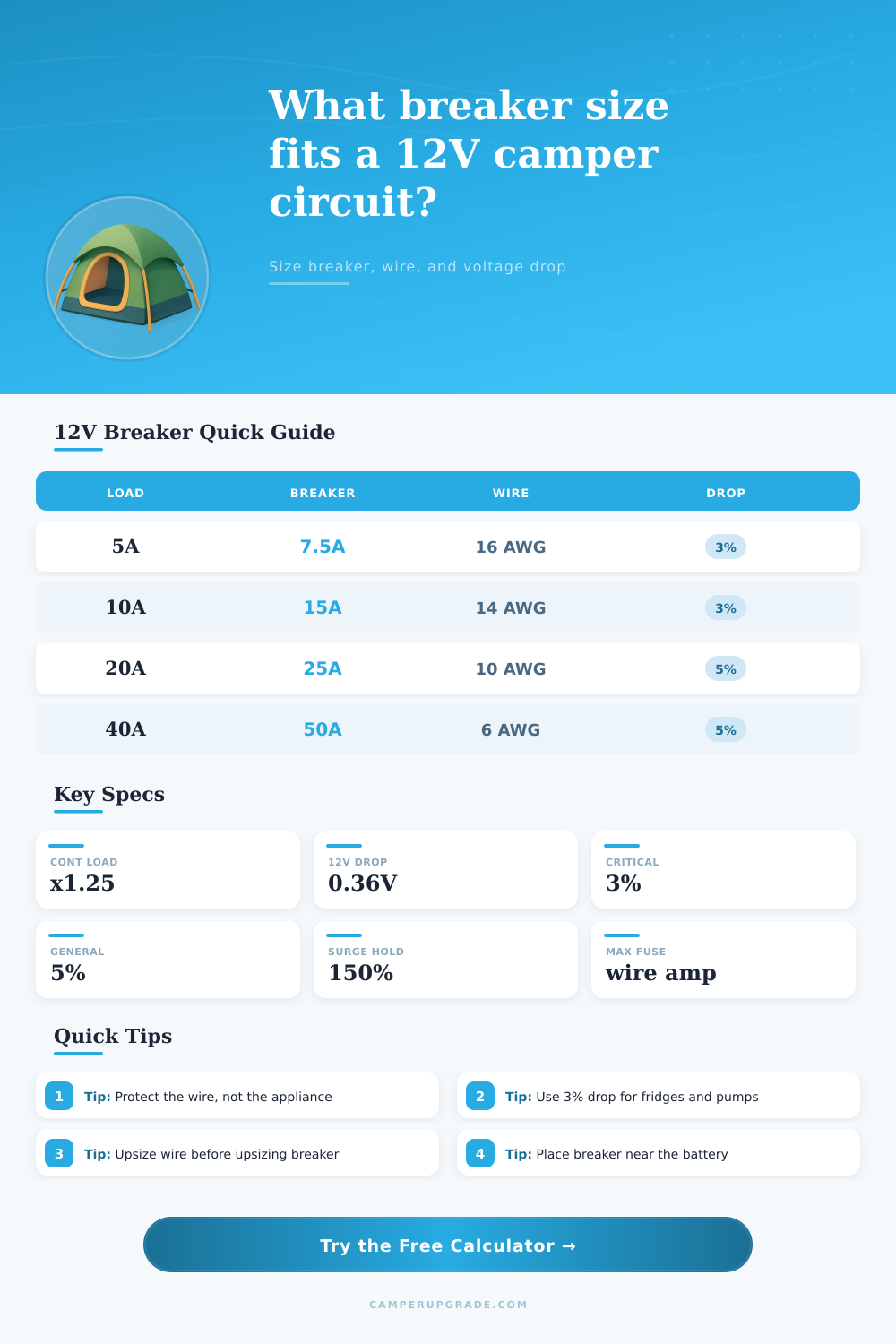
| 3% | 0.36V | Fridges, pumps, radios, chargers, controls | Low-voltage cutoffs and motors behave better. |
| 5% | 0.60V | General branch circuits and lighting | Balanced for most camper accessory runs. |
| 10% | 1.20V | Short-use, tolerant resistive loads | Use only when the device manual allows it. |
| Under 2% | 0.24V | Long fridge feeds or precision electronics | Often requires wire larger than ampacity alone. |
🔧 Protection Device Comparison Grid
| Device type | Best camper location | Strength | Watch point |
|---|---|---|---|
| Thermal reset breaker | Accessory branch circuits | Resettable and easy to service | Must be DC rated for the circuit voltage. |
| Manual reset breaker | Battery bay, charger feeds, panels | Works as a service disconnect | Choose an ignition-protected model where required. |
| MRBF terminal fuse | Battery positive post or busbar | Very short unprotected cable length | Terminal studs and cover clearance matter. |
| ANL fuse | Inverter feeds and high-current chargers | High ratings and common holders | Use proper crimped lugs and covered holders. |
| ATO/ATC blade fuse | Small fused distribution panels | Compact for many branch circuits | Panel and fuse holder temperature limits apply. |
📐 Common Camper Circuit Starting Points
| Circuit | Running amps | Typical breaker | Planning note |
|---|---|---|---|
| LED cabin lighting zone | 2A-5A | 5A-7.5A | Small gauge can work if the run is short. |
| Roof vent fan | 3A-6A | 7.5A-10A | Account for start current and long ceiling runs. |
| Water pressure pump | 7A-12A | 15A-20A | Motor surge often controls the breaker choice. |
| Compressor fridge | 5A-9A | 10A-15A | Use low voltage drop to avoid nuisance shutdowns. |
| 30A solar controller output | 25A-30A | 40A | Protect the battery-side conductor near the battery. |
| 40A DC-DC charger | 40A | 50A-60A | Follow charger maker fuse maximums and cable charts. |
🛠 Practical Sizing Notes
Have you ever had your camper fridge running but not cool? It’s enough to freak someone out. However, most of the time this isn’t because something mechanical has broken. This is usualy a voltage drop starving the compressor of the necessary power to cycle correctly.
Chances are you wired your batteries around the van and through some tight spots, thinking as long as the breaker doesn’t trip, all good. That assumption is exactly where most off-grid electrical projects goes wrong. Protection doesn’t just protect against fire, it protects equipment functioning right too.
Fixing Your Camp Fridge Power Problems
There is a simple calculator that will do the math for you. Once you understand what the numbers say, you has a plan instead of a guess.
First things first. Examine the load. Five amps doesn’t sound like much until you consider startup and how often it runs. For instance, suppose you have a fridge that run continuously for longer than three hours. In that case, electrical code typically says you should of assume it draws 125 percent of its constant power consumption. This is a safety margin to prevent insulation from overheating on hot wiring while used continuously.
And then there are surge currents to consider. Any appliance with a motor or compressor will draw twice or even three times the running current during startup. This means your breaker will trip every time the compressor kicks on if it’s only big enough to handle its normal draw. To help you get the right mix, the tool allows you to enter both steady state draw and surge current. This ensures protection device trips when necessary but remains intact during startup.
The other variable that is often neglected in this equation are wire gauge. The thinner the wire, the greater the resistance. Which means more of the voltage will be converted into heat before reaching your appliance. And remember, you’ve got precious little headroom to work with on 12-volt system. A single volt drop can send a touchy piece of electronics to sleep.
This brings us back to the calculator, which asks for both wire material and run length. Aluminum doesn’t conduct as well than copper, but even copper becomes less efficient at long distances. The distance from your battery in the front to your lights in the back matter more than you’d think. This is all nicely laid out on the page and the reference table shows how voltage drop limits can force you to use thicker wire than ampacity ratings alone would suggest.
This becomes especially important if you’re using a moddern inverter, because it needs certain things done exactly right to work properly. It’s a little thing, but it matters. Surprisingly, environmental variables matter as well. Wires wrapped snugly around another cable or bunched up in a single conduit can’t shed heat nearly as well as those running loose and open. That heat buildup increases their insulation’s temperature and reduces its ability to safely carry current.
It’s called derating. When installing several high-current cables in the same engine bay compartment, this increased thermal load must be accounted for. Real-world installs aren’t perfect, so the calculator has fields for bundling conditions and ambient temperature, though you won’t find those by searching “wire gauge”. While skipping them may save you a couple bucks on wire today, it could cause your insulation to degrade down the road.
And lastly, select the kind of protection device. For branch circuits, a thermal reset breaker is nice since you can just flip it back on when it trips. But maybe for those high-current main feeds or your input on your solar controller, an ANL holder or even a blade fuse may be better suited with their higher breaking capacity and reliablity. It’s not about trying to avoid a fire, but rather that under stress, the system responds as expected.
Protect the conductor and then the equipment falls into place. If you have the proper tool to interpret the ampacity charts, you don’t have to memorize them all. Simply know that each wire has its limit and every volt counts in 12-volt system. Respect the voltage drop and keep the connections tight so your camp stays powered up without any guessing.