Group Tent Capacity By Gear Calculator
Estimate how many people a group tent setup can really hold after sleeping pads, cots, packs, duffels, coolers, totes, wet gear, vestibules, and comfort reserve are counted.
Enter up to three tent types. Leave a count at zero if that tent type is not in the group.
Group tent capacity result
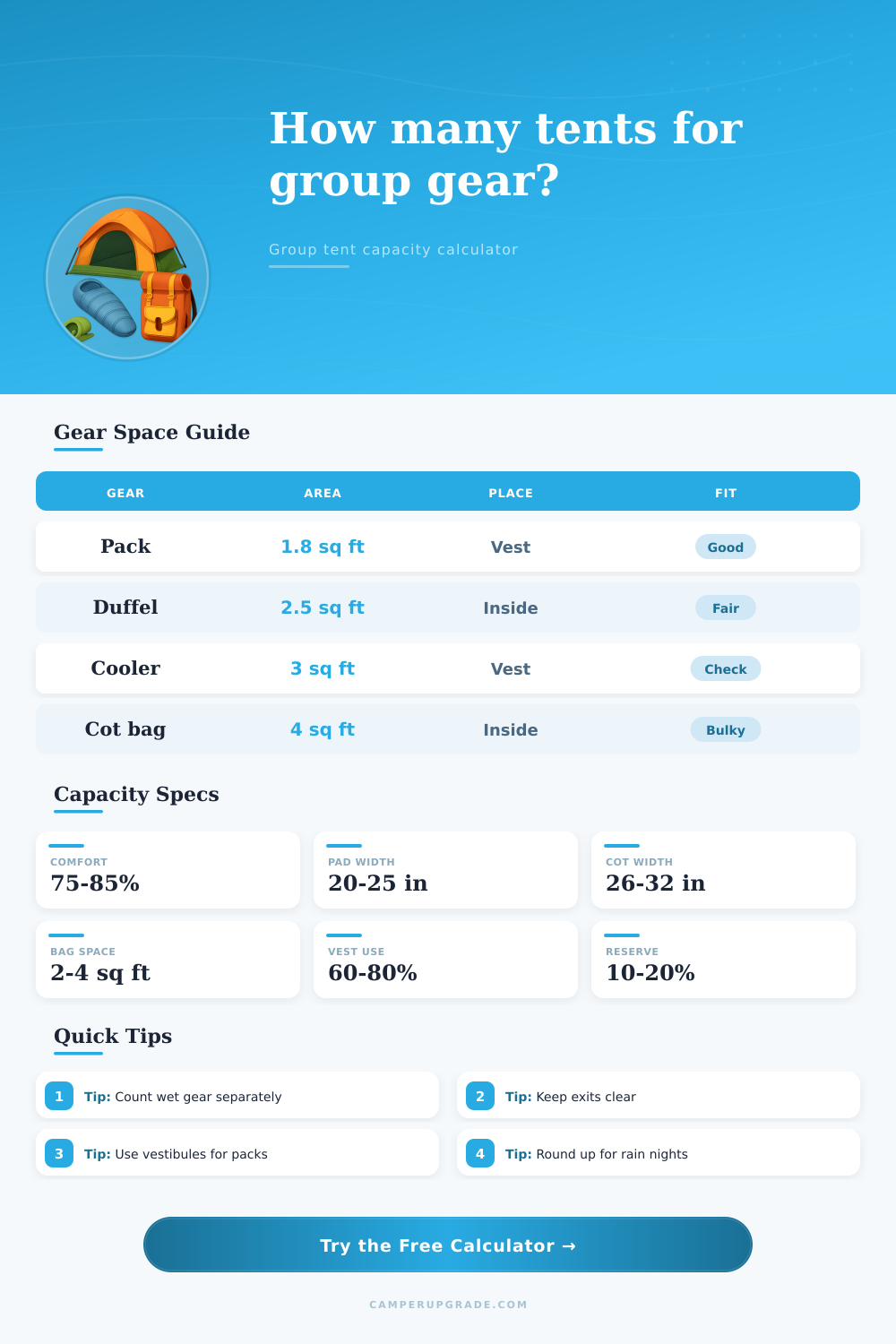
| Item or choice | Typical footprint | Best storage zone | Capacity note |
|---|---|---|---|
| Regular sleeping pad | About 12 to 14 sq ft with clearance | Indoor floor | Good baseline for backpacking and family tent layouts. |
| Camp cot | About 16 to 22 sq ft with clearance | Indoor floor | Cots reduce rated tent capacity quickly, especially in dome tents. |
| Loaded backpack | About 1.5 to 3 sq ft | Vestibule or tent edge | Keep packs outside the sleeping rectangle when weather allows. |
| Cooler or tote | About 2.5 to 5 sq ft | Vestibule, vehicle, or bear storage | Hard bins are poor indoor tent guests unless the tent is oversized. |
| Rainy conditions | Add 15% to 30% gear space | Protected storage | Wet boots, jackets, and tarps expand the shelter load. |
| Kids, pets, or winter kit | Add reserve before rounding | Indoor plus vestibule | Extra odd-shaped items usually matter more than printed capacity. |
When planning for a group, figure out number of tents needed, and then find the floor space remaining based off sleeping accommodations. Tent capacities refers to the number of long narrow pads that will fit in the tent on a dry night with little gear carried. In reality, most groups carry wet layers, food bins, packs, and sleeping system, making real-world capacities less than what’s printed on the tent.
The biggest use of floor space is for your sleeping pad or cot. Sleeping pads is bigger than you might expect, especially if they include space for shoulder width plus lofted bag. Cots take up even more volume due to their fixed size and dimensions that don’t stack well in tight spaces; they cut capacity much quicker then you’d guess from a label. You can substitute your sleep system and watch the available floor space decrease rapid on the calculator.
How to Choose the Right Tent Size
It gets worse with gear. The square footage per person grow bit by bit as people stash personal items in their tents. Equipment, coolers, and odd shape inflate the footprint of your shelter. And when it’s chilly or rainy, you pack more gear beneath cover, expanding the need for a vestibule. So the trip-condition setting increase demand.
On paper, a vestibule appears spacious; but it’s constricted by sloped walls and the swing of doors, limiting what will fit. To be accurate, usable-vestibule factor keeps the estimate reliable. Mostly it’s not the walls of the tent but what happens on the floor. A tent rated for 3 people can hold more if it has sufficient floor and no one is inside with all their stuff: no indoor gear, plus no floor for movement around doors, plus some sort of sleeping arrangement. If they pack in to capacity, then there won’t be enough room when someone needs to exit in the dark or dry a jacket. Saving space for such things allows the layout not to become an obstacle course.
Many pitfalls arise when people use manufacturer’s number as their lower limit instead of the upper. Many times, groups will find they have much less space than they thought in a tent designed for 6 people using pads. Then, when they adds cots and bins, they realize they can only fit three or four people. Another frequent error is storing everything inside because the vestibules feel small. Keep hard items and wet stuff out of the sleep area whenever you can. Separating your group’s gear into what goes inside and what goes in the vestibule make a difference.
Then the calculator will run those tradeoffs for you. It’ll count up what’s on the floor after protecting your sleep systems and any other items in protected storage. It will tell you if that still leaves room in your tents and flag if you’re too big of a group to be comfortabley.
Change your sleep setups. Try removing or adding a tent. Put more gear into your vehicles. See how the verdict changes. It’s pretty straightforward. Ideally, you’d want as much covered floor as possible to get people inside so no one steps on each other’s bags. You also want more room than necessary in case it rains overnight and your tent becomes a storage locker.
That’s where the math comes in, but ultimately how do they feel? How do you think they’ll go when it’s late at night, everyone is exhausted and the storm rolls in? You should of planned better if the group size are too large.