Shakedown Weight Calculator
Build a trip-ready camper weight check from dry weight, ratings, water, propane, batteries, passengers, cargo zones, hitch load, and shakedown reserve before the first real tow or drive.
🚙Camper Shakedown Presets
⚖Shakedown Weight Inputs
🔧Material and Spec Weight Comparison
📋Rating Margin Reference
| Check point | Good shakedown result | Caution range | Scale-day action |
|---|---|---|---|
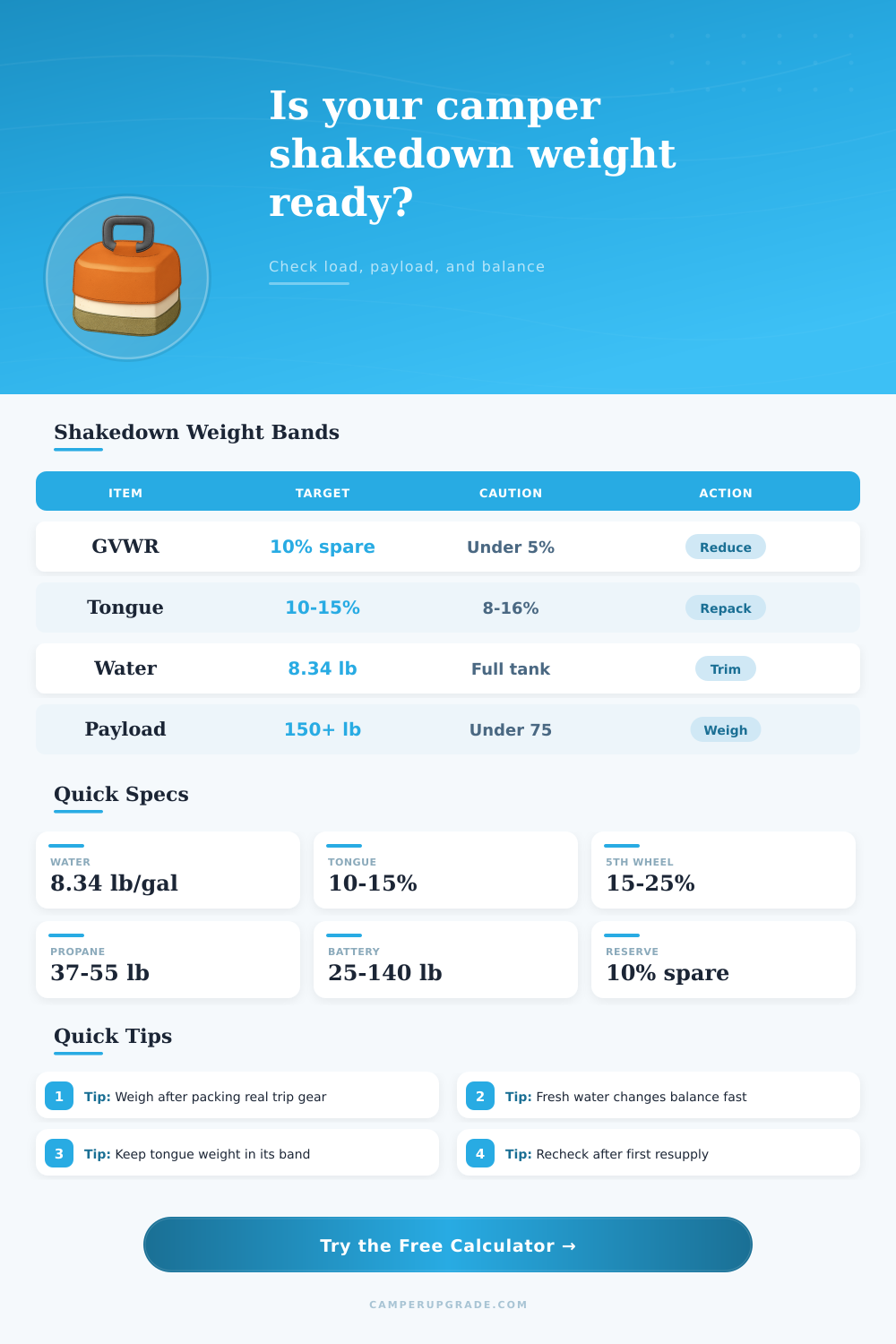
| Camper GVWR margin | 10% or more unused capacity | 5% to 10% unused capacity | Weigh loaded camper and remove low-value cargo if close. |
| Tow vehicle payload margin | 150 lb or more remaining | 75 to 150 lb remaining | Confirm door sticker payload and actual passenger weight. |
| Receiver or pin allowance | Hitch load below rating with spare margin | Within 10% of the rating | Move cargo, reduce water, or use a lighter front load. |
| Tongue or pin percentage | Inside the expected band for camper type | Just outside expected band | Repack front and rear zones, then reweigh. |
| Fresh water carried | Only the gallons needed for travel day | Large tank carried full by habit | Plan fill location, then compare water weight impact. |
🛞Camper Load Bands
| Camper type | Balance target | Common heavy zones | Shakedown warning sign |
|---|---|---|---|
| Travel trailer | 10% to 15% tongue weight | Front pass-through, propane, battery, rear rack | Rear cargo drops tongue percentage below the steady towing band. |
| Fifth wheel | 15% to 25% pin weight | Front bedroom, basement, generator bay | Pin draw uses too much truck payload after passengers. |
| Truck camper | Payload and rear axle margin | Water tank, batteries, rear storage, roof gear | Rear axle allowance is used before overall payload looks full. |
| Motorhome | GVWR and axle split | Basement bays, water, passengers, rear hitch carrier | Rear cargo or towed load crowds rear axle margin. |
| Teardrop | 10% to 15% tongue weight | Galley, tongue box, cooler, battery | A small gear change creates a big percentage swing. |
| Item | Typical weight | Where it acts | Calculator note |
|---|---|---|---|
| Fresh water | 8.34 lb per gallon | Tank position | Forty gallons adds about 334 lb before hoses or jugs. |
| Grey or black water | 8.34 lb per gallon | Tank position | Return trips can be heavier than outbound drives. |
| Two 20 lb propane cylinders | About 74 lb full | Usually tongue or front bay | Full cylinder weight includes metal tare weight. |
| Dual lead-acid batteries | About 124 lb | Tongue, front tray, or side bay | Battery swaps can change balance and payload. |
| Zone | Load effect | Best use | Shakedown habit |
|---|---|---|---|
| Front storage | Raises tongue or pin load | Light bulky gear and stable essentials | Weigh tools and hardware before they disappear in bins. |
| Center cabinets | Mostly raises total camper weight | Food, cookware, bedding, clothes | Use this zone for dense gear when possible. |
| Rear garage or rack | Can reduce tongue percentage | Only cargo the camper is rated to carry | Check sway margin after adding bikes or generators. |
| Truck bed cargo | Uses payload directly | Recovery gear, jugs, compact outdoor gear | Count it with passengers, hitch load, and pets. |
🗺Common Shakedown Loads
| Scenario | Typical added cargo | Fresh water choice | Weight watch point |
|---|---|---|---|
| First campground weekend | 500 to 900 lb | 5 to 15 gallons for travel | People and tongue load may use tow vehicle payload first. |
| Family bunkhouse trip | 900 to 1,500 lb | 10 to 30 gallons depending on fill access | Food, bikes, chairs, and games add up fast. |
| Boondock setup | 1,200 to 2,500 lb | Full or nearly full tank | Water, batteries, generator, and recovery gear drive the load. |
| Winter shakedown | 800 to 1,600 lb | Often reduced for freeze planning | Insulation gear, propane, clothing, and tools raise front load. |
| Small camper minimal kit | 250 to 600 lb | 0 to 10 gallons | Small GVWR means modest cargo can consume capacity quickly. |
💡Shakedown Weight Tips
Use this calculator as a planning check, then verify with certified scale weights and the rating labels on the actual camper, tow vehicle, hitch, tires, and axles.
Managing the weights of the camper is important because the weight of the camper affects how a camper tow. When a person begins to pack a camper, they may use an estimate of the weight of the camper that they feel is reasonable. However, once that person begins to load propane, water, and gear into a camper, that weight will change.
A shakedown weight check will allow the driver to viewing the weight of the camper prior to departure. In this way, a shakedown weight check is necessary to view the effect of loading liquids and gear into the camper. The weight calculator for a camper will ask for several value of the camper to be entered.
Check Your Camper Weight Before You Travel
The user will need to enter the dry weight of the camper, as will the GVWR of the camper, the payload allowance of the camper, and the cargo zone of the camper. The cargo zones are importance because the weight of items does not necessarily has to be even throughout the camper. For instance, loading heavy items into the front pass through of a camper will alter the tongue weight percentage of the camper more than if those same items were loaded into the axle of the camper.
Additionally, loading cargo into the rear of the camper can lower the tongue weight percentage to an amount that the camper cant tow effective. The weight calculator will ask for the weight of the water that the camper will use. The weight of water is 8.34 pound per gallon, which is the actual weight that will be added to the tank of the camper.
Additionally, a person will need to use the position selector for the fresh water tank to indicate whether the tank will be in the front or the back of the camper. If the fresh water tank is loaded near the axle, it will contribute to the total weight of the camper but not the tongue weight percentage. If, however, the fresh water tank is in the front of the camper, it will add to the hitch load of the camper.
This could add to the payload of the tow vehicle, especially if there are also passenger or cargo in the tow vehicle. The same information is asked of the camper for propane and batteries. The weight of propane and batteries is similar to that of water.
Additionally, because propane and batteries are often stored in the tongue or the front tray of the camper, they will have an impact on the hitch load of the camper rather than the center of the camper’s cabin. Using the weight calculator, a person can choose the size of the propane cylinder or the size of the batteries that the camper will tow. This allows drivers to determine the impact of propane and batteries on the camper instead of guess at that impact.
The reference table for the camper will include the target band of tongue weight or pin weight for different type of campers. Each camper will handle weight differently. For instance, a fifth wheel can have a higher pin weight percentage than a travel trailer can have in tongue weight.
Additionally, the payload of the truck and the rear axle of the truck will limit a truck camper. These bands will allow a camper to compare its weight to the target weight of campers of similar make and model. It is likely that a person will find that the weight of the camper is heavier than that which was accounted for in the plan for the camper.
To account for this, the camper may request a reserve target for the weight of the camper. For instance, a ten percent reserve target will account for any difference in scale reading and small items that may be loaded into the camper on the trip. Instead of loading the camper with one set of items and then running the camper through the weight calculator, an individual should load one complete load and then run the camper through the weight calculator.
Additionally, the camper should be weighed at a public scale to compare the weight indicated by the camper’s weight calculator. If the camper is outside of the target band for the camper, it may be necessary to move cargo from one side to the other. For instance, cargo can be loaded from the rear to the front of the camper, or items that are heavy in the camper can be replaced with light items.
Through the process of calculating the camper and the impact that each type of item will have upon the camper, it is possible to ensure that the load of the camper will match the rating provided on the door sticker on the camper. It is also possible to understand the impact of the camper’s load upon the way that it tows. Additionally, the drive will feel more steady in the road due to having recognized the issues that the camper may have with towing in the driveway instead of the highway.