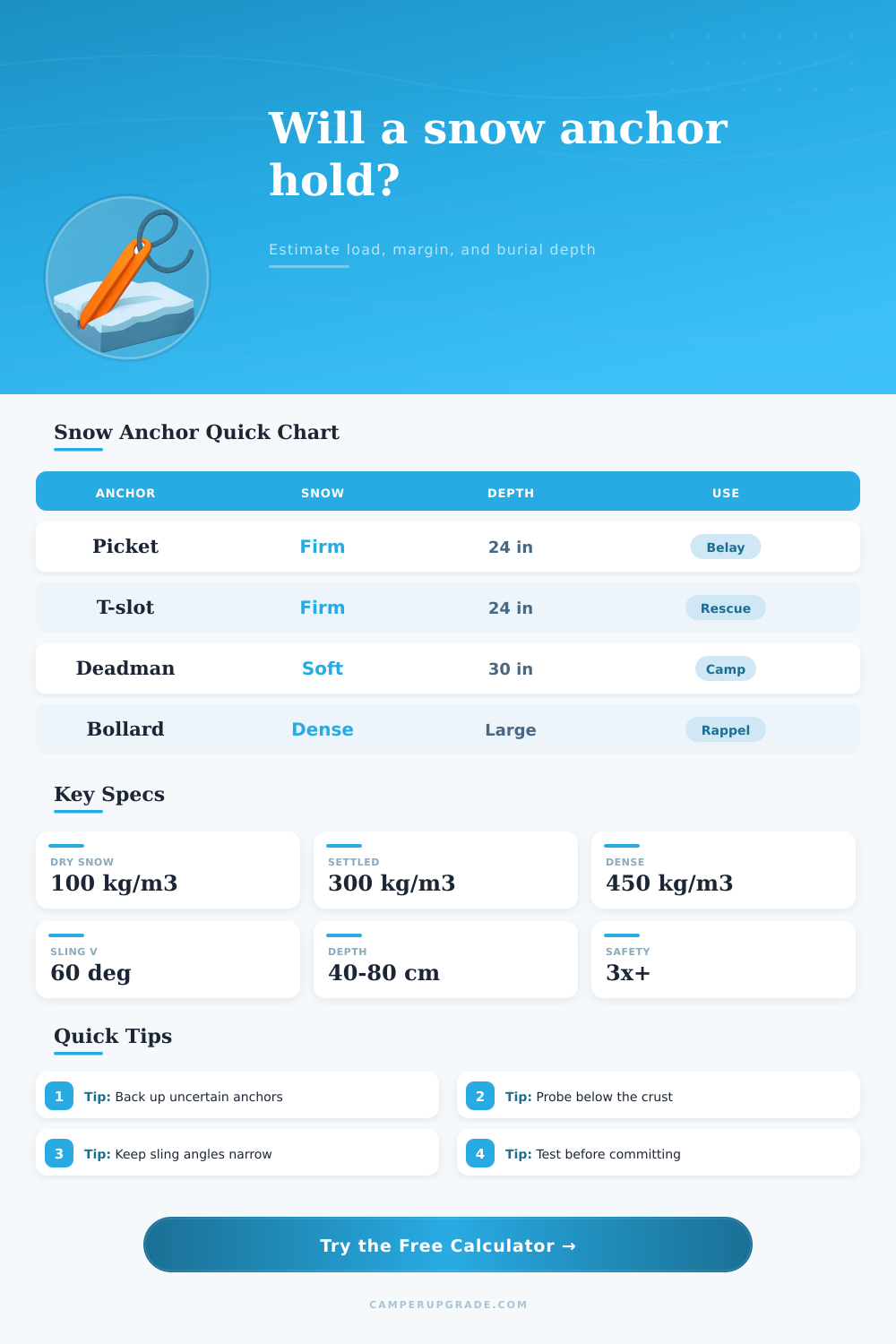
Snow Anchor Force Calculator
Estimate snow anchor holding force, required burial depth, force per anchor, and load margin from load, snow density, anchor type, burial depth, picket angle, sling angle, dynamic factor, crust support, and safety factor.
❄Snow Anchor Presets
⚙Anchor and Load Inputs
Planning limit: snow anchors are condition-sensitive and can fail suddenly. This calculator is a conservative comparison tool only; it does not verify snow stability, anchor construction, placement quality, edge effects, equipment rating, or climbing and rescue technique.
📊Anchor Spec Grid
📋Snow Anchor Reference Tables
| Anchor Type | Reference Depth | Reference Holding | Best Use |
|---|---|---|---|
| Vertical picket | 60 cm / 24 in | 3.2 kN / 720 lbf | Firm snow where a driven picket seats cleanly. |
| T-slot picket | 60 cm / 24 in | 5.4 kN / 1210 lbf | Buried picket loaded from a trench or slot. |
| Horizontal deadman | 65 cm / 26 in | 4.8 kN / 1080 lbf | Large buried object in consolidated snow. |
| Ski or splitboard deadman | 70 cm / 28 in | 6.2 kN / 1390 lbf | Broad surface area for soft to settled snow. |
| Ice axe deadman | 55 cm / 22 in | 3.6 kN / 810 lbf | Emergency anchor with limited bearing area. |
| Snow fluke | 55 cm / 22 in | 4.4 kN / 990 lbf | Fluke buried and loaded in supportive snow. |
| Buried pack or stuff sack | 75 cm / 30 in | 4.0 kN / 900 lbf | Emergency deadman when surface area is large. |
| Snow bollard | Large radius | 5.8 kN / 1300 lbf | Dense cohesive snow with smooth load path. |
| Paired pickets | 60 cm / 24 in | 6.0 kN / 1350 lbf | Equalized pickets with good separation. |
| Compact stake cluster | 40 cm / 16 in | 1.6 kN / 360 lbf | Camp or tarp loads, not life-safety loads. |
| Snow Density | Typical Feel | Model Factor | Anchor Note |
|---|---|---|---|
| 80 to 150 kg/m³ | Dry powder | 0.38 to 0.57 | Needs large deadman surface and extra depth. |
| 150 to 250 kg/m³ | Light settled snow | 0.57 to 0.82 | Driven anchors may cut or rotate. |
| 250 to 350 kg/m³ | Settled winter snow | 0.82 to 1.15 | Reference range for many presets. |
| 350 to 500 kg/m³ | Dense wind-packed snow | 1.15 to 1.55 | Strong if uniform, risky if slab is hollow. |
| 500+ kg/m³ | Wet or refrozen snow | 1.55+ | Can be strong, but surface melt can undercut. |
| Sling Angle | Force Per Anchor | Meaning | Planning Advice |
|---|---|---|---|
| 0° | 50% of load | Parallel legs | Best force sharing if geometry permits. |
| 30° | 52% of load | Narrow V | Efficient and easy to manage. |
| 60° | 58% of load | Common upper target | Good practical limit for many anchors. |
| 90° | 71% of load | Wide V | Margin falls quickly. |
| 120° | 100% of load | Very wide V | Each anchor sees the full load. |
| 150° | 193% of load | Severe angle | Avoid; geometry multiplies force. |
| Burial Depth | Approx Metric | Best Match | Depth Caution |
|---|---|---|---|
| 12 in | 30 cm | Tent stakes, tarp anchors, very small loads | Usually too shallow for serious loads. |
| 18 in | 45 cm | Compact picket or axe in firm snow | Requires strong cohesive snow. |
| 24 in | 60 cm | Common picket and T-slot reference depth | Still depends heavily on density and trench quality. |
| 30 in | 75 cm | Deadman, pack, ski, or rescue backup | Digging effort increases but margin improves. |
| 36 in | 90 cm | Soft snow or high safety factor | Probe for weak layers below the anchor. |
| Dynamic Factor | Scenario | Load Effect | Use In Calculator |
|---|---|---|---|
| 1.0x | Slow static pull | No multiplier | Gear hauling, tarp, or controlled test pull. |
| 1.3x | Low movement | Mild multiplier | Careful body-weight transition. |
| 1.8x | Slip or sudden sit | Moderate multiplier | Default cautious human-load planning. |
| 2.5x | Short fall or jolt | High multiplier | Use for poor stance or rescue uncertainty. |
| 3.5x+ | Shock-prone setup | Very high multiplier | Rebuild the system with qualified judgment. |
💡Snow Anchor Tips
This calculator intentionally rounds and simplifies snow behavior. Real holding strength depends on snow layering, trench shape, load direction, settling time, anchor material, and how cleanly the object bears against the snow.
A snow anchor force calculator is an tool that helps engineers and construction worker calculate the strength of a snow anchor system. A snow anchor system consist of many variable that a snow anchor force calculator translates into an estimate of the safety of the snow anchor system. These variables include snow density, the depth of burial of the snow anchor, the shape of the snow anchor, and the angle of the sling used in the snow anchor system.
The snow anchor force calculator make it possible for a worker to determine whether the snow anchor system will remain above the safety margin that has been set for that snow anchor system. The density of the snow that the snow anchor must hold is one of the primary variables that impact the strength of that snow anchor system. The density of snow can range from the density of light powder snow to settled winter snow and wind-packed snow.
How a snow anchor force calculator works
The snow anchor force calculator ask for the density of the snow that the snow anchor is to hold. The density of the snow will significant impact the modeled strength and holding capacity of the snow anchor. Hence, it is imperative to know the density of the snow for which the snow anchor will have to hold it’s weight.
The type of snow anchor that will be used will also have a bearing on the strength of the snow anchor system. If vertical picket are to be used, the snow anchor has to remain in a vertical position. Should there be any change in the angle of the pull of the vertical picket snow anchor, the strength of the system will wane.
Horizontal deadman anchors are strong in that they can handle any pull direction. Should snow bollards be used, the snow has to exhibit some level of cohesiveness. Should the snow be too soft when placing the snow bollard, there is a possibility of the snow shearing.
Depending on the type of snow anchor system that will be used, the snow anchor force calculator will assign different strength to the various snow anchors. The depth from which the snow anchor will be buried into the snow will also impact the strength of that snow anchor system. The deeper the burial of the snow anchor, the more greater the holding strength of the snow anchor.
For instance, if the depth of the snow anchor is increased from 18 inch to 24 inches, the strength of that snow anchor can increase by 30 or 40 percent. The snow anchor force calculator will provide the depth requirement of the snow anchor system, which will tell the snow anchor placer how much deeper the snow anchor has to be dug to accommodate for the chosen safety factor for the snow anchor system. The geometry of the sling between the two snow anchors and the dynamic load that might be placed on the system are two additional variables that can impact the strength of a snow anchor system.
The angle of the sling between the two snow anchors will impact the strength of the snow anchors that will have to hold that load. The wider the angle between the two snow anchors, the stronger each snow anchor must be to hold that dynamic load. Dynamic loading refer to the sudden movement or jerk in the load that is to be held by the snow anchor system.
The stronger the dynamic load on the snow anchor system, the more strength the snow anchors will need to withstand that load. The snow anchor force calculator combine these two variables to provide an estimate of the total force that each of the snow anchors will have to withstand. The safety factor is used as a buffer for the variables in the snow anchor system that the snow anchor force calculator cannot measure.
The snow anchor force calculator cannot account for the presence of weak layer of snow beneath the surface or the shape of the trenches of the snow anchors. A safety factor must be entered into the snow anchor force calculator. If the output of the snow anchor force calculator indicates that the utilization of the snow anchor system is too high for the snow that is to be held, then changes must be made to the plan for the placement of the anchors.
Changes to the plan can involve increasing the depth of burial of the snow anchor, changing the type of snow anchor to be used, or decreasing the angle of the sling of the snow anchor system. Although a snow anchor force calculator can provide a solid estimate of the strength of the snow anchor system that will be used, it is not a guarantee of the safety of those snow anchors. The variables of the snow that is utilized are not often uniform, and the snow can change after the placement of the snow anchor.
Hence, it is best to use the snow anchor force calculator to compare the different type of snow anchors that will be used and the depth to which they will be buried. Additionally, the snow anchor force calculator can be used to determine whether the combination of variables for the snow anchor will meet the safety factor that is required of that snow anchor system. Before placing any snow anchors into the snow that will be held, the numbers for that snow anchor system should of been run through the snow anchor force calculator.
After placing the snow anchors into the snow, it is important to test the strength of that snow anchor system. Should the snow anchor system be found to not be able to hold the load that is to be placed upon it, then the snow anchor must be rebuilt. It is important to follow this cycle of placing, testing, and rebuilding of snow anchors as it will ensure that the snow anchor system that is established will be functional.