Naismith Hiking Time Calculator
Estimate Naismith route time, adjusted elapsed time, latest turnaround point, and average speed from distance, elevation gain, descent, pack weight, terrain, rest breaks, group pace, and daylight buffer.
🏔Route Presets
⚙Hiking Time Inputs
📐Naismith Rule Spec Grid
This planner starts with Naismith's rule, then applies practical route adjustments. It is a planning estimate, not a guarantee for navigation, weather, snow, altitude, stream crossings, or emergency decisions.
📊Reference Tables
| Hiking rule | Base assumption | Best use | Watch out for |
|---|---|---|---|
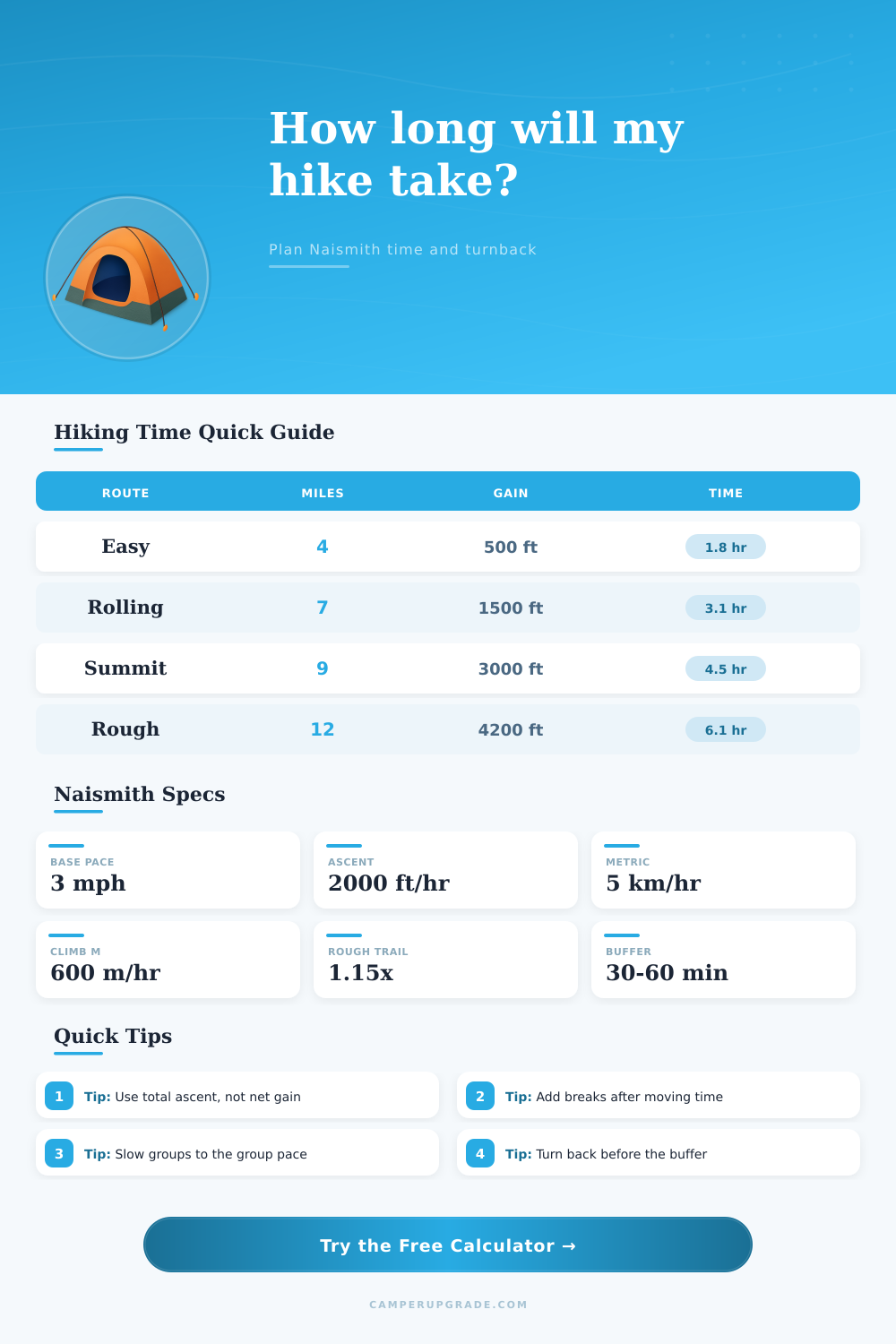
| Naismith rule | 3 mph plus 1 hour per 2,000 ft gained | Maintained trails with clear distance and ascent | Does not include long stops, rough footing, or slow groups by itself. |
| Metric Naismith | 5 km/h plus 1 hour per 600 m gained | Maps and guidebooks listed in kilometers and meters | Rounding can differ slightly from the imperial version. |
| Descent caution | Gentle downhill may be fast; steep downhill can be slow | Routes with major descents, steps, talus, snow, or tired knees | A long descent after a summit can take more time than expected. |
| Elapsed planning | Moving time plus breaks and regrouping | Daylight, pickup time, camp arrival, and shuttle planning | Elapsed speed is usually much slower than moving speed. |
| Terrain factor | Multiplier | Route example | Planning note |
|---|---|---|---|
| Smooth path or road walk | 0.95x | Rail trail, gravel road, easy approach | Can be faster than classic Naismith if navigation is simple. |
| Maintained hiking trail | 1.00x | Clear dirt path with normal grade changes | Good default when trip reports match map data. |
| Roots, rocks, and steps | 1.08x | Forest trail, stone steps, frequent uneven footing | Small delays add up on long routes. |
| Loose talus or sand | 1.16x | Scree slope, sandy wash, loose volcanic trail | Footing costs time even without extra elevation gain. |
| Mud, snow, or off-trail | 1.25x | Wet trail, shallow snow, faint route | Use a conservative daylight buffer. |
| Deep snow or bushwhack | 1.35x | Untracked winter approach or dense brush | Consider segment calculations and a firm turnaround. |
| Pack weight | Typical use | Calculator treatment | Field note |
|---|---|---|---|
| 0-10 lb / 0-5 kg | Short day hike or trail run vest | No meaningful pack penalty | Distance and climb dominate the time estimate. |
| 11-25 lb / 5-11 kg | Normal daypack with water, layers, and food | Small penalty above light-pack baseline | Water weight can change during the route. |
| 26-40 lb / 12-18 kg | Overnight, winter day kit, or shared group gear | Moderate time penalty, especially uphill | Use realistic descent pace if knees or footing are limiting. |
| 41 lb+ / 19 kg+ | Heavy backpack, long food carry, or technical kit | High penalty capped for planning stability | Break the route into smaller segments when the load is this high. |
| Route profile | Distance | Gain | Naismith moving time |
|---|---|---|---|
| Short local loop | 4 mi / 6.4 km | 500 ft / 150 m | About 1 hr 35 min before breaks |
| Rolling half-day | 7 mi / 11.3 km | 1,500 ft / 460 m | About 3 hr 5 min before adjustments |
| Mountain summit | 9 mi / 14.5 km | 3,000 ft / 915 m | About 4 hr 30 min before rough trail factors |
| Long rugged day | 12 mi / 19.3 km | 4,200 ft / 1,280 m | About 6 hr 5 min before breaks and group pace |
💡Naismith Planning Tips
For committing terrain, poor weather, avalanche conditions, extreme heat, altitude illness risk, or routes requiring technical skills, use this calculator only as an early planning check and follow local expert guidance.
A Naismith hiking time calculator are a tool that you can use to estimate how much time a hike will take. You might think that the distance on a map to the trails start is a good estimation of hiking time, but there is many factor at work. A hiking time calculator take into account these different factors so that you can more accurately calculate your hiking time.
The hiking time calculator is based off a rule created by a Scottish mountaineer. His rule specified that a fit individual should be able to travel at a speed of three mile per hour on flat terrain. Furthermore, the rule also stated that an individual should add one hour of hiking time for every two thousand feet of elevation gain that the hike would include.
How a Hiking Time Calculator Works
This rule work well for hikes that feature relatively easy terrain and flat area. However, there is other factors that can have a significant impact on hiking time. A hiking time calculator accounts for these factor.
One of the factors that influence hiking time is the gain in elevation that a trail will feature. This factor is cumulative, meaning that the trail will feature a start location and an end location that has the same elevation. Any amount of elevation gained en route to the destination will impact hiking time.
Therefore, it is necessary to use the hiking time calculator to enter the total amount of elevation gain that will be experienced during the hike. Descents are also crucial to consider. Any long descent on a hike can take up to as much time as the hikes ascent to the peak of that hike.
A hiking time calculator accounts for steep descents because they can cause strain on a hikers knees, and they require careful footing while descending those hills. The hiking time calculator accounts for the weight of the hiking pack. Any hike that features a hiking pack that is more heavier than a light daypack will take longer than a hike with a lighter pack.
The longer hiking time resulting from a heavier hiking pack is minimal for day hikes. However, if the hiking pack is too heavy for a hike that is to be made overnight or in the winter months, the additional weight of the hiking pack will take a more significant impact on the hiking time. Terrain features is also essential for hiking time estimates.
A hiking time calculator accounts for terrain features by using a multiplier for hiking terrain. For instance, terrain features like snow require the hiker to travel at a slower pace than smooth terrain. Finally, the hiking groups pace will change hiking time.
If a group features many children or people of different paces, the hiking group will take longer to travel the same distance compared to a group of adults who are all fast hikers. Therefore, hiking time calculators use a variable for the hiking groups pace. Other factors that are included in the hiking time calculator are hiking time for group breaks.
During a hike, hiking groups will take breaks to regroup or otherwise rest. Finally, another crucial factor is the daylight buffer for hiking trip. This hiking time calculator will calculate the hikes length and compare it to the amount of light that will be present during that hike.
If there is a significant amount of light during the hike, then the hiker can proceed with the hike. However, if the daylight buffer for the hike is less than one hour, then the hiking time will be flagged as a risk to the hiking group. Furthermore, for out and back hikes, the hiking time calculator can also calculate the turn-around time that a hiker should make for that destination so that the hiking group doesnt travel on the trail after sunset.
Despite the hiking time calculators many features, the tool cannot account for all the variables of a hike. For instance, the weather could have an impact on the footing of the trail. Additionally, the altitude of the hike may impact the energy of the hiker.
While the hiking time calculator comes with reference tables to account for terrain features, hiking groups, and other factors like terrain, the hiker must use this tool to determine the hiking time for the trip. The hiking time calculator will produce an estimate of the hike length. However, this hiking time is only a target hiking time and should not be relied upon to be that long.
Furthermore, the hiker should of use the hiking time calculator before the hiker departs from home. However, the hiker should use the hiking time calculator again upon arriving at the trailhead to account for any change in terrain or hiking equipment. This will allow the hiker to update the hiking time estimate for the hike.