Tent Stake Length Calculator
Estimate recommended stake length, usable embedment, pullout capacity, and spare stake count from soil, wind, guyline tension, stake angle, shelter height, diameter, holding power, and safety factor.
Good in firm soil and turf; moderate surface area for its packed weight.
Strong in hard ground, but smaller diameter needs firmer soil for good pullout hold.
Wide profile or deadman placement creates much more hold in low-density ground.
Useful where threads can bite; check plastic or light-duty models against real pull.
Balanced soil for normal tent stakes if roots and rocks do not block embedment.
Often grips well once penetrated, but can crack when very dry or soften when saturated.
Use longer stakes, wider anchors, or buried deadman anchors rather than short pins.
Capacity may drop after rain; re-seat stakes and add backup anchors when lines pump.
| Stake style | Typical size | Firm loam hold | Soft-ground note |
|---|---|---|---|
| Hook wire stake | 6 to 8 in x 0.16 in | 25 to 55 lb | Use only for low tents and mild wind. |
| Aluminum Y stake | 7 to 9 in x 0.38 in | 65 to 120 lb | Longer versions work better in loose topsoil. |
| Steel nail stake | 8 to 12 in x 0.32 in | 70 to 150 lb | Hard ground friendly but less surface area in sand. |
| V stake or channel stake | 9 to 12 in x 0.55 in | 90 to 180 lb | Good all-around hold when fully buried. |
| Screw stake | 10 to 16 in x 0.50 in | 110 to 240 lb | Thread bite depends heavily on soil texture. |
| Sand or snow stake | 12 to 30 in x 1.5 in | 120 to 300 lb | Best placed wide-side loaded or buried as deadman. |
| Ground condition | Calm shelter | Open wind | Storm check |
|---|---|---|---|
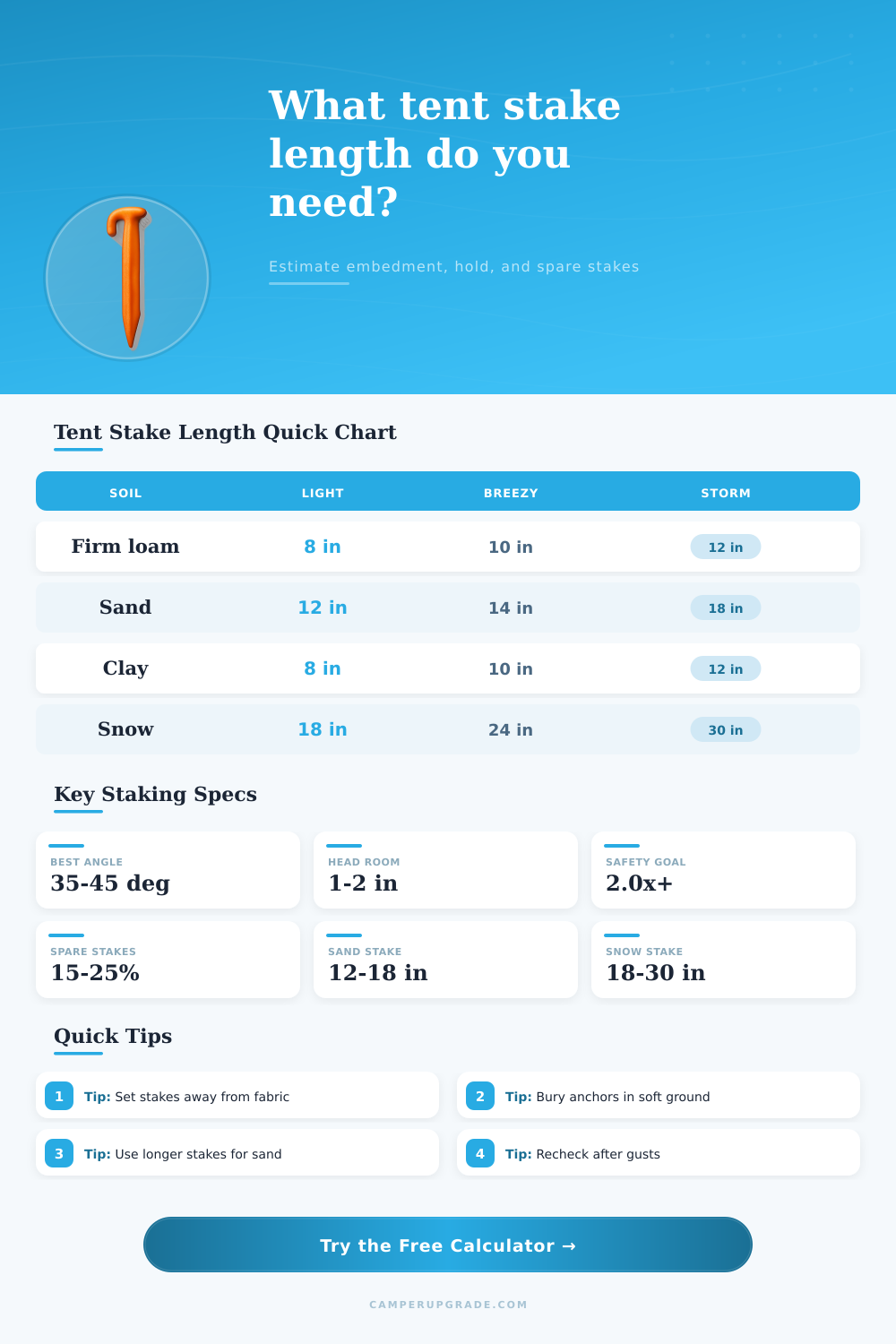
| Firm loam or turf | 7 to 8 in | 9 to 10 in | 12 to 14 in |
| Loose topsoil | 9 to 10 in | 12 in | 14 to 16 in |
| Packed clay | 7 to 8 in | 9 to 10 in | 12 in |
| Dry sand | 12 to 14 in | 16 to 18 in | 24 in or deadman |
| Wet mud | 10 to 12 in | 14 to 18 in | Use backup anchors |
| Snow or soft crust | 18 in | 24 in | 30 in or buried anchor |
| Stake angle from ground | Capacity adjustment | Embedment target | Use case |
|---|---|---|---|
| 25 degrees | 0.88x | Longer than calculated | Low tarp lines, shallow load path. |
| 35 degrees | 0.98x | Normal | Reliable all-purpose staking angle. |
| 45 degrees | 1.00x | Normal | Common target for tent and canopy lines. |
| 60 degrees | 0.86x | Add length | More upward pull; watch loose ground. |
| 75 degrees | 0.70x | Reposition stake | Often too upright for good pullout resistance. |
Root mats, hidden gravel, saturated topsoil, frozen crust, and trampled campsite pads can change real holding power more than the stake label suggests.
If the result shows short capacity, add more stakes, use longer anchors, lower the shelter profile, or divide the windward load across extra guylines.
When choosing the correct length for tent stakes, you have to consider the relationship between the tent, the ground, and a wind. Although tents come with stakes, stakes may not be apropiate for every environment. You should select the tent stakes based off the soil type in which the tent will be set up and the amount of wind forces that the tent will experience.
One of the main factors to consider when choosing tent stakes is the soil type. Different type of soil will offer different amounts of resistance to tent stakes. Loam and turf soil will offer a balanced hold on the tent stakes.
How to Choose the Right Length for Tent Stakes
Clay soil will offer a very strongly hold for tent stakes when the soil is seated, but the clay soil can crack when it is dry or can become slick when wet. Sand soil will offer very little resistance to tent stakes, possibly allowing the tent stake to exit the ground if there is any amount of wind that pass through the tent. Soil that contains snow or mud within the ground require different methods to secure the tent.
The snow and mud soil is very soft, and the tent stakes must be longer in these situations. Another factor that can affect the tent is the amount of wind that may hit the tent. The more wind that hits the tent, the more force is exert through the guylines that secure the tent to the tent stakes.
The force of the tent stakes diminishes for tents that have greater force of the wind hitting them compared to small tarps for backpacking. Additionally, the amount of force that the tent will experience based on the height of the tent and the degree of exposure to the wind will impact the length of the tent stakes that should be used for that tent. For instance, a tent that is on a ridge and exposed to the wind will experience more force with the wind than a tent that is located behind trees.
A tent located on a ridge will, therefore, require longer tent stake. Another factor to consider is the angle of the tent stakes. You should drive the stakes into the ground at an angle of around forty degrees.
If the tent stakes are driven into the ground at a steeper angle than this, the tent stakes will engage with less soil. Additionally, tent stakes driven at a shallow angle may lever upward against the tent when the guylines are under tension. The shape and the diameter of the tent stakes also impact the length of the tent stakes that should be used.
Tent stakes that are only thin wires will have less resistance against movement compared to tent stakes that have a larger diameter, such as Y-shaped stakes or channel stakes. Additionally, the holding power of the tent stakes is related to the amount of tent stake that is buried into the ground. Thus, if the tent stakes are reduced in the amount of buried tent stakes, the tent stakes will exhibit less holding power for the tent.
By using a tent stake calculator, a person can determine the length for tent stakes needed for their tent by selecting various factor of the tent and the environment in which the tent will be set up. The calculator can determine the depth for tent stakes to be embedded into the ground to provide resistance against the tent being pull away from its stakes. Additionally, the calculator can also suggest the number of spare tent stakes that should be carried in the tent.
A person should have spare tent stakes in case they hit a rock when driving in tent stakes or if they leave one behind at the tent camping spot. Many people make the mistake of using the same type of tent stake for every type of environment. The tent stakes used in clay soil will not necessarily work for sand soil.
Thus, a person should not use the same tent stake in every soil type. Additionally, many people may over-tighten the guylines that secure the tent to the tent stakes when they encounter weak tent stakes. However, by over-tightening these tent guylines, the tent stakes has to endure more force from the tent.
Thus, the tent stakes should match the weakest soil type that the tent will encounter. A variety of environmental condition may change during the camping trip. For instance, the dew that may form in the morning can make the soil soft, but after the afternoon sun exposure to clay soil, that soil can dry out and pull against the tent stakes.
The same amount of rain that can wet the tent stakes can turn the soil into mud. In these cases, a person should perform a tent stake pull test once the camping spot is located to ensure that the tent stakes are secure. In some instances, a person should leave tent stakes exposed above the ground.
One or two inches of tent stakes above the ground allows for easier removal of the tent stakes and prevents the guylines from rubbing against the tent. In soft soil, leaving tent stakes exposed allows for the tent stakes to be pulled out of the ground without bending the tent stakes. There are also reference tables that provide information regarding the different amounts of holding strength that the different types of tent stakes have with the different soil types.
These tables allow a person to determine if a wider tent stake should be used or if a different type of tent stake is needed if the tent stakes are too short for the tent site conditions. Using these tables will allow a person to carry the correct amount and type of tent stakes so that they are able to secure the tent from the wind. By properly matching tent stakes to the tent, the ground, and the weather conditions for those specific tents, a camper will be able to sleep more soundly during there camping trip.