Climbing Rope Diameter Calculator
Estimate a practical rope diameter, grams per meter, device compatibility, total rope weight, and durability score from climber weight, rope use, fall factor, sheath build, abrasion exposure, rope length, and pack weight priority.
Climbing rope diameter estimate
| Rope marking | Reference standard | Typical test role | Planning note |
|---|---|---|---|
| Single dynamic rope | UIAA 101 / EN 892 | One strand for lead falls | Common all-around sport, gym, and trad rope category |
| Half dynamic rope | UIAA 101 / EN 892 | Paired ropes, clipped alternately | Useful for wandering routes, alpine terrain, and full-length rappels |
| Twin dynamic rope | UIAA 101 / EN 892 | Paired ropes, both clipped together | Thinner system; both strands are used together at each piece |
| Static or low-stretch rope | UIAA 110 / EN 1891 | Low-stretch rope for static loads | Use for hauling, ascending, rescue, caving, or rope access, not lead falls |
| Accessory cord | UIAA 102 / EN 564 | Cordage, not a lead rope | Do not substitute accessory cord for a rated climbing rope |
| Rope setup | Light diameter | Balanced diameter | Durable diameter |
|---|---|---|---|
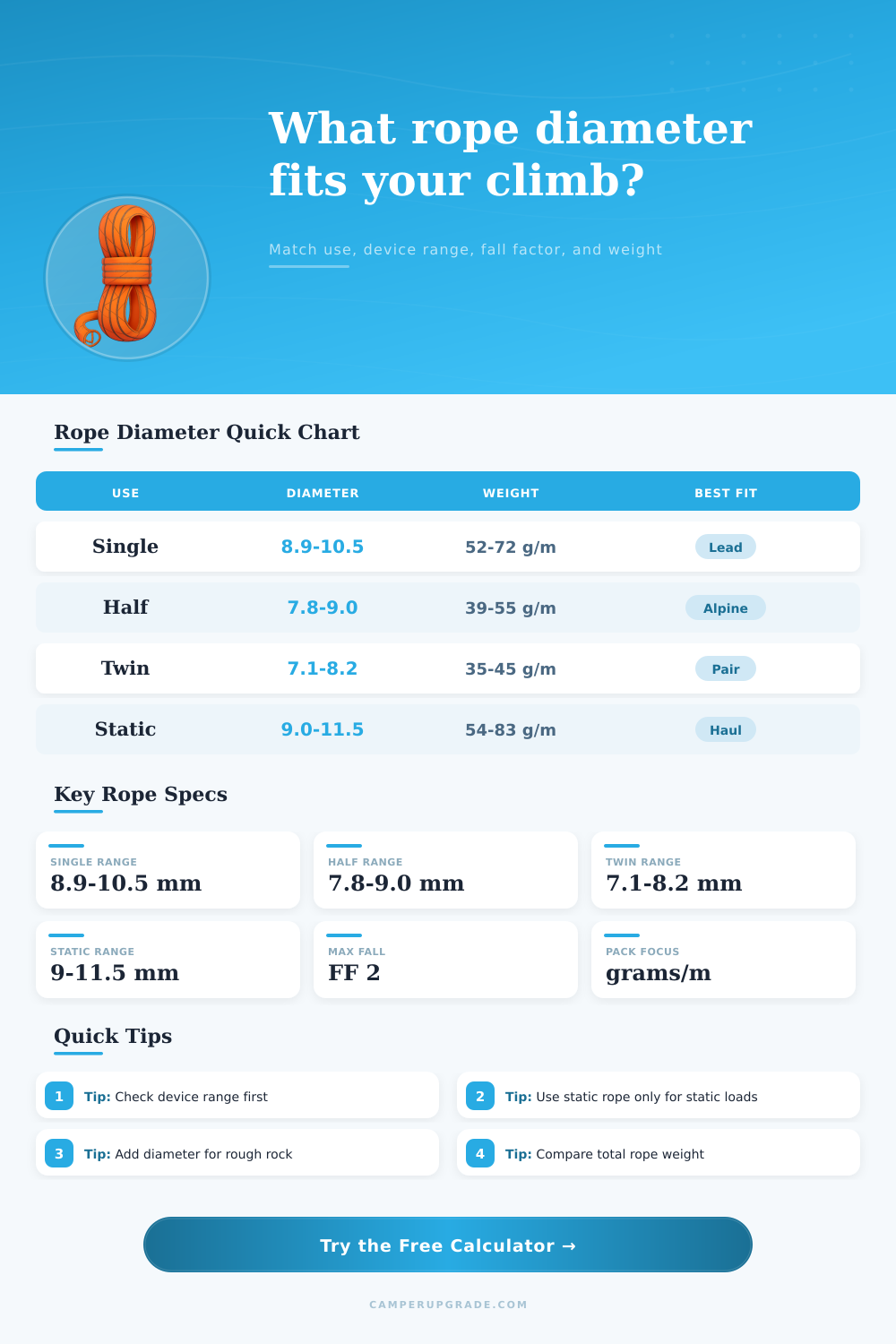
| Dynamic single | 8.9-9.2 mm, about 52-56 g/m | 9.4-9.8 mm, about 58-63 g/m | 9.9-10.5 mm, about 65-72 g/m |
| Dynamic half | 7.8-8.1 mm, about 39-43 g/m | 8.2-8.6 mm, about 44-49 g/m | 8.7-9.0 mm, about 50-55 g/m |
| Dynamic twin | 7.1-7.4 mm, about 35-38 g/m | 7.5-7.8 mm, about 39-42 g/m | 7.9-8.2 mm, about 43-45 g/m |
| Static or low-stretch | 9.0-9.5 mm, about 54-61 g/m | 10.0-10.5 mm, about 65-73 g/m | 11.0-11.5 mm, about 80-88 g/m |
| Device range example | Best rope match | What to watch | Calculator input |
|---|---|---|---|
| 7.1-8.5 mm | Twin, half, small alpine ropes | Thicker singles may not feed or lock correctly | Set min 7.1 and max 8.5 |
| 8.1-10.5 mm | Most modern single and half ropes | Very skinny twins or large static ropes may fall outside range | Set min 8.1 and max 10.5 |
| 8.5-11.0 mm | Single ropes and some static lines | Skinny alpine ropes may be below the printed minimum | Set min 8.5 and max 11.0 |
| 10.0-13.0 mm | Static, work positioning, hauling devices | Often not appropriate for dynamic lead belaying | Set min 10.0 and max 13.0 |
| Fall factor | Typical context | Diameter effect | Use note |
|---|---|---|---|
| 0.0-0.3 | Top-rope stretch, lowers, hauling, static loading | Durability and device fit matter most | Static rope may be valid only for truly static systems |
| 0.4-0.8 | Common protected sport or trad leader falls | Balanced diameter often fits well | Use a dynamic rope rated for the chosen system |
| 0.9-1.3 | Short rope out, ledges, early-route clips | Add diameter and sheath durability | Manage belay, clipping, and rope drag carefully |
| 1.4-2.0 | Severe planning case near maximum fall factor | Calculator pushes to the upper band | Dynamic ropes and careful system design are essential |
Choosing the correct diameter for a climbing rope are another crucial decision. The diameter of the climbing rope will affect the performance of the rope on the climbing route. Using a climbing rope whose diameter are too thin for the climbing route or an belay device may result in friction problems on the route and puts the climber at risk of the rope wearing down more faster than expected.
Using a rope whose diameter is to thick will add unnecessary weight to the pack and make the rope feel stiff in the climber’s hand. The diameter of the rope will affect how the rope performs on a route. Weight is a variable that many climber track when they are purchasing a new climbing rope.
How to Choose the Right Rope Size for Climbing
However, it is also a variable that many people misjudge when choosing the perfect climbing rope. People may consider the grams per meter of a rope when purchasing it. However, they may not consider how much the climbing rope will weigh with the additional length and the number of strand of rope that the climber uses on the climb.
A rope that is lighter per meter may end up being much heavier when using an alpine half-rope system. Additionally, the length of the rope may add to the total weight of the rope that the climber must carry for rappels on a climbing route. The calculator allow the user to input their weight, the length of the rope, and the number of strands that will be used for climbing.
The calculator will do the math for you to calculate the total weight of the rope. Device compatibility is another constraint on the diameter of the climbing rope. Many people discover this too late.
However, individuals can avoid this by checking the diameter range of their belay device. All belay devices and rappel devices will have the minimum and maximum diameter of the rope printed on the device. It is crucial that the climbing rope that an individual purchases falls within this range.
Using a rope that has a diameter that is too thin may lead to the rope slipping on the device. Additionally, a rope whose diameter is too thick for a belay device may result in the rope getting stuck on the device. These minimum and maximum diameter inputs will force the climber to look at the device’s printed diameter range before purchasing a climbing rope.
Another factor that affects the diameter of a rope is the fall factor on the climbing route. Routes with a low fall factor will feature lighter ropes. However, a high fall factor will require a climbing rope with a larger diameter with a tougher sheath.
The rope calculator will adjust the target diameter when the fall factor is increase. This does not replace a climber’s abilities to read the route but will give the climber an idea of the fall factor that will suit the route. The construction of the rope’s sheath and the type of abrasion that the rope will be exposed to will affect the lifespan of the rope.
Thin sheaths save climbers weight when climbing gym problems. However, a thin sheath will result in the rope showing core shots much faster on sharp limestone or dirty crack systems. The abrasion rating and sheath durability allow a climber to decide the type of route that they want to use the rope on.
Both of these choices are valid; however, it is essential for the climber to understand which choice they are making for the sheath of their climbing rope. Static ropes and dynamic ropes have different rules for their use. Static ropes are used for hauling and ascending the climbing route.
Because static ropes do not bounce when loaded with weight, they are better suited for these uses. However, they are not designed to handle the energy of a lead fall on a route. The tool will limit the durability score for static ropes if the user choose a fall factor higher than a very low value.
This will warn the climber of the differences in the certification of static ropes and dynamic ropes. One of the two main priorities in the rope calculator is the preference for speed versus rope durability. When climbing fast, light climbing ropes save on the total weight of the climber’s pack.
However, the preference for durability may be required when climbing on sharp rocks. The tool allows the climber to change this preference. Any change in preference for the rope will change the diameter of the rope.
Additionally, the shift in the rope’s diameter will change the total weight of the climbing rope in the climber’s pack. The length of a climbing rope will interact with the climbing rope’s weight and durability. A climber may prefer a longer rope to provide more rappel options for descent on the route.
However, a longer rope will add to the total weight of the rope that the climber must carry. Additionally, the longer the climbing rope, the more abrasion the rope will experience during its lifespan. Thus, the length of the rope is one of the inputs that will calculate the total weight of the rope that the climber will carry on their route.
Many people make mistakes when choosing a climbing rope. For example, the most common mistake is to choose the rope diameter that their friends use rather than finding the correct diameter for there own belay device. Another mistake is choosing the lightest rope available.
This may save some of the climber’s weight, but it will result in the rope wearing down more faster. Finally, some people may purchase a static rope instead of a dynamic rope. These may be the best choices when purchasing a rope at the time of the climb.
However, these choices can result in expensive and uncomfortably climbs. The climbing rope specifications will always remain the same. However, the rope calculator will allow the climber to create one estimate for the rope that includes the climber’s weight, the terrain, and the rope’s specifications.
The estimate will only be accurate if the climber input all the correct information. By providing accurate inputs for the device ranges of the rope and the abrasion of the route, the climber can trust the calculator’s result to provide them with an accurate reading of the rope that will best suit their climbing conditions. Thus, this tool will accelerate and standardize the process that each climber must take to find the perfect rope for their climbing conditions.