Camper Van Solar Panel Calculator
Estimate required array watts, panel count, roof fit, controller current, and daily harvest balance from van load, sun hours, shading, tilt, winter derate, and battery voltage.
Van solar estimate
| Van parking profile | Peak sun hours | Shading range | Winter derate |
|---|---|---|---|
| Open desert camp | 5.8-7.0 h | 0-8% | 85-100% |
| Coastal shoulder season | 3.8-5.2 h | 5-18% | 70-90% |
| Urban curb parking | 2.8-4.6 h | 15-35% | 60-85% |
| Forest campsite | 1.8-3.8 h | 25-60% | 55-80% |
| Winter mountain lot | 1.5-3.2 h | 10-35% | 40-70% |
| Panel watts | Typical dimensions | Mounted area | Best roof use |
|---|---|---|---|
| 100 W | 42 x 22 in | 8 sq ft with clearance | Small van or portable support |
| 160-200 W | 58 x 26 in | 12 sq ft with clearance | Compact roof lanes beside fan |
| 250-320 W | 60 x 30 in | 16 sq ft with clearance | Mid-size van roof array |
| 350-450 W | 68 x 40 in | 22 sq ft with clearance | High-roof or long-wheelbase vans |
| 500 W+ | 78 x 44 in | 27 sq ft with clearance | Long clear roof zones only |
| Installed array | 12V lithium | 24V lithium | 48V lithium |
|---|---|---|---|
| 200 W | 20 A MPPT | 10 A MPPT | 10 A MPPT |
| 400 W | 40 A MPPT | 20 A MPPT | 10 A MPPT |
| 600 W | 60 A MPPT | 30 A MPPT | 20 A MPPT |
| 800 W | 80 A MPPT | 40 A MPPT | 20 A MPPT |
| 1200 W | 120 A MPPT | 60 A MPPT | 30 A MPPT |
| Van use case | Daily load | Low-sun array | Roof note |
|---|---|---|---|
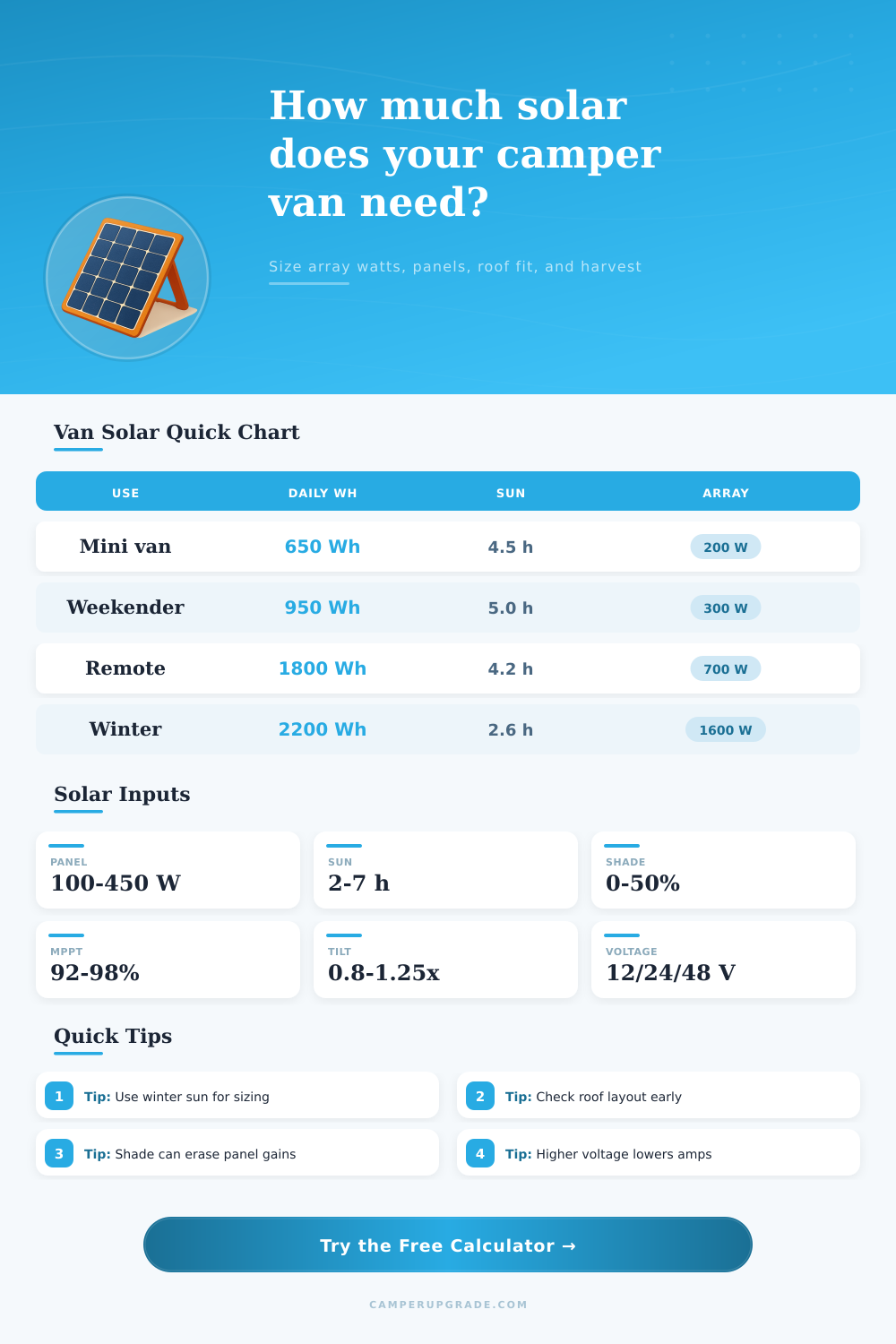
| Lights, USB, small fan | 400-700 Wh | 200-300 W | Fits most compact vans |
| Fridge and roof fan | 800-1200 Wh | 300-500 W | Two medium panels common |
| Laptop workdays | 1400-2200 Wh | 600-1000 W | Needs clean high-roof space |
| Winter parking | 1600-2600 Wh | 1000-1800 W | Often exceeds roof-only capacity |
| Heavy inverter bursts | 2200-3500 Wh | 1200-2400 W | Plan alternator or shore support |
When designing a solar power system for a camper van, a person must understand the way that solar panels produces electricity and how the panels will deliver that energy to the camper vans batteries. A solar power system is not formed based off solely upon the size of the solar panels that will be used. Rather, the solar power system is create based on the relationship between the solar panels, the energy that the camper van will use each day, and the amount of sunlight that will reach the panels while en route to the camper van.
Many individuals begins to form their solar panel system by calculating the total energy load that the camper van will use. The total energy load is the combined energy that each of the devices that will be present within the camper van will use, such as lights, fans, refrigerators, and laptops. Thus, the total energy load must be calculated before any individual begin to purchase solar panels for the camper van.
How to plan a solar power system for a camper van
The amount of sunlight that will hit the solar panels while en route to the camper van will vary based upon the location of the camper van and the time of year that they is traveling. The number of “usable” sun hours each day will impact the amount of energy that the solar panel can produce. For instance, an individual may experience high number of usable sun hours during the summer months when the camper van is traveling, but experience more fewer usable sun hours during the winter months due to the angle of the sun in the sky during these months.
Additionally, trees or buildings may create shade for the solar panels, which will reduce the amount of energy produced by the panels. Therefore, it is necessary to include a shade percentage in the calculations for the solar panel system. The amount of space on the roof of the camper van will limit the size of the solar panels that may be used on that camper van.
The physical size of the roof that can be utilized for the solar panel must be measured for each camper van, as many of the measurements will not include space for vents, roof hatches, or the ribs of the camper vans roof. Therefore, it is necessary to calculate the amount of usable roof space to ensure that the solar panel system will not be ordered for the camper van if those panels will not physically fit onto the roof. The solar charge controller will manage the electricity that moves from the solar panel to the camper vans batteries.
The type of charge controller that one should utilize is a Maximum Power Point Tracking (MPPT) controller, as these tend to capture more energy from the solar panels than other types of controllers. Additionally, the voltage that the battery bank will use will impact the solar charge controller. For example, if a higher voltage battery bank is used, the solar charge controller will have to handle the energy from the solar panels with lower amperage; lower amperage allow for smaller wires to be used in the camper vans electrical system.
Due to the fact that the solar panels may not create enough energy to meet the energy load of the camper van, various alternative can be used to charge the batteries. For instance, an individual could use portable solar panels or an alternator to provide the batteries with the energy that they requires each day. Additionally, another alternative would be increasing the size of the battery bank to allow for the batteries to store more energy that the camper van can use when the solar panels are not creating as much energy.
Finally, the energy that the camper van will use each day will impact the success of the solar power system. An individual that intends to use a large inverter and various electrical device will use more energy than an individual that only intends to use a few device, such as a small refrigerator and lights. Thus, the solar power system must be create according to the energy that will be used under the worst-case scenario for energy use.
By creating the solar panel system, solar charge controller, and battery bank according to the actual energy load of the camper van, that camper will enjoy consistent power and electricity while on the road. You’ll need to realize that this process could of been much simpler if you’ve planned ahead, but it’s important to recieve the right components. Its alot of work but it’s worth it for a moddern setup.