🔋 RV Inverter Battery Calculator
Size camper battery capacity, watt-hour draw, DC current, cable class, and surge margin from real AC inverter loads.
Formula Breakdown
| RV load | Running watts | Typical surge | Common runtime | Notes |
|---|---|---|---|---|
| Laptop and monitor | 80-140 W | 150-250 W | 3-6 hr | Good small inverter load. |
| 32 inch TV and sound bar | 100-220 W | 200-350 W | 2-4 hr | Often easy on battery capacity. |
| CPAP without heated humidifier | 35-70 W | 80-150 W | 7-9 hr | Check medical device power label. |
| Microwave | 900-1500 W | 1600-2500 W | 0.1-0.3 hr | Short runtime but high DC amps. |
| Coffee maker | 900-1400 W | 1200-1800 W | 0.1-0.2 hr | Heating loads draw hard briefly. |
| Induction cooktop | 900-1800 W | 1200-2200 W | 0.2-0.8 hr | Best on 24V or 48V systems. |
| Blender or small motor | 300-700 W | 900-1600 W | 0.05-0.15 hr | Surge rating matters more than Ah. |
| Small portable AC | 700-1200 W | 1800-3000 W | 0.5-2 hr | Large battery and cable demand. |
| Chemistry | Typical usable DoD | Inverter behavior | Planning note |
|---|---|---|---|
| LiFePO4 | 80-90% | Holds voltage well | Strong choice for heavy inverter use. |
| Lithium-ion | 75-85% | High energy density | Use pack BMS current limits. |
| AGM lead-acid | 45-55% | Voltage sag under high load | Often needs more Ah than lithium. |
| Flooded lead-acid | 40-50% | Sensitive to deep cycling | Keep discharge conservative. |
| Gel lead-acid | 45-55% | Moderate high-current ability | Watch charging and inverter current. |
| DC current band | Typical inverter size at 12V | Short cable class | Common protection range |
|---|---|---|---|
| 0-40 A | up to 400 W | 8-6 AWG | 40-60 A fuse |
| 40-80 A | 400-800 W | 4-2 AWG | 80-125 A fuse |
| 80-150 A | 800-1500 W | 1/0-2/0 AWG | 150-200 A fuse |
| 150-250 A | 1500-2500 W | 2/0-4/0 AWG | 200-300 A fuse |
| 250 A plus | 2500 W plus | engineered bus | device manual required |
| AC load | Runtime | DC Wh at 90% | LiFePO4 Ah at 85% DoD | AGM Ah at 50% DoD |
|---|---|---|---|---|
| 100 W | 4 hr | 444 Wh | 44 Ah | 74 Ah |
| 300 W | 2 hr | 667 Wh | 65 Ah | 111 Ah |
| 600 W | 1 hr | 667 Wh | 65 Ah | 111 Ah |
| 1000 W | 0.25 hr | 278 Wh | 27 Ah | 46 Ah |
| 1500 W | 0.5 hr | 833 Wh | 82 Ah | 139 Ah |
When you are setting up an inverter in an RV, you must consider the battery bank that will be used with the inverter. The battery bank will provide the energy that the inverter will convert into an amount needed for the RV’s appliances. The energy that the battery bank can provide is an essential factor to consider when setting up the inverter.
When considering the energy that the battery bank can provide, you must account for the fact that the inverter will draw energy from the battery bank, and different types of batteries will provide energy different. Additionally, different electrical loads will draw energy differently. For example, a laptop will draw a different amount of energy then a microwave or a coffee maker will draws.
Pick the Right Battery Bank and Inverter for Your RV
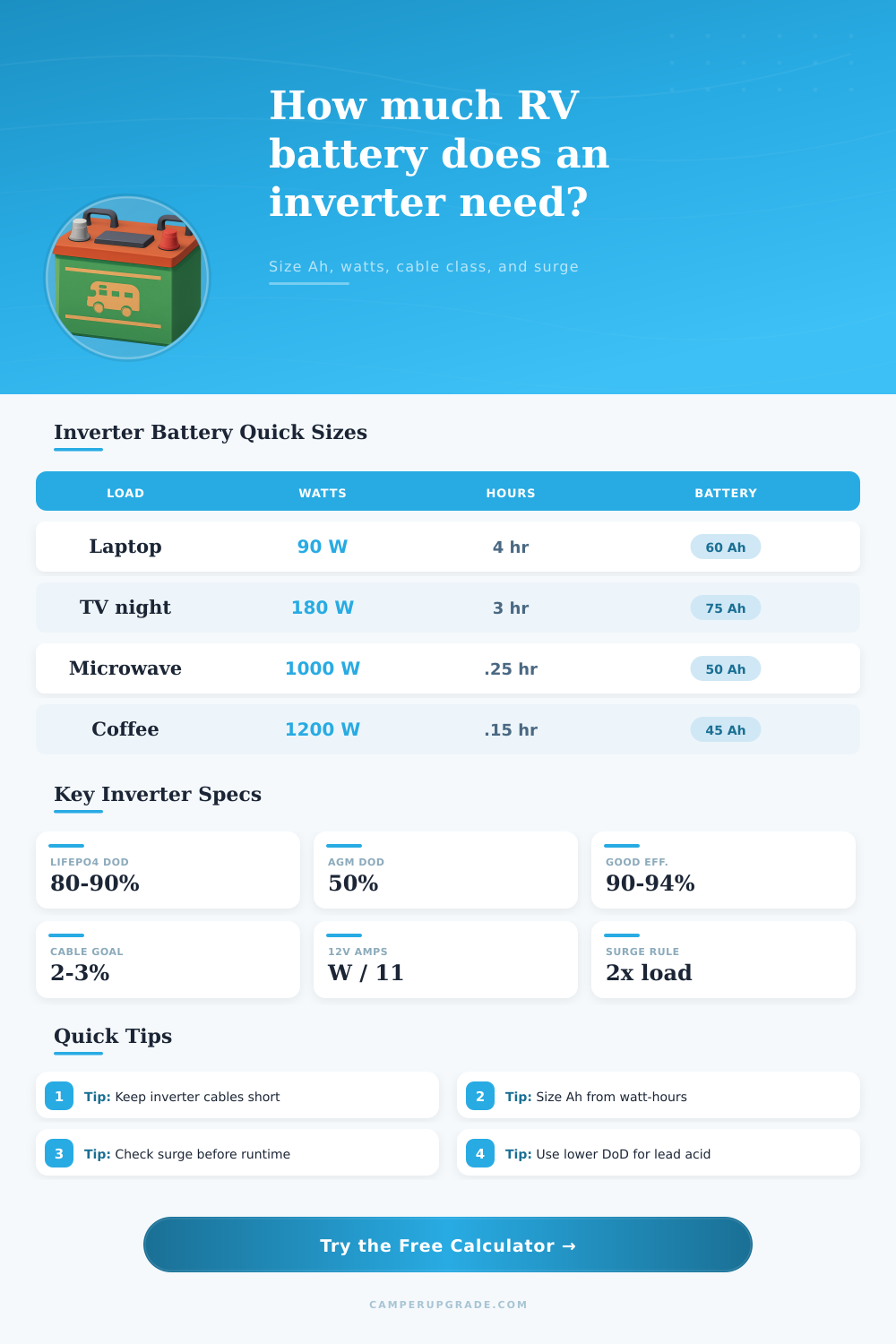
A coffee maker or a microwave will draw a large amount of energy for a short period of time. In contrast, a laptop will draw a small amount of energy over a long period of time. To determine the energy that the battery bank must have, you can use a battery capacity calculator.
The calculator will account for the energy that the different electrical loads in the RV will draw by the inverter. Another essential factor to consider with the battery bank is the chemistry of the batteries. The chemistry of the batteries will determine how much energy that you can use from the battery bank.
For instance, lithium iron phosphate batteries can handle deep cycling more times than lead-acid batteries can. If you decide on using lead-acid batteries, flooded or AGM batteries, you will be limited to using only half of the battery banks rated capacity. In this case, you would of needed to purchase a battery bank that has twice the amp-hour rating.
Another essential factor to consider is the system voltage that will be used with the inverter. Using 12 volts will pull a high amount of current that will pass through the cables that will connect the battery bank to the inverter. Using 24 or 48 volts will pull less current through the system.
Using less current allows for the use of smaller cables, reduces the amount of heat that the system creates, and reduces the voltage drop in the system. Even though using a 12-volt system is very common among RV users, using a higher voltage system will allow the inverter to be more efficient. Another essential factor to consider is the sizing of the cables that will be used to connect the battery bank to the inverter.
The current that comes from the battery bank will be higher than the load that is drawn on the inverter. This is because the inverter will experience energy losses when performing the voltage conversion. If the cables are too small or too long for the system, the voltage at the inverter will drop.
This can cause the inverter to overheat or shut off. Using a calculator will help to determine the proper size for the cables. Another important factor to consider is the surge capacity that the inverter will provide.
Many appliances will require a surge of power to start. For instance, the starting wattage for an air conditioner will be two to three times the running wattage of the air conditioner. Using an inverter that cannot handle this surge will cause the inverter to fault.
Using a calculator will help to determine the ratio of the running wattage to the starting wattage to see if the inverter can handle the appliance that will be used in the RV. Other factors that will impact the performance of the battery bank and inverter include the ambient temperature of the RV, the effect of sunlight on the solar panels that will charge the battery bank, and the way that the RV is used. Each of these factors will impact how the battery bank will be used and how deep the discharge of the batteries will go.
Additionally, a calculator will provide a baseline for the battery bank and inverter setup, but you must also consider these factors. Many people will make mistakes when they are setting up the inverter and battery bank in there RV. For instance, they will believe that the inverter capacity is the only factor that matters.
However, the battery bank and the cables that connect the battery bank to the inverter must also be able to provide the current that the inverter requires. Many people will also under estimate the amount of energy that appliances that require high amounts of power will use. Using a calculator to determine the energy use of all of the appliances in the RV will ensure that the battery bank is large enough.
Your goal is to create a battery bank that matches your actual use of your RV. If you are only using small electronic devices in your RV, a lithium battery bank that is 12 volts may be sufficient for your needs. However, if you are planning to use a portable air conditioner or an induction cooktop, you may want to consider purchasing a 24-volt battery bank with more robust cabling.
Using a calculator to determine the proper voltage and battery bank will ensure that your inverter and battery bank system can meet your actual needs. By creating a battery bank, an inverter, and cables that are correctly matched to one another, the electrical system will provide reliable power to the lights, fridge, and water pump in your RV.