Trolling Motor Thrust Calculator
Estimate required thrust, recommended motor class, amp draw, and battery Ah from loaded boat weight, hull type, wind, current, margin, shaft length, voltage, runtime, and prop efficiency.
Trolling motor sizing estimate
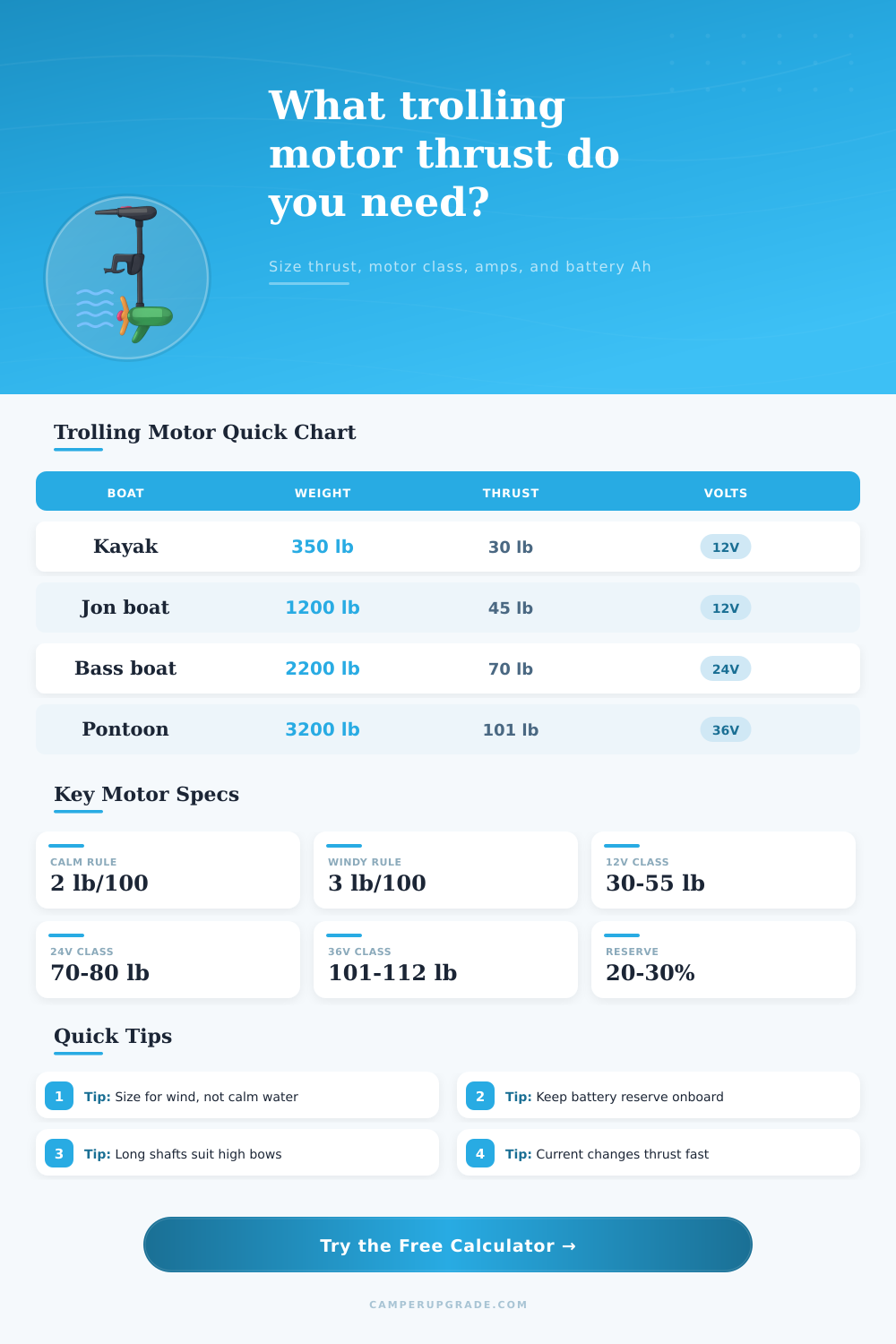
| Loaded boat weight | Calm baseline | Windy control | Typical class |
|---|---|---|---|
| 300-600 lb | 12-18 lb | 25-30 lb | 30 lb / 12V |
| 700-1200 lb | 18-30 lb | 36-45 lb | 40-45 lb / 12V |
| 1300-1800 lb | 30-42 lb | 45-55 lb | 55 lb / 12V |
| 1900-2600 lb | 42-60 lb | 70-80 lb | 70-80 lb / 24V |
| 2700-3600 lb | 60-80 lb | 101-112 lb | 101 lb / 36V |
| 3600+ lb | 80+ lb | 112+ lb | 112 lb+ / 36V |
| Input | Low effect | Medium effect | High effect |
|---|---|---|---|
| Wind speed | 0-8 mph | 9-15 mph | 16+ mph |
| Current speed | 0-0.4 mph | 0.5-1.0 mph | 1.1+ mph |
| Hull windage | Kayak / skiff | V-hull / bay boat | Pontoon / deep V |
| Prop efficiency | 95-105% | 85-94% | Below 85% |
| Control margin | 10% | 20-30% | 40%+ |
| Motor class | Common voltage | Max amp guide | Battery note |
|---|---|---|---|
| 30 lb | 12V | 28-32 A | 50-100 Ah common |
| 40-45 lb | 12V | 38-45 A | 75-125 Ah common |
| 50-55 lb | 12V | 46-55 A | 100-150 Ah common |
| 70 lb | 24V | 40-45 A | Two 12V in series |
| 80 lb | 24V | 50-56 A | Higher reserve useful |
| 101-112 lb | 36V | 46-56 A | Three 12V in series |
| Mount height above water | Protected water | Chop or wake | Common boat |
|---|---|---|---|
| 10-16 in | 30-36 in shaft | 36-42 in shaft | Kayak, canoe, transom |
| 17-22 in | 42-48 in shaft | 48-52 in shaft | Jon boat, low skiff |
| 23-28 in | 52-60 in shaft | 60-72 in shaft | Bass boat, V-hull |
| 29-34 in | 60-72 in shaft | 72-87 in shaft | Deep V, pontoon |
| 35+ in | 72+ in shaft | 87+ in shaft | High bow, rough water |
Choosing the correct amount of thrust for your trolling motor depend on the type of boat that you have and the conditions that you typicaly fish in. You must select a motor that can provide enough thrust to hold your boat in a fixed position, but you must also avoid buying a motor that is too heavy or that draws too much power from your battery bank. A trolling motor that has a few extra pounds of thrust may be beneficial when traveling in choppy water, but you must consider the conditions in which you typicaly fish.
In addition to the weight of the boat, which is a primary consideration when choosing a trolling motor, the weight of the boat isnt the only factor that you must consider. For instance, a loaded bass boat and a jon boat may have the same weight, but the way that each type of boat will move through the water is very different. The wind increase the force that the trolling motor has to overcome, and the higher the wind speed, the more force that the motor must generate.
Choosing the Right Trolling Motor Thrust
The same is true of the current in the water; the faster the current, the more force that the motor will have to overcome in order to maintain the position of the boat. The type of hull on the boat is another factor in the selection of a trolling motor. For instance, a flat bottomed jon boat will slide more easily in the wind than a flat-bottomed jon boat with a higher hull design.
A deep-V hull design will move more easily through choppy waters but will catch more force from the wind. Pontoons sit higher above the water than jon boats so that more force from the wind will push the pontoons off of there target course. Another factor that a trolling motor calculator consider is the hull factor of the boat that you own.
The length of the motor shaft is another consideration when choosing a trolling motor. The length of the shaft dictates the depth that the propeller of the boat will travel in the water. If the propeller of the boat lift out of the water due to choppy waters, the thrust provided by the trolling motor will diminish.
You must choose the length of the shaft according to the height of the motor above the waterline and the amount of chop that you encounter in your fishing spot. A shaft that is too short will waste the power of the motor, and a shaft that is too long will add unnecessary weight and cost to the boat. The voltage choices for the trolling motor will impact the thrust that the motor put out and impact your battery bank choices.
Trolling motors that use 12 volts are common on small boats. However, larger trolling motors may use 24 or 36 volts to provide the same amount of power with a lower amperage draw. The use of lower amperage reduces the size of the cables that are used to power the motor, reduces the amount of heat that is created by the motor, and extends the life of the battery.
A trolling motor calculator will show the amperage draw of the motor at the voltage that you select for the motor. The capacity of the batteries that are used to power the motor need to be carefully calculated. For flooded lead-acid batteries, the capacity that can be used is limited to 50% of the batterys total capacity if the battery is to last for a long period of time while motorized.
However, for lithium iron phosphate batteries, 80% or more of the batterys capacity can be use. The runtime that you want the motor to run for needs to be factored into the selection of batteries. In addition, you also need to consider the reserve capacity of the battery in case there are unexpected currents in the water or if there are weed patches that the propeller of the boat has to move around to allow the boat to continue forward.
An additional factor that the trolling motor equation considers is the efficiency of the propeller. The propeller should be in good condition and clean of any vegetation. A damaged propeller or a propeller with vegetation on it will create a less efficiently movement of the boat.
By including an efficiency setting into the trolling motor calculator, you can account for any movement inefficiency of the propeller. The final factor that can be included in the trolling motor calculation is the personal preference of the fisherman in terms of a control margin percentage. Trolling motors provide for the addition of a control margin percentage so that some fishermen can add more power to the motor than is otherwise calculated.
For example, a motor that is calculated to provide 20 lbs. Of thrust may have a margin of 20% added to it, making the trolling motor provide 24 lbs. Of thrust.
This extra power is helpful in the instance of fighting against the tide or against the movement of the boat caused by the current. Choosing a trolling motor involves a tradeoff of many of the factors that the trolling motor calculator considers. For instance, using a heavier battery bank will increase the runtime of the motor, but it will add more weight to the boat.
Using a higher voltage for the motor will reduce the amperage draw of the motor, but it will require new battery and a new charger. Using a longer motor shaft will allow the propeller to travel further into the water when the boat is traveling over choppy waters, but the motor will take more effort to stow into the boat. These are just a few of the many tradeoffs that you should of considered before purchasing the trolling motor that is best for your fishing boat.