Rope Working Load Calculator
Estimate working load limit, derated breaking strength, knot-adjusted capacity, and safety margin from rope MBS, material, wear, bends, environment, and load type.
Rope working load estimate
| Material | Stretch profile | Planning derate | Best use note |
|---|---|---|---|
| Nylon | High stretch | 0% | Absorbs shock but changes length when wet |
| Polyester | Low stretch | 0% | Good UV and wet stability for camp lines |
| Polypropylene | Medium stretch | 10% | Floats, but UV and abrasion need caution |
| HMPE | Very low stretch | 5% | High strength with careful bend control |
| Aramid | Very low stretch | 10% | Heat tolerant but bend fatigue matters |
| Manila | Medium stretch | 20% | Natural fiber needs dry inspection |
| Paracord | Medium stretch | 15% | Useful lashing cord, not primary recovery rope |
| Static kernmantle | Low stretch | 5% | Predictable utility line when rated for the task |
| Connection | Typical loss | Efficiency kept | Planning note |
|---|---|---|---|
| Proper eye splice | 5-15% | 85-95% | Often stronger than a knot when made correctly |
| Figure-eight loop | 15-25% | 75-85% | Predictable loop for many utility ropes |
| Bowline | 25-35% | 65-75% | Easy loop, but count the bend at the knot |
| Trucker's hitch | 30-45% | 55-70% | Useful tensioner with high local bend stress |
| Clove hitch | 35-45% | 55-65% | Can slip or crush depending on surface |
| Unknown knot | 40%+ | 60% or less | Use a conservative manual loss value |
| Bend ratio D/d | Estimated efficiency | Rope stress | Use note |
|---|---|---|---|
| 1:1 to 2:1 | 50-70% | Severe | Avoid tight shackles, pins, and edges |
| 3:1 to 4:1 | 75-85% | High | Acceptable only with extra margin |
| 5:1 to 7:1 | 88-94% | Moderate | Common pulley and tree-wrap range |
| 8:1 to 10:1 | 95-98% | Low | Good planning target for many ropes |
| 12:1 or more | 99-100% | Very low | Preferred for high-strength low-stretch rope |
| Load condition | Dynamic factor | Typical safety factor | Planning note |
|---|---|---|---|
| Static tied bundle | 1.0x | 3:1 to 5:1 | Only when load is controlled and non-critical |
| Camp line with sway | 1.25x to 1.5x | 5:1 to 7:1 | Wind and movement reduce reserve |
| Hoist or pulley pull | 1.5x to 2.0x | 7:1 to 10:1 | Count friction, bends, and shock at start |
| Vehicle pull or recovery | 2.0x to 3.0x | 10:1+ | Use rated recovery gear and trained technique |
| Life support or fall arrest | Specialized | Certified system | Do not use a utility WLL calculator |
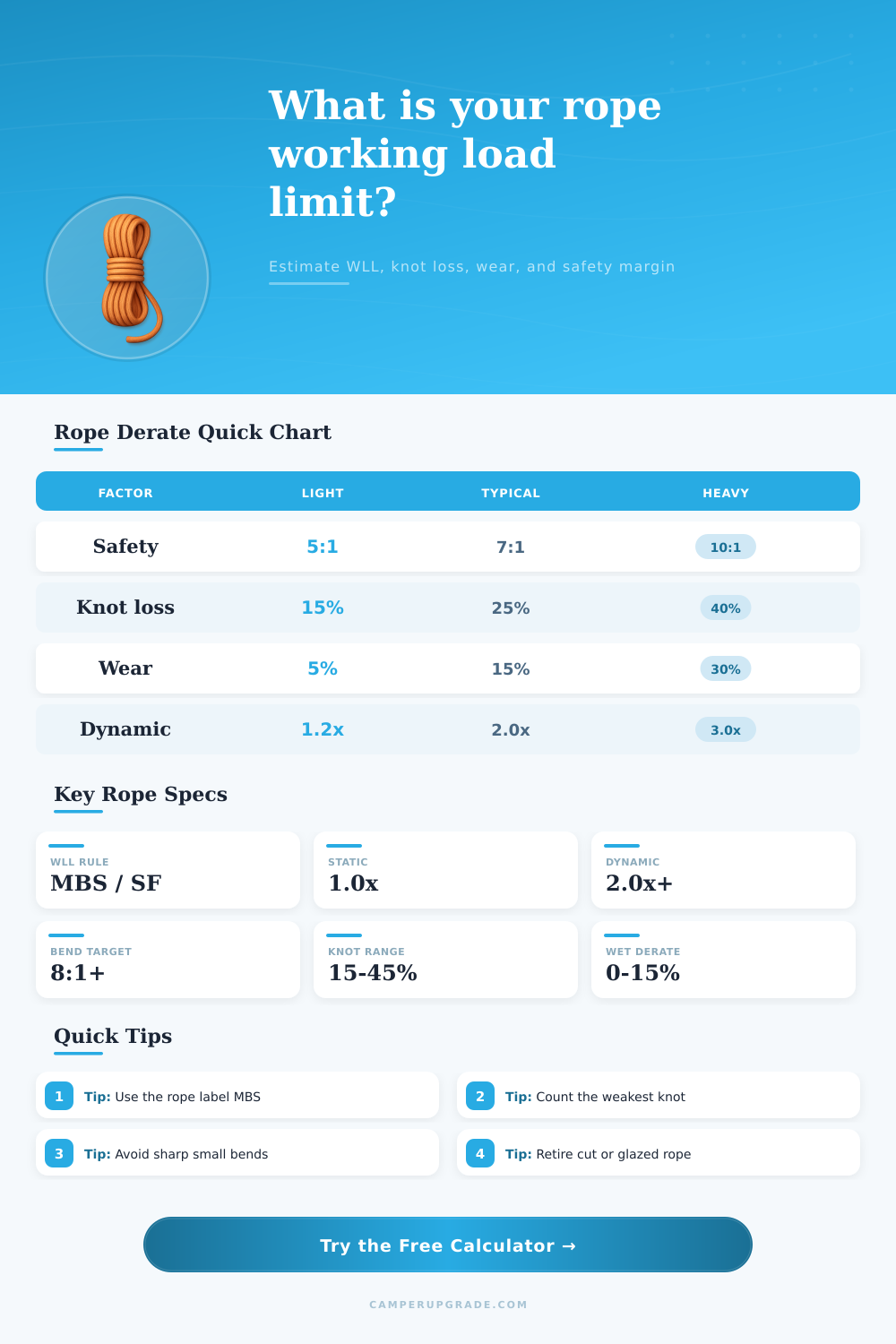
A working load calculator can help you to determine the amount of weight that a rope can safely carry. The minimum breaking strength of a rope is printed on the label attached to the rope. This minimum breaking strength are a number that a laboratory obtained for the rope, and it indicates the amount of weight that the rope can hold when it is being pulled in a straight line.
In the wild, however, there are additional factor that can reduce the strength of that rope; factors like friction, moisture, and flexing of the rope reduce the amount of strength that the rope can exhibit. A working load calculator take the minimum breaking strength of the rope, and applies reductions for each of these factors; the result is the amount of weight that the rope can actualy carry in the wild. Many of the factors that reduce a ropes strength include the presence of knot in the rope.
How a Working Load Calculator Works
Each time that a rope is knotted, some of the fibers of the rope begin to rub against each other. Thus, each knot reduce the strength of the rope. Some knots, like figure-eight knots, preserve more of the strength of the rope then other knots, like clove hitch knots.
A working load calculator allows for the input of the type of knot that is being used, and calculates the resulting reduction in the strength of the rope due to the knot. For instance, if the user changes the knot from a bowline to a splice, the strength of the rope will increase because a splice creates less stress on the rope then a bowline knot. Bends in the rope will also reduce the strength of the rope.
For instance, if the rope is placed over a small carabiner gate or a thin branch, the outer fibers of the rope will carry the majority of the load that is placed on the rope. The inner fibers will carry less of the load, which reduces the amount of strength of the rope. Working load calculators include an input to account for the ratio of the bend in the rope; a small ratio indicates that the outer fibers of the rope will carry the majority of the load, and the larger the ratio for the shackle or pulley over which the rope is placed, the more strength that the rope will have without having to purchase a new rope.
The materials of the rope may impact the strength of the rope. For instance, if the rope is made of nylon, it will stretch and absorb shock, but its length will change if it becomes wet. Polyester ropes hold their length better and resist UV radiation more better than nylon ropes.
Some of the best ropes include materials like HMPE, which is very strong, but does not exhibit strength when it is placed into tight bends. This type of information can be entered in the working load calculator so that the user doesnt have to memorize the coefficients for each type of rope material. Additional factors that can contribute to the reduction of the strength of the rope include the wear and environmental factors of that rope.
For example, a rope left in the sun for long periods of time will have less strength than a new rope. A rope dragged across gravel will have less strength than a new rope. A rope stored in damp conditions will have less strength than a new rope.
Working load calculators allow the user to input these factors to increase the allowance for the strength of the rope that is lost due to wear and the environment. Dynamic loads placed upon the rope will also reduce the strength of the rope. Loads that are static will remain in one place; dynamic loads will move.
For example, loads placed upon a tarp will swing in the wind. These dynamic loads can increase the weight of the load that is placed upon the rope. Working load calculators include a load-type selector that accounts for the additional weight of these dynamic loads.
The load-type selector ensures that the working load calculator accounts for the worst case scenario of the additional weight of these moving loads. Reference tables for each of these factors are provided for the working load calculator. These tables allow the user to verify that the number input into the working load calculator is within the normal parameters for those factors.
Thus, the working load calculator will calculate the strength of the rope, and determine how much load can be placed upon it without the rope failing. Additionally, the calculator will calculate a margin number for the system. This margin number will indicate to the user if there is any margin for error in the amount of load that is to be placed upon the rope.
Thus, this number will allow the user to understand if the current system is safe. Some of the mistake that many users make with working load calculators are using the minimum breaking strength as the working load limit for the rope, or ignoring the impact that small bends in the rope will have upon the strength of that rope. For instance, it is incorrect to use the same safety factor for a tarp line as it is for a vehicle recovery strap.
Another mistake is to treat all ropes the same; for instance, a paracord lashing has different strength characteristic than a kernmantle haul line. Working load calculators make these types of mistakes visible to the user; they show how quickly the margin for error decreases for the user when these factors are ignored. Finally, it is important to realize that a working load calculator is not a replacement for the physical inspection of the rope.
A working load calculator cannot see if a rope has been cut in half inside a sheath, for instance. Additionally, the calculator cannot see if the rope has been glazing or exposed to salt water. Thus, the calculator is a tool that can help the user to calculate the impact of the factors that are visible and measurable to the user; the calculator will help the user to determine if there is enough strength remaining in the rope to meet the demands of the users project.
Thus, the minimum breaking strength of the rope is a starting point for the user, but adjustments should of been made according to the presence of knots, bends, wear, and movement of the load to determine the actual strength of that rope.