Propane Regulator Sizing Calculator
Estimate RV propane regulator capacity from appliance BTU loads, simultaneous use, altitude derate, reserve margin, inlet cylinder pressure, and target outlet water column.
Propane regulator estimate
| Appliance | Typical input | Sizing note | Calculator field |
|---|---|---|---|
| Small RV furnace | 12000-20000 BTU/hr | Cycles heavily in cool weather | Furnace |
| Large RV furnace | 30000-40000 BTU/hr | Often the biggest steady load | Furnace |
| Tank water heater | 8800-12000 BTU/hr | May fire with furnace | Water heater |
| Cooktop burner set | 15000-27000 BTU/hr | Add burners used together | Cooktop and oven |
| Absorption refrigerator | 1200-2200 BTU/hr | Small but often continuous | Refrigerator |
| Outdoor grill | 10000-30000 BTU/hr | Include low-pressure quick-connects | Outdoor load |
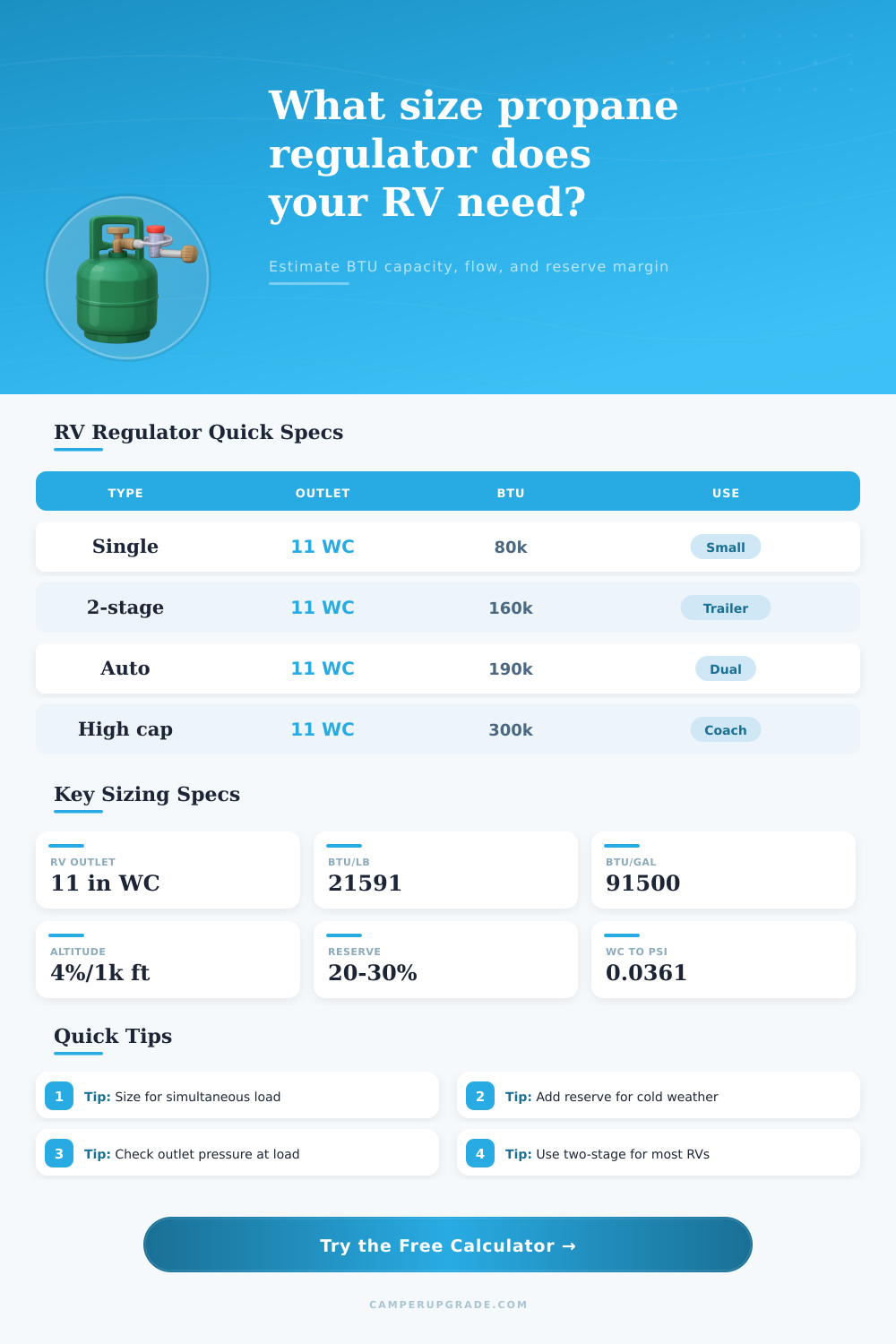
| Regulator type | Typical rating | Outlet range | Best RV use |
|---|---|---|---|
| Single-stage low pressure | 60000-80000 BTU/hr | 11 in WC | Small campers and limited loads |
| Two-stage RV regulator | 160000 BTU/hr | 11 in WC | Most travel trailers |
| Auto-changeover two-stage | 160000-190000 BTU/hr | 11 in WC | Dual cylinder trailers |
| High-flow two-stage | 225000-300000 BTU/hr | 11 in WC | Large fifth wheels and coaches |
| First-stage regulator | 250000-400000 BTU/hr | 5-10 PSI | Requires second-stage regulator |
| Adjustable high pressure | Varies widely | 1-20 PSI | Not for low-pressure RV manifold |
| Active load | Propane lb/hr | Propane gal/hr | 20 lb cylinder hours |
|---|---|---|---|
| 30000 BTU/hr | 1.39 lb/hr | 0.33 gal/hr | 14.4 hr |
| 60000 BTU/hr | 2.78 lb/hr | 0.66 gal/hr | 7.2 hr |
| 90000 BTU/hr | 4.17 lb/hr | 0.98 gal/hr | 4.8 hr |
| 120000 BTU/hr | 5.56 lb/hr | 1.31 gal/hr | 3.6 hr |
| 160000 BTU/hr | 7.41 lb/hr | 1.75 gal/hr | 2.7 hr |
| 225000 BTU/hr | 10.42 lb/hr | 2.46 gal/hr | 1.9 hr |
| Condition | Rule of thumb | Why it matters | Calculator input |
|---|---|---|---|
| 11 in WC outlet | 0.397 PSI | Normal RV appliance manifold pressure | Target outlet WC |
| 20 lb cylinder, warm | Good for light loads | May struggle with high continuous BTU | Inlet pressure |
| 30 lb cylinder pair | Better vapor area | Useful for furnace plus water heater | Selected preset |
| Cold cylinder | Lower vapor pressure | High load can frost the cylinder | Reserve margin |
| High altitude | 4% per 1000 ft | Appliance output and regulator capacity need allowance | Altitude |
| Long low-pressure run | Add allowance | Pressure drop rises with length and load | Line length |
| RV setup | Connected load | Usual regulator | Reserve target |
|---|---|---|---|
| Truck camper | 25000-45000 BTU/hr | Single or compact two-stage | 20% |
| Small travel trailer | 45000-80000 BTU/hr | Two-stage 160k | 20-25% |
| Family travel trailer | 75000-120000 BTU/hr | Two-stage or auto-change | 25% |
| Four-season trailer | 100000-160000 BTU/hr | Auto-change or high-flow | 25-35% |
| Fifth wheel | 120000-200000 BTU/hr | 225k two-stage | 30% |
| Large coach | 180000-280000 BTU/hr | 300k two-stage | 30% |
A propane regulator perform two specific tasks at the same time. The first task is to reducing the high pressure coming out of the propane cylinders to a lower pressure that the appliances will use. The second task is to ensure that the propane regulator maintains the low pressure at a steady rate, even if the demand for propane change.
Most recreational vehicles requires that the propane pressure is set to eleven inches of water column at the manifold. This setting is low enough to prevent the high pressure of the propane in the cylinder from damaging the propane line, but high enough to allow for the propane appliance to perform their tasks effective. If the propane pressure drop below the necessary rate while the appliances are running, appliances like the furnace and the water heater will not be able to perform their tasks effective.
How a propane regulator works and how to pick the right size
If the propane pressure is too high for the appliances, the flames from those appliances will be too high and their safety devices may trip. Thus, the propane regulator must be able to handle the variable load create by the appliances without any changes in the outlet pressure from the regulator. A variety of factors will impact how the propane regulator perform.
The total load that all of the appliances can use at once is one factor, as is the percentage of that propane load that the appliances will use simultaneous. The altitude at which the propane system is located will affect its capacity to deliver propane to the appliances. Other factors include the size of the propane tanks, the length of the line after the propane regulator, and the inlet pressure of the propane cylinder.
The inlet pressure changes with the weather, which changes the amount of propane in the tank. A calculator can adjust for each of these factors. The calculator makes an allowance for altitude, as is the chosen reserve margin.
Additionally, you can compare the propane load that is entered into the calculator to the selected propane regulator to determine whether or not the propane regulator has enough headroom to handle the load. Furthermore, the calculator can provide an estimate of how quickly a twenty pound propane tank will be emptied when all of the appliances are running simultaneously. While many individuals will choose the propane regulator that was originally installed on the trailer, that original propane regulator may not handle the additional appliances that are common to trailers, such as a generator, outdoor kitchen, or larger furnace.
Such an original propane regulator may be a limiting factor to the trailers propane system, even though the propane regulator may not visibly be broken. The propane regulator may have been sized to handle only the largest appliance on the trailer. For instance, such a propane regulator may be sized to handle only the furnace, but not the combination of the furnace, water heater, and cooktop.
Cold weather can impact both the propane regulator and the propane tank. The propane tank will lose its vapor pressure in cold weather. A reserve margin is used to account for the drop in vapor pressure.
Additionally, a reserve margin is used to account for the aging of the propane system. The diaphragms within the propane regulator may wear with time, and the outlet pressure may change from the tanks specifications. A twenty five percent reserve margin is used when the propane system is to be relied upon to provide heat to the trailer and its occupants in remote locations.
Altitude can also impact the propane system. At altitudes of 5,000 feet, propane systems may lose their capacity to deliver propane at the proper rate to the appliances. At altitudes of 8,000 or 9,000 feet, propane tanks may not be able to provide the amount of propane to maintain a furnace.
The calculator accounts for altitude according to the rule of four percent per thousand feet of altitude. This is a conservative allowance for the altitude of the trailer. Another factor that can impact the propane system is the length of the propane line after the propane regulator.
The longer the propane line, the more friction loss incurs from the propane moving through the line. This friction loss can reduce the propane pressure to the appliances. You can enter the length of the line after the propane regulator into the calculator to allow for this friction loss in the system.
For instance, if the propane line moves from one end of the trailer to the other, the propane pressure at the end of that propane line will be less than the propane regulator specifications. The tables within the article include information about the different loads of the appliances, as well as information about the different types of propane regulators. These tables allow for the determination of whether an appliance such as a furnace is large or small for that type of trailer.
Additionally, these tables indicate whether the propane regulator that is to be chosen for the trailer is within the normal range of propane regulators of that make and model of trailer. Additionally, another table includes information about pounds and gallons per hour, which allows for the estimation of the number of winter nights that the propane tanks will last. Another goal in the creation of this calculator is to avoid the oversizing of each component of the propane system.
An oversize propane regulator may help highlight other issues in the propane system. Furthermore, an oversize propane regulator will cost more money than a propane regulator of the appropriate size. Thus, one goal is to find the right propane regulator that has enough headroom to account for changes in altitude, temperature, and the number of appliances that are simultaneously in use.
Such a propane regulator will allow for the propane pressure in the system to remain steady, each appliance will have the propane it needs to function, and the consumption of propane will be easily and accurately predicted.