RV Vent Fan CFM Calculator
Estimate required airflow, real fan output after roof vent losses, air-change time, and CFM margin for cooking, sleeping, shower humidity, and warm-weather cooling.
Vent fan estimate
| RV ventilation task | Suggested ACH | Best fan behavior | Calculation note |
|---|---|---|---|
| Sleeping area stale air | 4-6 ACH | Quiet continuous exhaust | Volume × ACH ÷ 60 |
| General trailer refresh | 6-8 ACH | Roof exhaust with low intake | Good all-day baseline |
| Cooking and odor purge | 8-12 ACH | Higher speed during cooking | Use lid and screen losses |
| Shower or wet bath steam | 12-15 ACH | Small zone, high priority | Add humidity multiplier |
| Wet gear drying | 10-14 ACH | Exhaust plus cracked window | Run longer after dripping stops |
| Heat dump after parking | 10-18 ACH | High speed until delta drops | Temperature delta boosts demand |
| Fan setup | Typical rated CFM | Useful zone | Loss sensitivity |
|---|---|---|---|
| Small 12V bath vent | 40-90 CFM | Wet bath or toilet room | Duct grilles matter a lot |
| Low-profile powered vent | 150-300 CFM | Truck camper or bunk zone | Screen loss is noticeable |
| Standard 14 in roof fan | 450-750 CFM | Most trailers and vans | Rain hood can trim output |
| High-output roof fan | 750-1000 CFM | Large cabin heat purge | Needs open intake air |
| Dual roof fan setup | 900-1800 CFM | Class A or fifth wheel zones | Balance intake and exhaust |
| Roof fan plus bath fan | 500-850 CFM | Humidity plus cabin refresh | Separate zones may not add fully |
| Restriction | Typical loss | When to use it | CFM formula effect |
|---|---|---|---|
| Clean insect screen | 8-15% | Normal roof vent screen | Rated CFM × 0.85-0.92 |
| Dusty or fine screen | 18-30% | Fine mesh, pollen, road dust | Clean screen before sizing up |
| Rain cover or hood | 5-15% | Low lid angle or exterior cover | Add with screen loss |
| Short bath duct | 10-20% | Fan pulls through a small grille | Use bend / grille field |
| Tight intake path | 15-35% | No cracked window or door gap | Make-up air multiplier |
| Excellent crossflow | 0-5% | Low window open across cabin | Near full fan performance |
| RV zone | Typical dimensions | Approx volume | CFM at 8 ACH |
|---|---|---|---|
| Teardrop cabin | 8 x 5 x 4 ft | 160 ft³ | 21 CFM |
| Camper van living area | 12 x 5.5 x 5.8 ft | 383 ft³ | 51 CFM |
| Wet bath | 3 x 4 x 6.5 ft | 78 ft³ | 10 CFM |
| 22 ft travel trailer | 18 x 7.5 x 6.6 ft | 891 ft³ | 119 CFM |
| Fifth wheel bedroom | 12 x 8 x 7 ft | 672 ft³ | 90 CFM |
| Large Class A salon | 28 x 8.3 x 7 ft | 1627 ft³ | 217 CFM |
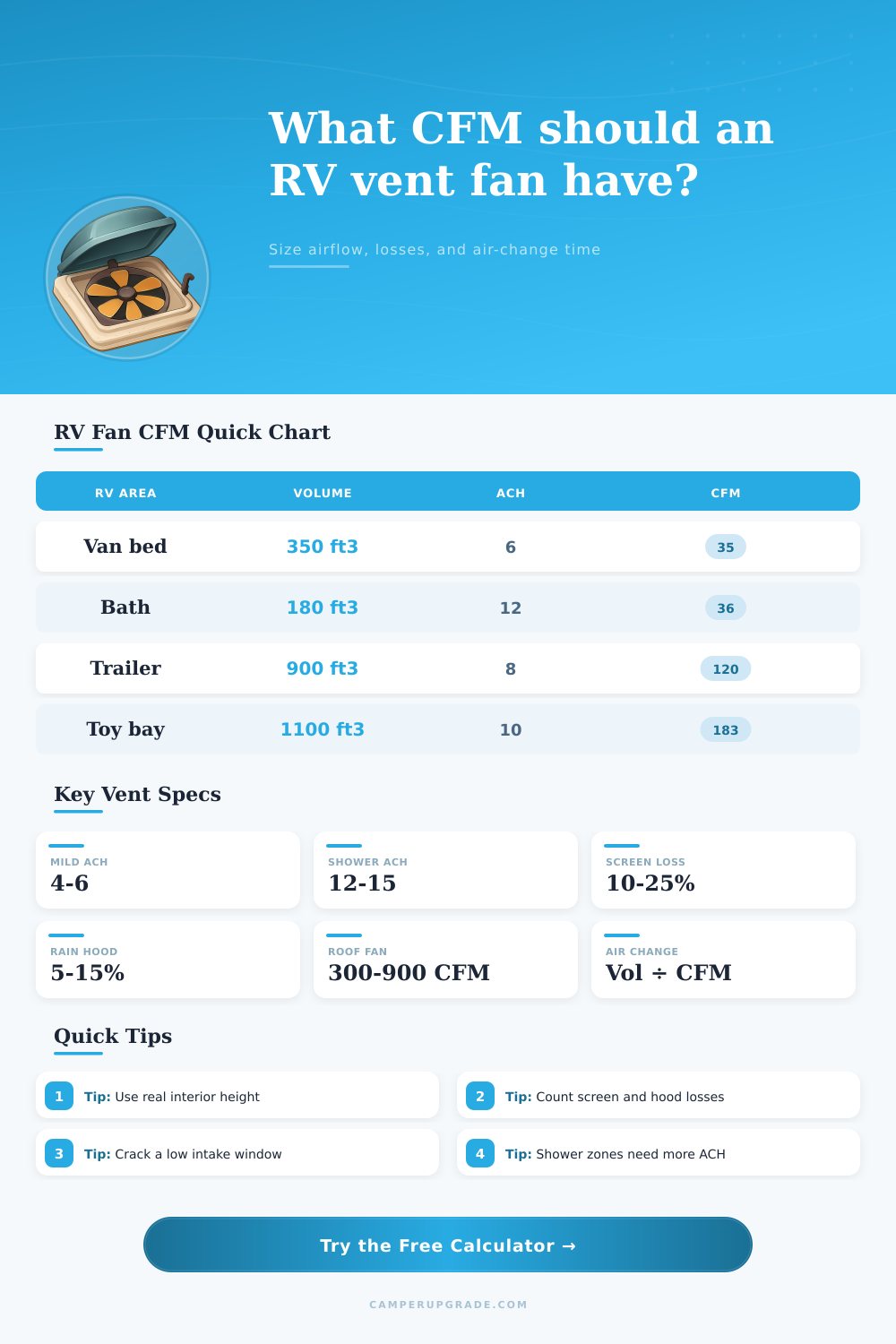
An RV vent fans is a device that moves air in an RV to remove moisture or odors from the enclosed space. Many people feel that the RV vent fan moves not enough air, which may be due to the screens that limit the amount of air that can enter the RV. An RV vent fan CFM calculator will tell you the amount of air an RV vent fan must moves to ensure that the air within an RV is always fresh.
The RV vent fan CFM calculator performs this function by considering the volume of the RV and how it will be used. The first of the concepts to understand with the RV vent fan CFM calculator is air change per hour, or ACH. Air changes per hour will tell you the number of times the air within your RV will be changed within the period of sixty minutes.
How to Use an RV Vent Fan CFM Calculator
It is important to understand that the air changes per hour will vary depending on the activity that take place within the RV. For instance, the sleeping area may require a lower air change per hour than the bathroom or kitchen area, where there is an abundance of odors and moisture. The RV vent fan CFM calculator will allow you to choose the use case for the RV area to automatically adjust the air changes per hour setting.
Setting the air changes to too low a number may make the RV vent fan not effective remove the moisture that is created in the shower area. The second concept that you must understand is the volume of the space within your RV. Using a measuring tape, you can calculate the length, the width, and the average height of the area where people will sleep and live within the RV.
You should not measure the exterior of the RV. Many RVs have ceilings of varying height that may affect the volume of the RV. Once you have entered the volume of the RV in the calculator, along with the air changes per hour setting, the calculator will provide a raw reading of the CFM that is required for that RV.
The raw CFM is not the final reading for the RV vent fan that you will purchase. RV vent fans lose some of their capacity to move air due to the screens, the hoods, and the bends in the ducts that the RVs uses to direct the air from one area of the RV to the RV vent fan. The RV vent fan CFM calculator will account for these losses.
Another factor that is introduced into the RV vent fan calculation is the effect that the temperature within the RV has on the movement of air. If the outside air is much hotter than the air within the RV, the RV vent fan will have to work harder to remove the heat from the RV. Likewise, if the air within the RV is damp or if the RV is loaded with wet gear, the RV vent fan will have to move more air to remove the moisture from the RV.
These factors will be accounted for in the RV vent fan CFM calculator. Additionally, if the RV does not have an intake for the air to enter the RV, the RV vent fan will not be able to effectively move air through the RV. The RV vent fan CFM calculator will also feature a make-up air setting to account for the number of intakes within the RV.
Not all areas within an RV have the same volume. For instance, the bath and sleeping area will take up less volume than the kitchen or full-size travel trailer. The RV vent fan CFM calculator can account for these difference in the volume within RVs.
An additional mistake that many individuals make with their RVs is to purchase only one RV vent fan to serve the entire RV. Each area within the RV should have its own RV vent fan that is calculated to provide the correct amount of CFM output for that specific area to avoid under or overbuilding the RV’s ventilation system. The type of RV vent fan that is selected for the area also has a bearing on the ventilation needs of an RV.
For instance, a small bath will only require a small bath vent to provide the correct amount of CFM output for the area. A standard four-inch RV vent fan may be used in a living area or a trailer. High-output RV vent fans will be required in large RVs with large salons for the same reason that large RVs have higher ventilation needs.
The RV vent fan CFM calculator will allow the individual to select the class of RV vent fan that will be used to provide the appropriate starting CFM reading for that RV. RV vent fans will lose some of their capacity to move air due to various factors within an RV. An insect screen will reduce the output of the RV vent fan by eight to fifteen percent of the total capacity of the RV vent fan.
Additionally, a rain hood placed onto the RV will increase the loss of the output of the RV vent fan. Fine mesh screens or road dust can reduce the output of the RV vent fan to as little as thirty percent of the total output that the RV vent fan can move when it is moving air within an RV. An RV vent fan that moves a great deal of air when it is in the showroom will move little air once it is install on an RV.
The RV vent fan CFM calculator will account for these losses to provide an individual with an accurate reading of the actual CFM output that will be provided by the RV vent fan that is purchased for that RV. The RV vent fan CFM calculator will also provide the time it will take for the RV to complete an air change within that RV. Knowing the time it will take for an air change will allow the individual to decide if the RV will be best with the RV vent fan set to high for only twenty minutes or to the low setting for a longer period of time.
Another feature of the RV vent fan CFM calculator is the margin result. The margin result will tell the individual if the RV’s current vent fan setup has enough capacity to effectively ventilate the RV or if the current RV vent fan system is failing to perform that function. If the margin result provides a negative number, the RV will have lingering smell or steam within the RV.
Lastly, the RV vent fan CFM calculator will account for the path that the air will take to the RV vent fan. If an RV owner opens a window on the opposite side of the RV from the RV vent fan, the RV vent fan will be able to move air more effectively. This feature accounts for this crossflow of air to the RV vent fan.
If the individual does not account for these intake paths for the RV, the RV vent fan CFM calculator will assume that the RV’s RV vent fan will be fighting against itself. Finally, another factor to consider with the RV vent fan is the habits of the RV owner. For instance, if the RV owner lives in the RV for long periods of time, the RV may be set to the lower setting of the RV vent fan.
If the RV owner only uses the RV for short periods of time, such as only during the hours of the shower, the RV owner may choose a different setting. An RV vent fan that is slightly too small for the RV owner’s needs for the showers may allow the RV owner to open a door to the RV to increase the amount of air that moves through the RV. However, the opposite is true for RV vent fans that are too large for the RV; they will create more noise and use more power then needed for the RV.
To determine the appropriate RV vent fan for your RV, you must measure your RV’s volume, choose the most popular use case for the RV, and account for each loss percentage for the RV.