Fifth Wheel Pin Weight Calculator
Estimate loaded pin weight, payload use, hitch reserve, and truck axle margin from trailer weight, pin percentage, cargo placement, and truck ratings.
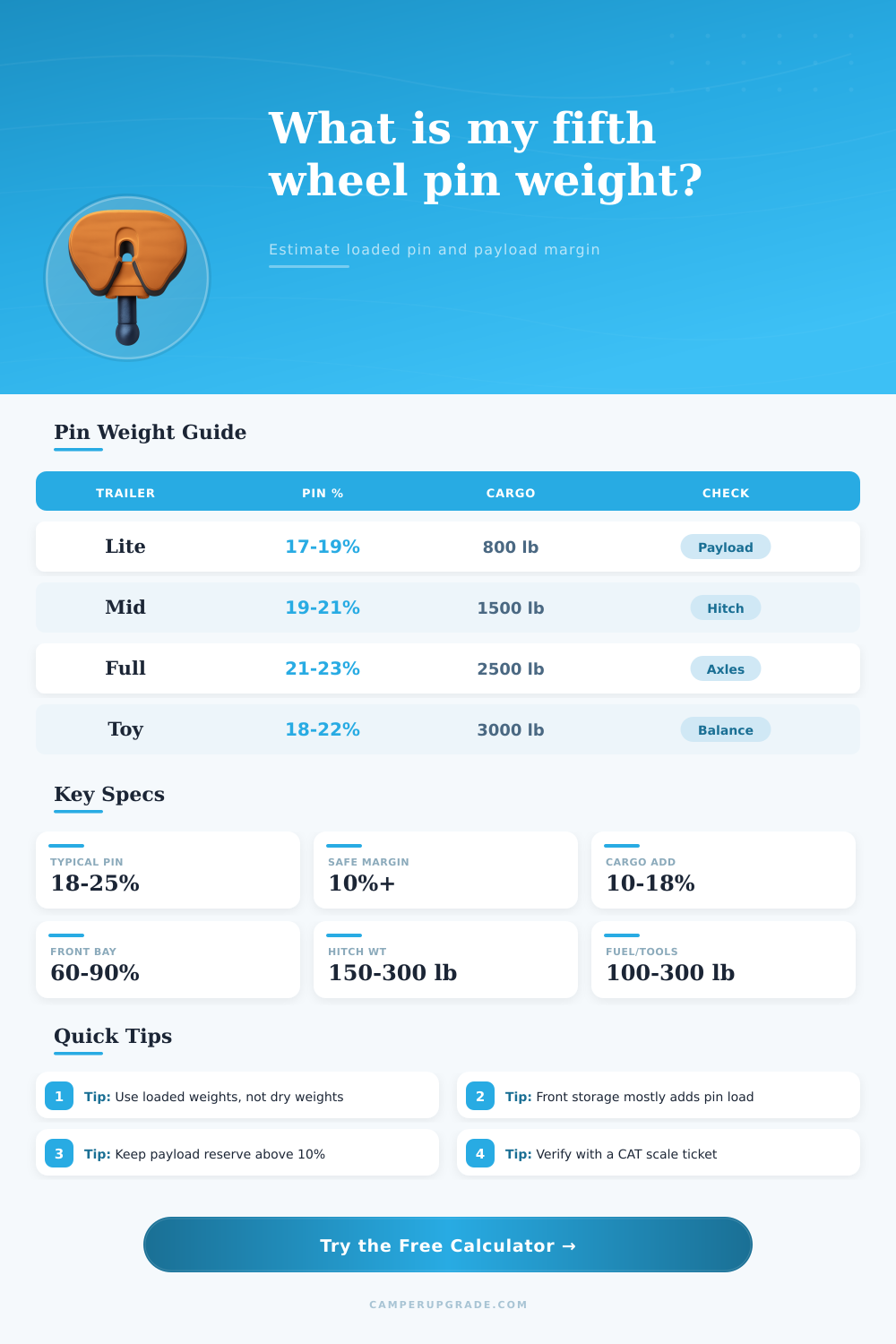
| Fifth Wheel Type | Typical Pin Range | Why It Changes | Use In Calculator |
|---|---|---|---|
| Lightweight fifth wheel | 16% to 20% | Smaller front cap and limited storage | Start at 18% |
| Mid-profile bunkhouse | 18% to 22% | Family cargo and forward compartments | Start at 20% |
| Full-profile luxury | 20% to 25% | Large front closet, washer prep, batteries | Start at 22% |
| Toy hauler with empty garage | 20% to 26% | Heavy forward section before toys load | Start at 23% |
| Toy hauler with rear toys | 16% to 22% | Rear cargo can lighten pin percentage | Start at 19% |
The table gives planning ranges only. Scale weights are the best way to confirm actual loaded pin weight.
| Cargo Location | Approx Pin Share | Example 200 lb Load | Calculator Input |
|---|---|---|---|
| Front generator bay | 80% to 95% | Adds 160 to 190 lb | Front storage load |
| Bedroom closet | 60% to 85% | Adds 120 to 170 lb | Cargo ahead of axles |
| Kitchen near axles | 30% to 55% | Adds 60 to 110 lb | Cargo ahead of axles |
| Rear living storage | 5% to 30% | Adds 10 to 60 lb | Lower forward percent |
| Toy hauler garage | -10% to 20% | May reduce pin load | Adjust pin percent |
| Truck Load Item | Common Weight | Counts Against Payload | Calculator Field |
|---|---|---|---|
| Fifth wheel hitch | 150 to 300 lb | Yes | Hitch installed in bed |
| Driver and passenger | 300 to 450 lb | Yes | Passengers and cab cargo |
| Full auxiliary fuel tank | 250 to 700 lb | Yes | Fuel, bed tools, accessories |
| Toolbox and bed gear | 100 to 350 lb | Yes | Fuel, bed tools, accessories |
| Pin weight from trailer | Trailer dependent | Yes | Calculated result |
| Remaining Payload | Result Meaning | What To Check | Next Step |
|---|---|---|---|
| 20% or more | Comfortable planning reserve | Rear axle and hitch rating | Confirm with scale |
| 10% to 20% | Usable but watch added gear | Passengers, fuel, tools | Recheck when packed |
| 0% to 10% | Tight payload match | Door sticker payload | Reduce load or upgrade truck |
| Below 0% | Over payload rating | All truck ratings | Do not tow as entered |
Pin weight refer to the amount of weight that a fifth wheel trailer contribute to the bed of the towing truck. The pin weight is determine by taking the loaded weight of the trailer and multiplying that weight by the percentage of the trailer’s total weight that is resting on the truck. The loaded weight and percentage is both variables that can be entered into the calculator provide on this website.
The calculator will determine the remaining payload capacity for that truck based on these entries. Fifth wheel trailer often have a dry weight that is published in the trailer’s brochure. However, that weight dont include the weight of water, propane, batteries, clothes, or food.
What Is Pin Weight and Why It Matters
Each of these item will contribute to the pin weight percentage of the trailer. For instance, fifth wheel trailers that has sleeping compartments that have sleeping berths may have a relatively low pin weight percentage when the trailer is empty. However, if the sleeping compartment also contain a built-in closet, the pin weight percentage of the trailer may be higher when the trailer is loaded with clothing.
Similarly, trailers that contains a sink in their sleeping compartments may have a more high pin weight percentage when they contain cleaning liquids. Thus, it is important for trailer owners to enter the correct percentage into the calculator. A two-point change in that percentage may indicate a change in the pin weight that is several hundred pound.
Cargo that is placed in portions of the trailer in front of the axle will contribute to the pin weight of the trailer. For instance, if an owner place a heavy generator in the front storage compartment of the trailer, that weight will contribute to the pin weight. Thus, an owner must enter the percentage of the total weight of that cargo that is placed onto the truck.
By contrast, if the same owner instead store that generator in the rear of the trailer, less of that weight would contribute to the trailer’s pin weight. Therefore, two trailers with the same cargo in the same amount may have different pin weight. Truck payload is the total weight that the truck’s payload rating allow for the truck to carry.
This can include the weight of the passenger, the fuel in the truck’s tank, any accessories that is attached to the truck, and the fifth wheel trailer hitch itself. The fifth wheel hitch typically weigh between 150 and 300 pound. Thus, the payload that is remaining can be calculated by subtracting both the loaded fifth wheel trailer’s pin weight and the weight of any items that are considered to be fix to the truck (such as camping tools) from the payload rating for that specific truck.
For instance, a payload rating of ten percent indicate that there is a ten percent difference between the payload that is estimated for that truck and the actual payload that the truck is to be carried. Another measurement of the weight that is to be carry by the truck is the rear axle reserve. This measurement calculates the actual weight that is to be placed onto the rear axle of the truck.
This calculation consider the weight of the portion of the fifth wheel hitch that is positioned onto the truck’s rear axle, as well as the weight of fuel and tools that is within the truck’s truck bed. The weight that is to be placed onto the truck’s axles may indicate to the trailer’s driver that the truck will feel heavy when viewed from the rear of the truck. Additionally, a heavy weight onto the rear axle can affect the way that the truck move over driveways or bumps at highway speeds.
The tables that is provided within this website can show the percentage of the fifth wheel trailer’s weight that is resting on the truck for different types of fifth wheel trailers. These tables are not rules, but they do provide context for what percentage should be entered into the calculator. For instance, a fifth wheel trailer that is use to transport toy vehicles may have a higher percentage when the trailer is empty of toy car than a trailer that is use to transport RVs.
As the toys is loaded into the trailer, the percentage of the total weight of the trailer that is resting on the truck may increase. Thus, the calculator does not make guesses as to these percentage, but the calculator does require the driver to provide the correct figure. One of the most common mistake that is made with the trailer calculation is treating the trailer as though its weight is a fixed number.
For fifth wheel trailers that has water tanks, propane tanks, and any other items that can be loaded onto the trailer, the addition of these items will increase the trailer’s pin weight by an amount that is expressed as a percentage of the total weight of the trailer. Thus, if an owner run the calculator for the trailer with empty tanks, but then calculate the same trailer when it has water and propane tanks with the same amount of water and propane in each tank, there will be a difference in the percentage of the total trailer weight that is resting on the truck. Therefore, an owner should calculate the trailer with the tanks both empty and loaded.
Another of the most common mistake is that many individual are unaware of the weight of the fifth wheel trailer hitch. That hitch must be able to support the total loaded weight of the fifth wheel trailer. Thus, if an individual place additional cargo into the front storage compartment of the trailer, the weight that is placed onto the fifth wheel trailer hitch may increase to an amount that is beyond the loading capacity of the hitch itself.
Therefore, the weight of the hitch and the payload of the fifth wheel trailer are visible to the trailer owner so that these limitation can be understood. Finally, the last way in which the weight of the fifth wheel trailer and truck can be determined is in reviewing the scale ticket from a weigh station. While the calculation of the total weight of the trailer and truck is a useful tool to determine the total weight of those two trailers before they are driven from the trailer park, those scale tickets are the most accurate method of determining the weights of those trailers.
By knowing the limit of the trailer prior to departing from the park, the trailer can be adjusted or the amount of cargo that is to be transported can be reduced. Thus, this calculator is a helpful planning tool that allow trailer owners to determine the effect that moving cargo from one portion of the trailer to another can have upon the total pin weight; the calculator can be used to determine how loading cargo into the front storage compartment may reduce the payload of the trailer.