Off-Grid RV Solar Calculator
Size RV solar panels, usable battery capacity, inverter rating, and reserve days from real off-grid loads, sun hours, battery chemistry, panel wattage, and system losses.
🚙Off-grid RV solar presets
⚡Daily load, battery, panel, sun, and inverter inputs
Solar sizing breakdown
🔋Panel and battery spec grid
📊Solar sizing reference tables
| Daily load | 3 sun h | 4.5 sun h | 6 sun h |
|---|---|---|---|
| 800 Wh | 342W | 228W | 171W |
| 1,500 Wh | 641W | 427W | 321W |
| 2,400 Wh | 1,026W | 684W | 513W |
| 3,600 Wh | 1,538W | 1,026W | 769W |
| Bank | 12V Wh | Lead usable | LiFePO4 usable |
|---|---|---|---|
| 100Ah | 1,280 | 640 Wh | 1,024 Wh |
| 200Ah | 2,560 | 1,280 Wh | 2,048 Wh |
| 300Ah | 3,840 | 1,920 Wh | 3,072 Wh |
| 500Ah | 6,400 | 3,200 Wh | 5,120 Wh |
| Panel | 3 sun h | 4.5 sun h | 6 sun h |
|---|---|---|---|
| 200W | 468 Wh | 702 Wh | 936 Wh |
| 400W | 936 Wh | 1,404 Wh | 1,872 Wh |
| 800W | 1,872 Wh | 2,808 Wh | 3,744 Wh |
| 1,200W | 2,808 Wh | 4,212 Wh | 5,616 Wh |
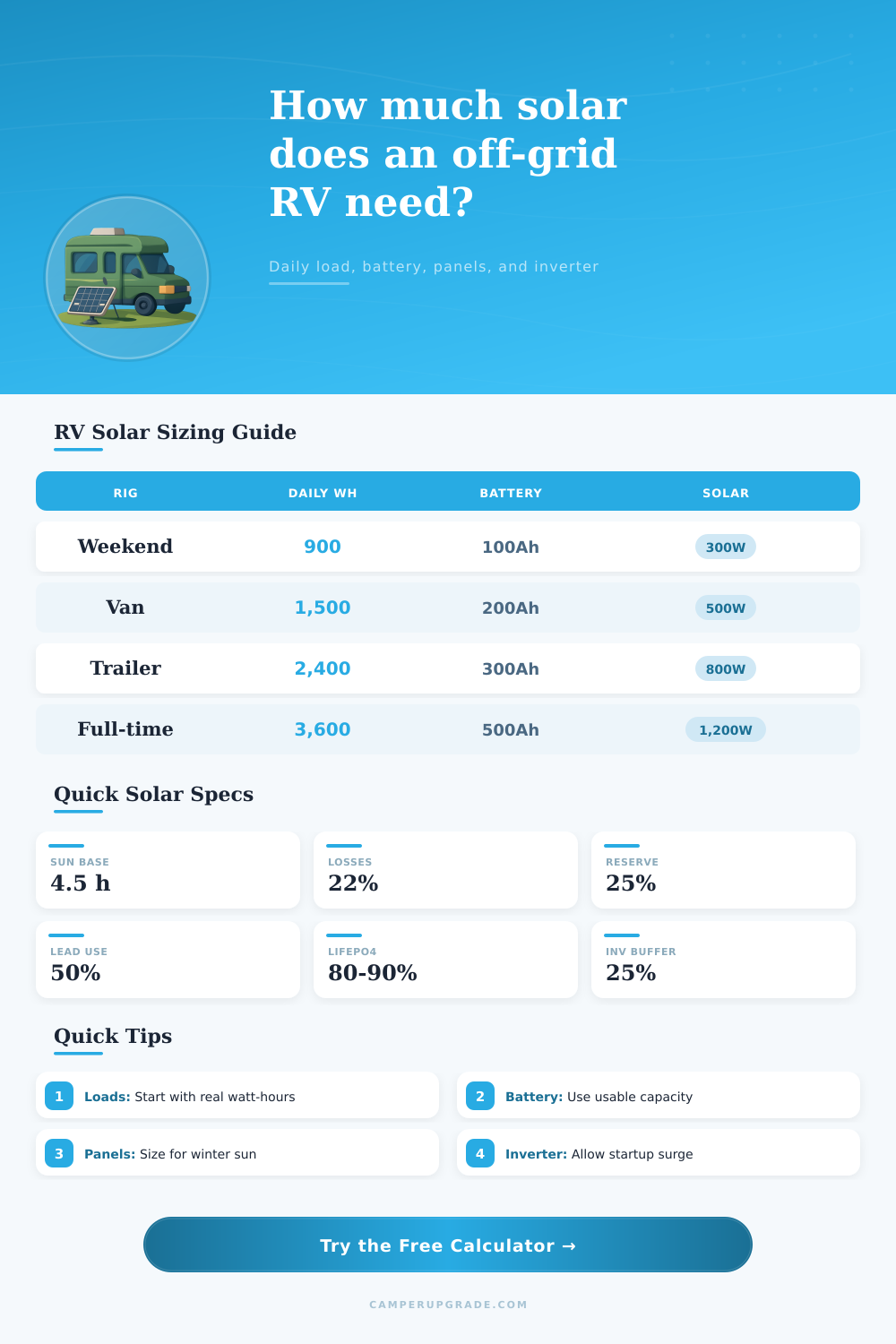
| RV scenario | Daily Wh | Battery | Solar |
|---|---|---|---|
| Lights and phones | 500-900 | 100Ah | 200-300W |
| Fridge weekend | 1,200-1,800 | 200Ah | 400-600W |
| Remote work | 2,000-2,800 | 300Ah | 700-1,000W |
| Full-time rig | 3,200-5,000 | 500Ah+ | 1,000W+ |
💡RV solar sizing tips
Planning an off-grid RV power system requires that you understand the amount of electricity that your RV will use. Many off-grid RV travelers do not understand how much electricity their RV will use while the engine is off and while they are not connected to the power hookups at there camping location. Their RV will use electricity to power the fridge, fans, and any number of charging cables for there electronic devices.
The amount of electricity that their RV uses will be affected by the amount of cloudy weather that their RV experiences while on the road. To determine the size of the battery and the solar array that your RV will need, it is important for you to understand the amount of electricity that the RV will use while off-grid. The calculator requires that you provide specific inputs to calculate the size of each component of the RV power system.
How to Plan Solar Panels and Batteries for Your RV
For instance, you will need to provide an estimate of the daily watt-hour number that the fridge, the fans, the devices that will be charged while off-grid, and any inverter loads will use. Additionally, you will need to adjust the total watt-hour number for the losses that occurs with inverter conversions. Finally, you can also adjust the number of days of battery chemistry, the number of sun hours that the RV will experience each day, and the type of batteries that will be used in the RV power system.
Each of these adjustments will impact the other components of the RV power system, which is why you need to provide each of these settings. The number of sun hours that the RV will experience each day is a critical factor in the sizing of the solar array that will be installed on the RV. The number of sun hours that the RV will receive will vary with the time of year that the RV is on the road, and where the RV is on the road.
While the RV may experience abundant sunlight and solar panel production during July, the same solar panel may produce less energy during the shoulder seasons of spring or autumn, especially if the RV travels to regions where trees or mountains may block some of the sunlight that reaches the RV. By adjusting the number of sun hours that is entered into the calculator, the RV owner can determine how many watts of solar production will be required to provide power to the RV for each different scenario. Additionally, by increasing the wattage of the solar panel that is installed on the RV, the number of solar panels that you will need to be purchase can also be reduced.
In addition to the number of sun hours that the RV will experience each day, the number of reserve day that the battery bank will have is also a critical factor in the power system. For instance, adding an extra half day of battery capacity to an RV battery bank will not necessarily double the number of days that the battery bank will be able to provide power to the RV. However, adding an extra half day of battery bank capacity will change the way the RV battery bank functions during periods of changing weather conditions.
By adjusting the number of days of battery bank reserve that is provided to the RV, the traveler can determine if the additional weight of the batteries is worth the cost of the additional days of power that they will receive when the RV is off-grid. Similar to the sizing of the battery bank, the inverter that will be used in the RV power system must also be sized appropriately. The inverter will have to provide enough continuous wattage for the largest load that is used on the RV while it is off-grid, as well as include additional surge wattage that is required to provide power to devices that contain motor or compressors.
The calculator will adjust for the type of load that will be used, to ensure that the inverter that is purchased will not be too small for the load that will be placed upon it. For instance, if the inverter is too small for the RV, the inverter may continuously trip when devices such as microwaves or air conditioners are turned on. The output of the solar panels will be less than the theoretical maximum output for the amount of area of the solar panel.
The orientation of the solar panel may not allow for it to capture all of the sunlight that falls upon the RV while on the road. The solar panel may overheat, reducing the amount of electricity that it can produce. Additionally, solar panels can lose some of their production if they are shaded by any object on the RV, such as vents or the satellite dish.
Additionally, solar panels lose some of their production if they are covered in dirt, pollen, or any other form of grime. Travelers who have experience with off-grid RV power systems often provide an additional 10 to 15 percent to the theoretical maximum production of the solar panel to account for these potential issues. This additional 10 to 15 percent provides the RV power system with some extra leeway to provide power to the RV if the solar panels are not under ideal conditions.
Some of the most common mistakes in RV power system planning occur in two specific areas. One of the most common mistakes is to size the RV power system according to the best-case scenario in which the RV will receive the maximum amount of sunlight each day, and in which all of the electronics will be used at the same time. Such a sizing will result in an off-grid power system that is inadequate to provide power to the RV the majority of the time.
The other of the two most common mistakes is to provide too much power to the RV. If the size of the solar panel system or the battery bank is too large relative to the needs of the RV, this will result in unnecessary additional weight and cost to the RV owner. Both of these errors can be avoided by using the RV power system calculator to test each scenario.
Another of the most common mistakes is treating the battery bank as if it has a fixed number of amp-hours, when, in reality, that capacity is a usable number. Lead acid batteries, for instance, lose 50 percent of their amp-hour capacity if they are only used 50 percent of the time (as recommended to extend their life). While lithium batteries will provide closer to 100 percent of their nameplate capacity, they also benefit from not using the batteries at the limit of their capacity.
The calculator will automatically adjust for the depth-of-discharge rate of the batteries when they are selected, so that no error are made with the math for determining the amp-hour capacity of the battery bank. The two reference tables located on the calculator can be used to quickly review the calculations that were made for the RV power system. These reference tables will show the number of watts of solar panel production that will be required for each number of watt-hours that the RV will use each day.
Additionally, the reference tables will show the number of watt-hours of capacity that each size of battery bank will provide to the RV. These reference tables are not to be used as a replacement for the calculation that was made, but they can be used to review whether the power system that is created is within the same range as other RVs and power systems that may be well-known to the RV owner. Overall, the intention for using such a calculator is to create an RV power system that is appropriate for the way in which the owner plans to travel with their RV.
For example, some RV owners will travel to areas of the country that receive a great deal of sunlight with a southern exposure from the RV. Other off-grid RV travelers, however, may travel to wooded areas that do not receive the same amount of sunlight each day. These scenarios can be tested with the calculator to ensure that the RV owner does not have to guess at the various factors for power system sizing and setup.
Once each of the factors are determined for the specific RV, the RV owner can begin to make decisions regarding the hardware that will be used to mount the batteries and solar panel to the RV.