Camping Tent Weight Calculator
Estimate tent body, rainfly, poles, stakes, footprint, guylines, stuff sacks, and trail weight per camper for backpacking, family camping, and four-season shelters.
⛺Tent Weight Presets
⚙Capacity, Fabric, Poles, Season, and Footprint Inputs
Tent Weight Results
🧵Fabric and Pole Spec Grid
📊Tent Weight Reference Tables
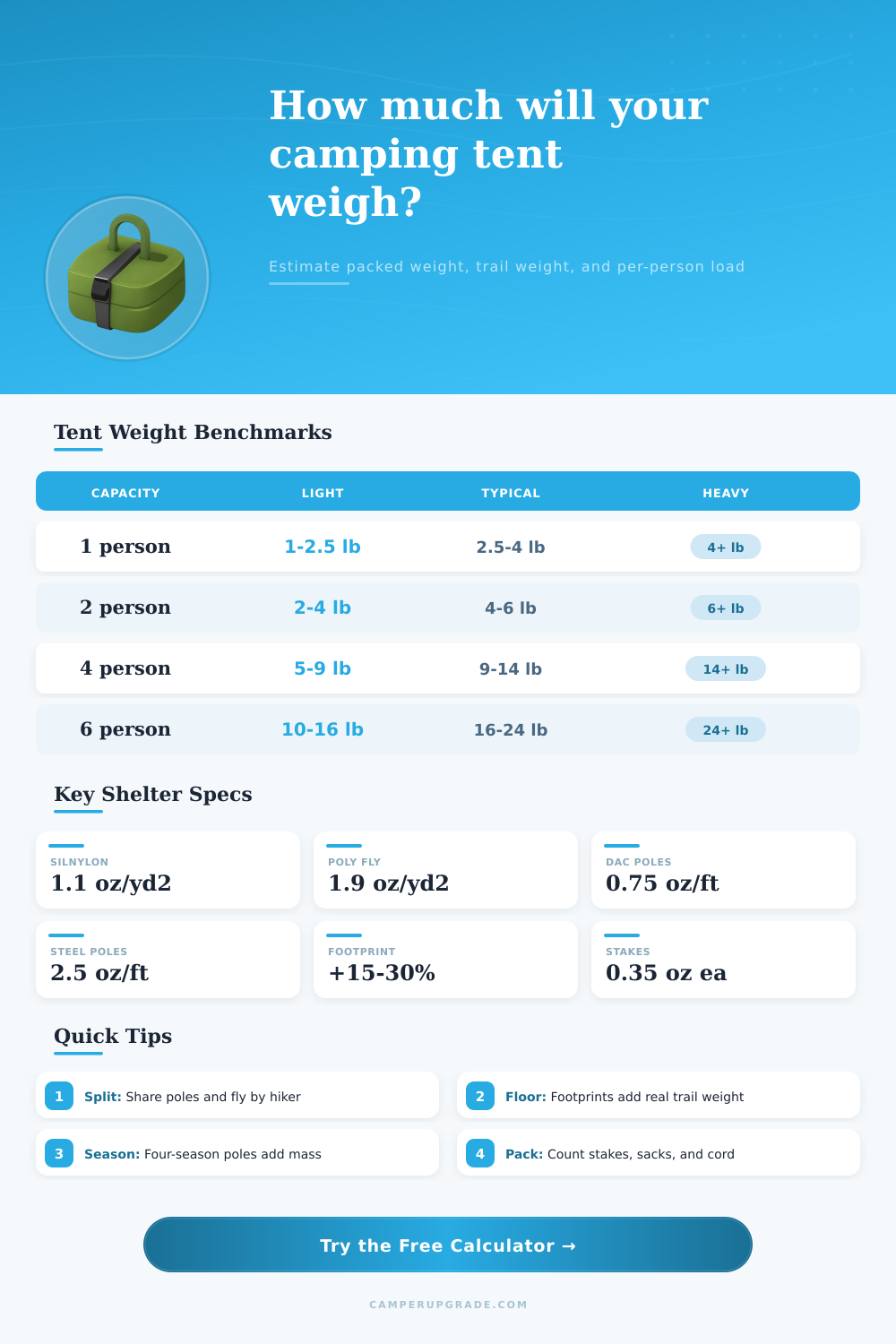
| Capacity | Ultralight target | Typical backpacking | Campground range |
|---|---|---|---|
| 1 person | 1 to 2.5 lb / 0.45 to 1.13 kg | 2.5 to 4 lb / 1.13 to 1.81 kg | 4 to 7 lb / 1.81 to 3.18 kg |
| 2 person | 2 to 4 lb / 0.91 to 1.81 kg | 4 to 6 lb / 1.81 to 2.72 kg | 6 to 12 lb / 2.72 to 5.44 kg |
| 3 person | 3.5 to 6 lb / 1.59 to 2.72 kg | 6 to 9 lb / 2.72 to 4.08 kg | 9 to 16 lb / 4.08 to 7.26 kg |
| 4 person | 5 to 9 lb / 2.27 to 4.08 kg | 9 to 14 lb / 4.08 to 6.35 kg | 14 to 22 lb / 6.35 to 9.98 kg |
| 6 person | 10 to 16 lb / 4.54 to 7.26 kg | 16 to 24 lb / 7.26 to 10.89 kg | 24 to 42 lb / 10.89 to 19.05 kg |
| 8 person | 14 to 24 lb / 6.35 to 10.89 kg | 24 to 36 lb / 10.89 to 16.33 kg | 36 to 70 lb / 16.33 to 31.75 kg |
| Fabric or component | Typical spec | Weight behavior | Best fit |
|---|---|---|---|
| Dyneema composite | 0.51 to 0.8 oz/yd² | very light, low stretch, bulky pack | solo and two-person ultralight shelters |
| 10D-20D silnylon or silpoly | 0.9 to 1.3 oz/yd² | light fly weight with careful handling | backpacking tents and tarptents |
| 30D ripstop nylon | 1.3 to 1.6 oz/yd² | balanced weight and durability | mainstream double-wall backpacking tents |
| 68D polyester | 1.9 to 2.4 oz/yd² | stable wet pitch but heavier fabric | car camping domes and family tents |
| 150D polyester | 4 to 5.5 oz/yd² | rugged floor and cabin panels | campground tents with higher abrasion |
| Cotton canvas | 7 to 10 oz/yd² | comfortable and durable but very heavy | base camp, bell tents, and long stays |
| Pole material | Estimated oz per ft | Weight notes | Common shelter type |
|---|---|---|---|
| No dedicated poles | 0 oz/ft counted | trekking poles already in carried kit | pyramid, tarp, trekking-pole tent |
| Carbon fiber | 0.45 to 0.65 oz/ft | very light but cost and crush sensitivity vary | ultralight tarps and premium shelters |
| Premium aluminum | 0.65 to 0.9 oz/ft | strong balance of weight and durability | backpacking domes and tunnel tents |
| Standard aluminum | 0.9 to 1.25 oz/ft | durable at a moderate weight penalty | camping domes and larger backpacking tents |
| Fiberglass | 1.35 to 1.9 oz/ft | budget-friendly, heavier, bulkier sections | campground tents and screen shelters |
| Steel | 2.1 to 3.2 oz/ft | strong for tall walls, heavy in transport | cabin tents, canvas tents, shelters |
| Accessory | Light estimate | Typical estimate | Heavy estimate |
|---|---|---|---|
| Footprint or ground sheet | 0.4 to 1 lb / 0.18 to 0.45 kg | 1 to 2.5 lb / 0.45 to 1.13 kg | 2.5 to 8 lb / 1.13 to 3.63 kg |
| 8 stakes and guylines | 2.5 to 4 oz / 71 to 113 g | 4 to 8 oz / 113 to 227 g | 8 to 24 oz / 227 to 680 g |
| Stuff sacks and pole bags | 1 to 3 oz / 28 to 85 g | 3 to 8 oz / 85 to 227 g | 8 to 24 oz / 227 to 680 g |
| Repair sleeve and patches | 0.5 to 1 oz / 14 to 28 g | 1 to 3 oz / 28 to 85 g | 3 to 8 oz / 85 to 227 g |
| Snow or sand anchors | 6 to 12 oz / 170 to 340 g | 12 to 28 oz / 340 to 794 g | 28 oz+ / 794 g+ |
| Porch awning poles | 8 to 16 oz / 227 to 454 g | 1 to 3 lb / 0.45 to 1.36 kg | 3 lb+ / 1.36 kg+ |
💡Tent Weight Tips
🧮Calculator Weight Method
Choosing a tent requires you to consider the total amount of weight that you are willing to carry. The weight that you are required to carry into the wilderness is dependent upon whether you are undertaking a weekend camping trip or a camping trip that will last for several weeks. While a tent that is heavy when packed may be the most comfortable tent while camping at a car campground, that same tent may be a problem for those who must carry that tent up a mountain pass, or who must fit the tent onto a bicycle rack.
Overall, then, the weight of the tent is a significant factor to consider when choosing which tent to use for camping trips. A calculator is available on this page that will allow you to calculate the total weight of a tent that you are considering, as well as the amount of weight that each of the individuals that will be camping will share. Each of these values is an important one; the total weight of the tent is important in determining the overall load that each camper must carry on a trip, but the per-person share of the tent weight is the value that will change how each person feels about how heavy of a tent they will have to carry.
Choose a Tent by Weight
One of the primary factors in the total weight of the tent is the choice of fabric for the tent. Ultralight materials will reduce the total weight of the tent, but may be fragile when camping on rocky terrain or when encountering strong winds. Conversely, fabrics that are heavy will increase the total weight of the tent, but may provide more durability to the tent and less noise within the sleeping tent.
The calculator accounts for the weight of the tent fabric based off the size of the tent and the type of fabric that you are to utilize for the tent. The type of material that is used for the tent poles also introduces a tradeoff into the total weight of the tent. Materials like carbon fiber or aluminum will be among the lightest available options for tent poles.
However, materials like fiberglass or steel will be heavier than aluminum poles. Additionally, many tent designs avoid using tent poles altogether; instead, users use trekking poles. However, this option is only available to users that already intend to carry trekking poles while on there camping trip.
The season for which you are to use the tent will impact the number of mesh panels that are included on the tent, which can impact the total weight of that tent. A tent that is to be used during four seasons will have additional features than a tent that is only to be used during the summer months. These additional features will impact the total weight of the tent.
This factor is considered within the tent weight calculator. Finally, various accessories for the tent can add to the total weight of the tent. Accessories like footprints, stakes, guylines, and stuff sacks will add to the total weight of the tent.
The tent weight calculator considers each of these items. The conditions of the trips that are to be taken may not be the same as those described on the tents product pages. Furthermore, an actual camping trip may require the addition of accessories to the tent.
These factors is considered within the calculator. Many individuals who search for tents dont consider the weight of all of the components of the tent. However, the calculator for tent weights does consider all factors relating to the tents total weight.
Some tent configurations may be used for camping trips with entire families. A tent that sleeps six individuals may offer more sleeping space than a tent with fewer sleeping spaces. However, the tent may be very heavy with such a high packed weight.
A calculator can help to determine if the tent can be split between three or four individual. Reference tables are included on this page that help to illustrate the weight of different camping tents in relation to other tents in the market. This information dont have to be memorized to understand the weight of the tent that you are considering.
Factors like weather and terrain will impact the type of tent that you select for camping trips. For instance, a tent made of lightweight silnylon will handle rain well, but may require those seams on the tent to be sealed after each use. A tent that is made of heavy canvas will be more durable during camping trips with wet or snowy terrain, but may pose problems when camping in areas with strong winds.
These factors are outside the scope of the calculator, but can be applied to the results of the calculator. While a lightweight tent is always an advantage for camping trips, a balance between the weight of the tent and the features of the tent are the most important factors for selecting camping gear. For camping trips that require a great deal of mobility, the weight of the tent is the more important factor.
For camping trips in which mobility is not an issue, features like durability and sleeping space are the more important factors. Thus, the calculator that is available on this page allows each person to enter their specific information about their camping trips. From this starting point, each individual can determine the tradeoffs between the features and the weight of the tent that they feel are the most important to them.