Camping Knife Weight Calculator
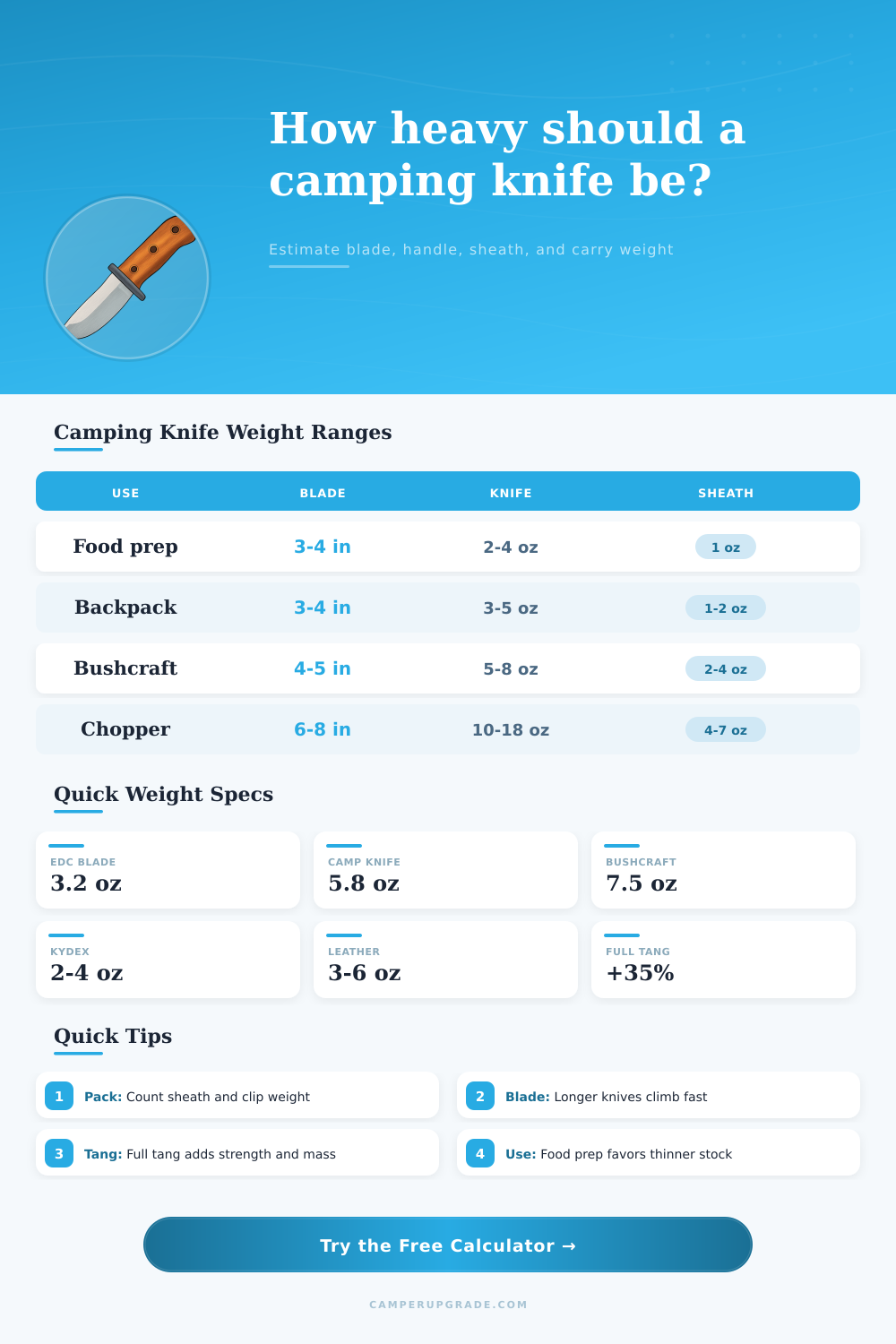
Estimate total carry weight from blade length, steel density, stock thickness, handle material, tang style, sheath choice, clip hardware, and camping use.
🏕Camping Knife Presets
⚙Blade, Handle, Sheath, and Use Inputs
Knife Weight Results
🔪Blade and Material Spec Grid
📊Camping Knife Weight Reference Tables
| Camping knife type | Typical blade length | Knife-only weight | Best weight use |
|---|---|---|---|
| Neck knife or emergency blade | 1.8 to 2.8 in / 4.6 to 7.1 cm | 1.2 to 3 oz / 34 to 85 g | Fire kit, cordage, backup cutting |
| Folding camp pocket knife | 2.8 to 3.5 in / 7.1 to 8.9 cm | 2.5 to 5 oz / 71 to 142 g | Light camp chores and pocket carry |
| Backpacking fixed blade | 3.2 to 4.2 in / 8.1 to 10.7 cm | 3.2 to 5.8 oz / 91 to 164 g | Food prep, tent stakes, small tasks |
| General camp belt knife | 4.0 to 5.0 in / 10.2 to 12.7 cm | 5 to 8 oz / 142 to 227 g | All-around campsite work |
| Bushcraft full tang knife | 4.0 to 5.5 in / 10.2 to 14.0 cm | 6 to 10 oz / 170 to 283 g | Carving, feather sticks, batoning small wood |
| Large camp chopper | 6.5 to 10 in / 16.5 to 25.4 cm | 11 to 24 oz / 312 to 680 g | Limbing, chopping, splitting kindling |
| Blade material | Density used | Weight note | Common camp reason |
|---|---|---|---|
| 420HC stainless steel | 7.74 g/cc | near standard steel weight | easy sharpening and corrosion resistance |
| 14C28N stainless steel | 7.70 g/cc | slightly lighter than 1095 | balanced edge, toughness, stainless care |
| 1095 carbon steel | 7.85 g/cc | standard outdoor carbon steel mass | tough fixed blades and field sharpening |
| CPM 3V tool steel | 7.82 g/cc | similar weight to carbon steel | high toughness for hard camp use |
| AEB-L stainless steel | 7.65 g/cc | small weight difference | thin slicing knives and wet camps |
| Titanium utility blade | 4.51 g/cc | about 42% lighter than steel | corrosion-proof emergency or dive-style use |
| Sheath or carry method | Typical weight | Weight driver | Camping fit |
|---|---|---|---|
| No sheath counted | 0 oz / 0 g | knife stored elsewhere | kitchen roll or pocket folder only |
| Nylon sleeve sheath | 0.8 to 2 oz / 23 to 57 g | fabric, snap, liner | light belt or pack pocket carry |
| Kydex sheath with eyelets | 1.8 to 4 oz / 51 to 113 g | plastic thickness and eyelets | secure wet-weather fixed blade carry |
| Leather belt sheath | 3 to 6 oz / 85 to 170 g | thick leather and stitching | traditional belt knife or bushcraft kit |
| Hybrid sheath | 3.5 to 7 oz / 99 to 198 g | plastic insert plus leather body | stiff retention with quieter carry |
| Neck sheath and cord | 0.7 to 1.8 oz / 20 to 51 g | small molded sheath and cord | small fire kit or backup blade |
| Use target | Carry weight target | Blade traits | When it gets heavy |
|---|---|---|---|
| Food prep and light camp tasks | 2 to 4.5 oz / 57 to 128 g | thin stock, tall enough to slice | thick handle scales |
| Backpacking general camp use | 3 to 6.5 oz / 85 to 184 g | 3 to 4 inch stainless or carbon blade | full leather sheath |
| Wet canoe or fishing camp | 4 to 8 oz / 113 to 227 g | stainless steel, secure sheath | oversized kydex mounts |
| Bushcraft carving and wood processing | 6 to 11 oz / 170 to 312 g | full tang, thicker spine, strong tip | survival pouch extras |
| Survival kit or emergency blade | 5 to 12 oz / 142 to 340 g | stout blade and reliable sheath | ferro rod, sharpener, pocket |
| Limb trimming and chopping | 14 to 30 oz / 397 to 850 g | long blade, forward weight | quarter-inch stock and leather |
💡Knife Weight Tips
🧮Calculator Weight Method
When you are planning to carrying a knife on a trail, you must consider the total weight of the knife system. Many peoples will choose a knife based off its appearance and brand reputations. However, many people will fail to account for the weight of the knife system’s sheath and any hardware that may be attached to the knife.
The weight of the sheath and hardware will add to the total weight of the knife system beyond the weight of the knifes blade. The calculator can help you to calculate the total weight of the knife system. The calculator will show you the total weight of the knife system before you purchase the knife system.
How to Find the Total Weight of Your Knife, Sheath, and Hardware
The weight of the knife system will start with the weight of the knifes blade. The weight of the blade will depend upon the length of the blade, the thickness of the blade, the height of the blade at the heel, and the grind of the knife blade. A thin blade will usually weigh more less than a thick blade with a heavy grind.
The calculator will use a grind factor to take into account the differences of the blade grind that you select. The weight of the handle will be the next part of the knife system to consider. A knife with a skeletonized tang will be lighter than a knife with a full tang handle.
A full tang requires the use of more steel to create the handle of the knife, increasing the weight of the knife. The construction of the handle will impact the weight of the knife system, though it will primarily impact the total weight of the knife system. The tang input on the calculator will allow you to calculate and add the weight of the steel within the handle.
The weight of the sheath and any hardware to the knife will increase the weight of the knife system. A Kydex sheath is light in weight, while a leather sheath will be heavier. If you add a lanyard or ferro loop to the knife sheath, the weight of the sheath will increase.
The dropdown menu for the hardware will allow you to add the weight of the sheath and hardware for you’re knife system. The use that you will make for your knife will determine the weight of the knife system. If you will only use the knife for food preparation, a knife that is thin and light in weight will be a good choice.
However, if you use the knife for bushcrafting tasks, the knife will need to have a thicker spine and tang to allow for improved performance with such tasks. Consequently, the increased thickness will add to the weight of the knife system. The use selector will allow you to compare the total weight of your knife system against a target weight for the knife that is to be used for a specific use.
The knife system calculator is a planning tool for knife systems. While the calculator may account for the total weight of the knife system, the weight of the knife may change with small details of the knife. For this reason, it is recommended that you weigh the knife and sheath on a kitchen scale prior to your trip.
Weighing the knife system on a scale will ensure that you know the exact weight of the system that you will carry on your trip. The knife system calculator can be used to compare different knife systems to determine the best knife for the type of trip that you will take. Folding knives tend to be light and are often a good choice for those who plan on going on short trips.
Fixed blade knives, however, may be a better choice for those who plan on preparing meals on the trip. Using the calculator will allow you to compare scenarios for your trip. By finding the knife system that falls within an acceptable weight range, you will avoid carrying too much weight on your trail.